
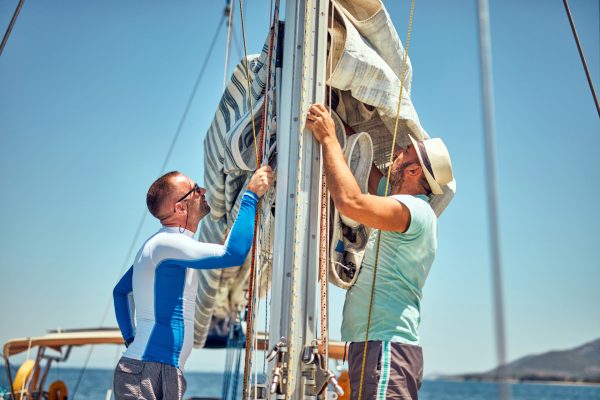
Buying a second-hand sailing yacht is always a significant investment. Going without a survey means taking the risk of discovering hidden defects, construction flaws or traces of past damage too late. Yet many boaters, pressed by the desire to set sail, keen to save a few hundred euros or won over by a reassuring listing, neglect this survey of their future boat. In reality, a pleasure boat survey is far more than a simple technical inspection: it is a guarantee of transparency, safety and fair value.
Whether you are a long-time sailor or a new enthusiast looking for your first boat, commissioning an independent marine surveyor is the best way to secure your purchase. But what exactly does this survey involve? Why is it essential? And how can it save you thousands of euros?
Key points: the 4 pillars of a sailing yacht survey
A sailing yacht survey is a complete and impartial assessment, carried out by a certified professional. Here is what it systematically covers:
- The condition of the hull: checking for cracks, osmosis, poorly executed repairs or traces of impact.
- The rigging: inspection of the masts, shrouds, sails, winches and all running rigging components.
- The engine and propulsion: checking operation, wear, potential leaks and maintenance.
- Safety and navigation equipment: testing electronic instruments, bilge pumps, fire extinguishers, etc.
The surveyor does not merely list the visible defects. Thanks to their experience and specific tools (moisture meter, borescope camera, etc.), they detect problems invisible to the naked eye: internal corrosion, material fatigue, or concealed repairs.
Why, in our view, is a survey essential?
1. An impartial and professional assessment
Unlike the seller, who has an obvious interest in playing down their boat’s defects, the surveyor is an independent third party. Their role? To provide you with an objective opinion on the actual condition of the sailing yacht. Without this survey, you risk relying on biased, or even false, statements. But above all, you risk being carried away by love at first sight and letting passion get the better of reason.
Concrete example: A sailing yacht may appear in perfect condition during a viewing, yet hide advanced osmosis (a polyester hull disease) or an engine at the end of its life. Without a survey, these problems can be costly to repair, or even render the boat unusable.
2. An accurate financial valuation
The marine surveyor does not merely point out defects: they also estimate the boat’s actual market value. This valuation is crucial in order to:
- Check that the asking price is consistent with the condition of the sailing yacht.
- Avoid overpaying for a boat whose value has been inflated by the seller.
- Identify undervalued models, if you are looking for a good deal.
Good to know: Some sailing yachts, even older ones, can be worth more than their initial purchase price if they have been well maintained. Conversely, a mistreated boat can lose up to 50% of its value within a few years.
3. Invaluable help with negotiation
The survey report is a weighty argument when negotiating the price. Indeed, it:
- Lists the work to be expected (hull, engine, rigging, etc.).
- Estimates the cost of these repairs.
- Enables you to justify a price reduction to the seller.
Practical case: If the survey reveals that €10,000 of work must be budgeted for (antifouling paint, replacement of the shrouds, engine overhaul), you can negotiate an equivalent reduction on the sale price. Without this report, the seller could refuse any discussion.
4. A requirement for certain insurance companies
Insurance companies are becoming increasingly demanding. For older sailing yachts (over 10 years) or high-value ones (over €50,000), many require a recent survey report before issuing an insurance policy. Without this document, you risk:
- Not being covered in the event of a claim.
- Paying higher premiums, as the insurer will regard the boat as a risk.
- Having your application refused outright.
How does a marine survey proceed?
A sailing yacht survey follows a rigorous process, generally in several stages:
- Making an appointment: the surveyor travels to the place where the boat is located (marina, shipyard, etc.).
- Full inspection: they examine the hull (above and below the waterline if possible), the deck, the rigging, the engine, the equipment and the interior.
- Specific tests: use of tools such as the moisture meter to detect moisture in the hull, or the borescope camera to inspect hard-to-reach areas.
- Sea trial (if possible): to check the boat’s behaviour under sail and under engine.
- Writing the report: a detailed, photo-illustrated document that records the defects, their severity, and the estimated repair costs.
Duration: expect 2 to 4 hours for a complete survey, depending on the size and condition of the sailing yacht.
Cost: between €300 and €800 depending on the size of the boat and the complexity of the survey. A minimal investment compared with the potential savings!
Who can carry out a marine survey?
Not all surveyors are equal. To be sure of the quality of the assessment, favour:
- A certified surveyor recognised by professional bodies (such as the Fédération Française des Experts Maritimes et Fluviaux – FFEMF).
- An independent professional, who has no connection with the seller or the shipyard.
- A specialist in the type of boat you wish to buy (sailing yacht, catamaran, motorboat, etc.).
Where to find them?
- In professional directories (FFEMF, Union des Experts Maritimes, etc.).
- Through sailing federations or boating clubs.
- By asking your insurer or a marine broker for advice.
How much does a marine survey cost? And how much can it save you?
| Type of boat | Average survey cost | Potential savings |
|---|---|---|
| Sailing yacht from 6 to 10 m | €300 – €500 | €2,000 – €10,000 |
| Sailing yacht from 10 to 15 m | €500 – €800 | €5,000 – €20,000 |
| Sailing yacht over 15 m | €800 – €1,500 | €10,000 – €50,000 |
Example: For a 12 m sailing yacht bought for €50,000, a survey costing €600 may reveal €15,000 of work. You can then negotiate a price reduction of €10,000 to €15,000 – a return on investment 20 times greater than the cost of the survey!