
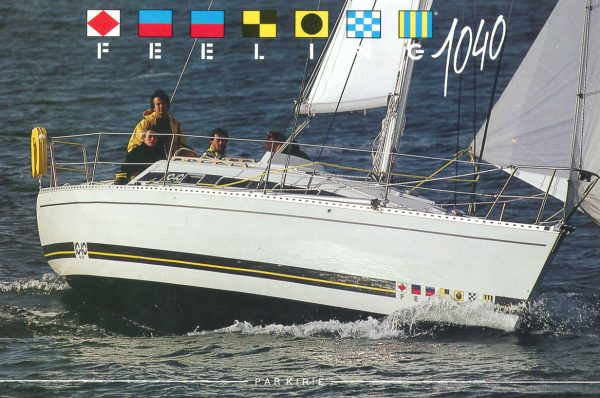
The Feeling 1040 is a racer-cruiser monohull built by the Vendée-based Kirié shipyard from 1985 to 1987, to designs by naval architect Philippe Harlé, with interior styling by Michel Mortain. Measuring 10.40 metres in length with a displacement of approximately five tonnes, she is a masthead sloop with a fixed keel (or a reduced-draft version, depending on the model), certified in navigation category 1 and therefore suitable for offshore sailing. Produced in only about one hundred units, she remains a sought-after yacht on the second-hand market, renowned for the balance between performance and living comfort that characterised the Feeling range of that era.
Key Points
The Feeling 1040 features generous sail area relative to her weight (a sail area/displacement ratio of 13) and ballast accounting for 43 per cent of displacement, a high figure that guarantees commendable stiffness under sail. Her polyester construction is renowned for being sound and durable, as numerous owners attest. The points of vigilance for a boat of this generation concern the age of the rigging, the condition of the original engine (Volvo 18 or 28 horsepower depending on the version) and the classic water ingress around the chainplates and the mast step. The value for money on the second-hand market, generally ranging between 30,000 and 45,000 euros depending on equipment and maintenance, remains one of her main assets.
History of the Feeling 1040
The history of the Feeling 1040 is inseparable from that of the Kirié shipyard, one of the oldest French pleasure-boat builders. Founded in 1912 by the Kirié family in a garage in the rue de la Forêt in Les Sables-d’Olonne, the company moved to Le Château-d’Olonne in the early 1970s and made its name with its sailing fishing-cruisers, the famous “Fifty” series, and their motorised counterparts, the “Anges de mer”. At the beginning of the 1980s, the shipyard took a decisive step by launching a range of fast cruising sailboats named Feeling, which quickly became its showcase.
It is in this context that the Feeling 1040 was born in 1985, to designs by Philippe Harlé, one of the most prolific French architects of his generation, with Mortain responsible for the interior layouts. Construction uses laminated polyester, with solid and seaworthy hulls that explain the remarkable longevity of the fleet. Approximately 100 units left the workshops between 1985 and 1987, a modest figure explained by the boat’s semi-premium market positioning.
A common misconception must be corrected here: the 1040 is not exactly the younger sibling of the Feeling 1090, but rather its direct predecessor. The Feeling 1090, launched in 1986 and produced until 1995, shares the same architecture, the same beam and the same displacement as the 1040, with an additional 40 centimetres of hull and a slightly larger sail area (71 m² versus 67 m²). The 1090 was moreover voted “Boat of the Year 1987”, an accolade that retroactively benefited the 1040’s reputation. In reality, the two yachts share identical sail load and ballast, which makes the 1040, at nearly the same length, at least as lively as her successor — hence her reputation as the sportiest sheep of the lineage.
On the 10.40-metre racer-cruiser market of the mid-1980s, the Feeling 1040 competed against the Beneteau First 345, the Dufour 4800, the Grand Soleil 34, the Sun Shine, the Espace 1000 and the Gladiateur. Against these rivals, she stood out through her significantly higher ballast ratio and the quality of her finish, the signature of the Vendée shipyard.
Interior Layout
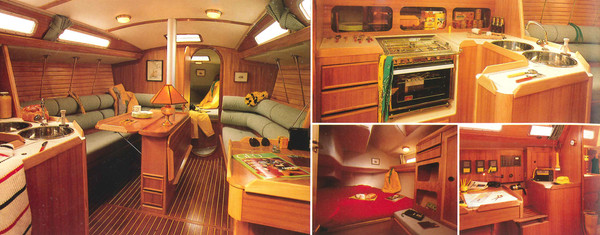
The Feeling 1040 is available in two- and three-cabin versions, with four to eight berths and a headroom of approximately 1.90 metres, remarkable for a boat of this size and era. The three-cabin version, the most common on the second-hand market, arranges a double cabin forward, a double aft to port, and a third, more modest, aft to starboard, with the heads located between the two. The saloon, lit by portlights and the coachroof opening, offers a decent chart table for both coastal and offshore cruising programmes. Owners regularly praise the warmth of the Kirié interiors, with wooden joinery and careful styling that contrasts with the mass-produced boats of the same decade. Storage capacities (300 litres of water, 120 litres of fuel) allow several weeks of cruising without a technical stopover.
Sailing Qualities
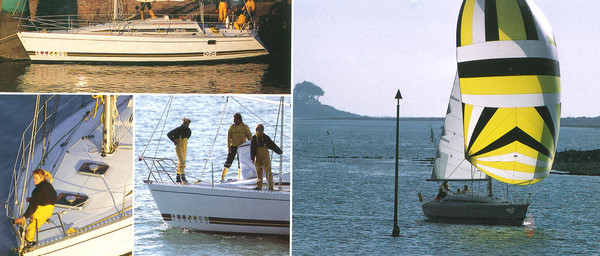
On the water, the Feeling 1040 lives up to her racer-cruiser credentials. Her ballast/displacement ratio of 0.43 places her, together with the 1090, at the top of the Feeling range of the era; she offers a stiffness that allows the full sail plan to be carried in moderate wind conditions where other boats of her category take a reef. Her hull, with a waterline length of 8.80 metres, provides good passage through the sea and sound behaviour close-hauled in chop, a quality owners readily mention. Two keel versions coexisted: a fixed keel of 1.83 metres (or 1.90 metres depending on sources), guaranteeing excellent windward performance, and a reduced-draft version (1.40 metres) for tidal sailing. Under spinnaker, with up to 75 m² of canvas, the boat proves capable of respectable speeds on downwind legs with a small crew. The 18 or 28 horsepower Volvo engine provides sufficient motorisation for harbour manoeuvres and motoring passages.
Owners’ Reviews
Owners’ feedback is remarkably consistent. Owners who have published their impressions on specialist pages summarise a widely shared feeling: Kirié boats are of excellent build quality, with solid and seaworthy hulls and warm interiors. Second-hand listings confirm the robustness of the fleet: 1986 examples are commonly found with refurbished joinery and flooring, a replaced Volvo 28 horsepower engine, a furler, an electric windlass and an autopilot, proof that these boats receive dedicated maintenance from owners attached to their vessel.
The existence of an owners’ club, which gathers technical documentation, cruising stories and model-specific upgrade sheets, attests to the vitality of the community and constitutes a valuable resource for any buyer. Enthusiasts also cite the sailing pleasure: a boat that holds the sea, does not tire her crew and whose performance remains respectable against more recent designs. In 2009, a 1986 example was listed at around 40,000 euros; today, prices range between 30,000 and 45,000 euros, a remarkable stability that illustrates the model’s solid residual value.
Technical Specifications Feeling 1040
| Specification | Value |
|---|---|
| Shipyard | Kirié (France, Le Château-d’Olonne) |
| Naval architect | Philippe Harlé (interior: Mortain) |
| Production years | 1985 – 1987 |
| Number of units built | approx. 100 |
| Programme | Racer-cruiser |
| Length overall | 10.40 m |
| Hull length | 9.98 m |
| Waterline length | 8.80 m |
| Beam | 3.60 m |
| Draft | 1.40 m (shallow version) or 1.83 – 1.90 m (fixed keel) |
| Displacement | approx. 5,050 – 5,500 kg |
| Ballast | 2,150 kg (43% of displacement) |
| Air draft | 19 m |
| Rig type | Masthead sloop |
| Total sail area | 67.1 m² |
| Mainsail | 25.6 – 32 m² |
| Genoa | 41.5 m² (23 m² working jib) |
| Spinnaker | up to 75 m² |
| Sail area/displacement ratio | 13 |
| Hull material | Laminated polyester |
| Headroom | 1.90 m |
| Cabins | 2 or 3 |
| Berths | 4 to 8 |
| Heads | 1 |
| Fresh water capacity | 200 to 300 L |
| Fuel capacity | 120 L |
| Engine | Volvo diesel 18 or 28 hp (inboard) |
| Navigation category | 1st (offshore) |
| HN handicap group | 19 – 20.5 |
| Indicative second-hand price | €30,000 – €45,000 |