

The Feeling 1090 is a benchmark sailboat in its category. This 10.90-meter cruiser remains highly sought after on the second-hand market.
The Feeling 1090 is one of those sailboats in high demand on the used market. A successful hull, a functional interior, and above-average quality are what have won over sheet trimmers and aspiring long-distance sailors.
Feeling 1090 or Feeling 1040?
The Feeling 1090 should not be confused with the Feeling 1100, designed by the half-tonner specialist Ron Holland. The Feeling 1090 was launched by the Kirié shipyard in 1987. 
In fact, the Feeling 1090 uses the hull of the Feeling 1040, which was launched by the Kirié shipyard two years earlier. The Feeling 1040 was one of the first boats designed jointly by Philippe Harlé and Alain Mortin. This hull is simply a marvel, one of the most efficient of its generation, in the tradition of the Feeling 920. The Feeling 1090 therefore retains the same hull.
The two boats are identical, except for three details. The 1090 gains a few centimeters thanks to the addition of a stern platform above the waterline. Similar to its competitor, the Sun Shine 36, which became the 38 in the same way. The second, and most obvious, difference is the coachroof. While the Feeling 1040 features a wedge-shaped coachroof, the 1090 opts for a panoramic coachroof. This choice changes everything: the boat is much brighter. Finally, the Feeling 1090 is equipped with a taller mast, which was offered as an option on the Feeling 1040.
More than 200 sailboats were produced by the Kirié shipyard from 1987 to 1995. A version with a wedge-shaped coachroof was later introduced. The Feeling 1090 is one of the references in the category of 10-11 meter sailboats of its generation.
Feeling 1090, a benchmark at sea
The Feeling 1090 is a sailboat praised by coastal crews and long-distance sailors alike. If this boat is universally acclaimed, it is no coincidence. At its launch, the press included it in comparisons with a variety of sailboats such as the First 35S5, Centurion 36, Oceanis 390, and even the Vulcain.

This shows the boat’s versatility. Indeed, this hull is a true success. The boat is one of the most efficient upwind, with an above-average speed/course ratio. The Feeling 1090 is also very comfortable on downwind courses. At the same time, this fast cruiser is easy to handle and very seaworthy. The boat is always stable at the helm, performs well in a breeze, and its behavior is always reliable.
For maneuvering, there is plenty of space. The cockpit is spacious, and four people can find their place without getting in each other’s way. The Feeling 1090 was equipped with a wheel steering system as standard. The side decks are comfortable, and moving forward is easy. Finally, the mainsheet traveler is located at the foot of the companionway—less convenient for solo sailing but safer for family cruising.
One unit participated in the Route du Rhum in 1998, and sailor Jean-Luc Van Den Heede owned a Feeling 1040 (or did before his Rustler 36, purchased for the Golden Globe Race).
A comfortable and bright sailboat

What sets it apart from many of its contemporaries is its coachroof. The panoramic coachroof of the Feeling 1090 provides above-average brightness in the saloon. At the same time, it offers a clear view forward, which is highly appreciated.
Its living space is very functional. At the foot of the companionway, there is a large chart table to starboard. Behind it are the head and shower. On the opposite side is the aft cabin. Note the excellent headroom in the cabin: 1.95m. One of the strengths of this true cruiser is its galley. Indeed, this U-shaped galley is a model of its kind. It allows for cooking at anchor or at sea and provides maximum storage. And eating well on a cruise is important.
Finally, the forward cabin is quite spacious, measuring 2m in length and 1.70m in width. However, it is the aft cabin that is considered the owner’s cabin.
Feeling 1090 Specifications
Hull length: 10.81 m 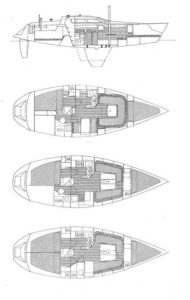
Waterline length: 8.8 m
Beam: 3.6 m
Draft: 1.40 or 1.80 m
Displacement: 5,050 kg
Ballast: 2,150 kg
Sail area: 71 m²
Mainsail: 27 m²
Genoa: 44 m²
Spinnaker: 89 m²
Engine: 30 hp