
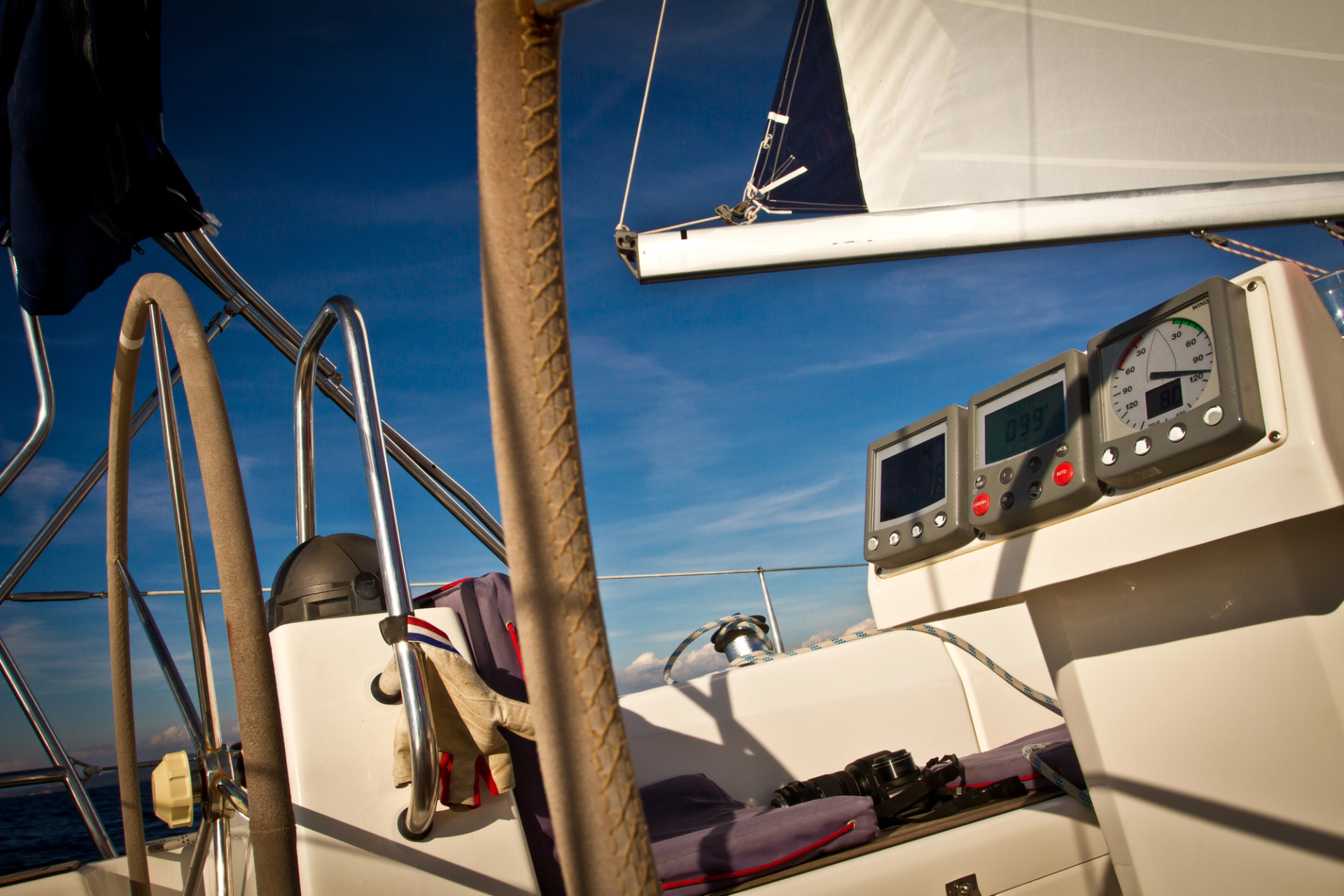
Sailing has always been a school of freedom. A parenthesis where the wind, the waves and the horizon dictate the rhythm. Yet, in the age of total connectivity, our cockpits increasingly resemble spaceship command centers: Fishfinder-chartplotter combos, touchscreen tablets with routing software, high-resolution fishfinders, NMEA 2000 networks, connected anemometers, AIS, radars… Innovations are multiplying, promising ever greater safety, precision, and control. And that’s excellent news: these tools save lives, optimize performance, simplify navigation, and make the sea more accessible to both novices and experienced sailors.
Yet, I surprise myself, I who am passionate about new technologies, the self-confessed geek who loves testing the latest nautical applications, to to seek those moments when all I have to do is listen to the wind in the shrouds and feel the hull cut through the water. Instinct, experience, and that unique feeling of becoming one with your boat and with the sea.
Quite the contrary. The progress made in recent years in the field of onboard electronics has revolutionized the practice of sailing. autopilots, weather alerts real-time or collision detection systems Who would dare do without it in case of thick fog or night crossings?
But it must be noted that This growing dependence on screens and data may, in the long run, distance us from the very essence of sailing. How many boaters today still know Reading a paper map, estimating their position with a bearing compass, or assessing wind strength without an anemometer? How many of us, when passing another boat, still look up from our tablet to exchange a wave or a smile?
It’s about learning to feel your environment, to understand the signs that the sea and the sky send us. And that, no screen will ever be able to replace.
Log out for better navigation
So, how do we do it? Should we throw everything overboard and return to the Stone Age of navigation? Of course not. But What if we learned how to dose it?
1. Coastal navigation, an ideal playground
Why not try the experience of disconnecting?
- Take out the paper map and draw your route with a pencil.
- Use a bearing compass to take stock.
- Observe the buoys, the landmarks, the alignments as sailors of old did.
- Listen to the sounds of the boat : the lapping of the water against the hull, the creaking of the shrouds, the wind in the sails… These are all clues that will tell you more than a screen.
2. Lessons from the Ocean Globe Race
Ocean Globe Race It made a lasting impression. Fifty years after the first edition of the Whitbread Round the World Race, crews have completed a circumnavigation of the world… without GPS, without modern satellite communications, and with instruments reduced to the bare minimum. Their adventure proved that , even on the most hostile oceans.
Their secret? Meticulous preparation, in-depth knowledge of their boat, and above all, absolute confidence in their ability to read the sea and the sky. Of course, no one is suggesting that this experience be replicated solo on a production sailboat. But their example reminds us of one essential thing: sailing is first and foremost a story of men and women, not machines.
3. The pleasure of autonomous decision-making
There is something exhilarating about to make a decision and to accept the consequences. No safety net. No automatic recalculation. Without the little voice of the software whispering in your ear: “Watch out, you’re drifting.”
That’s also what sailing is about: learn to trust your judgment, your experience, your feelings. What if, sometimes, we make a mistake? Whatever. The important thing is to relearning to navigate with your gutnot just with his brain and his tools.
What if we tried it, in practical terms?
I am not advocating the rejection of modern tools. I believe in balance. In the ability to know when to use them, and when to put them aside.
So, the next time you go to sea, Even if only for an hour, the time it takes for a stroll in the bay or a day trip.
- and take out the card.
- Put away the tablet and observe the horizon.
- Put down the screensTake the reins, and let yourself be carried away.
You might well rediscover why, deep down, you love sailing so much. Because sailing, before being a question of performance or technology, It’s a question of freedom, simplicity, and connection with what surrounds us.
And who knows? Perhaps, like me, you will come to appreciate those moments when, ultimately, true luxury is having nothing else to do but sail.