
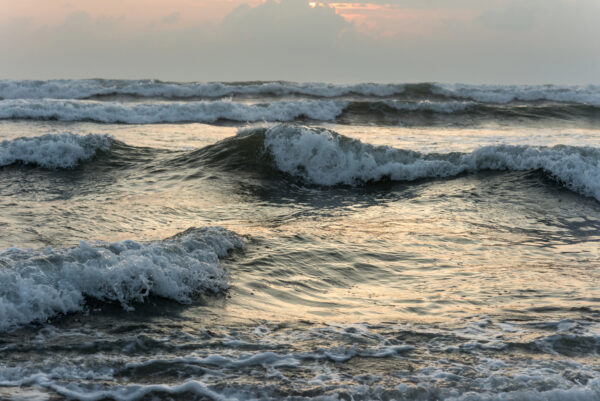
Some eagerly await the waves along the beaches of Brittany and the Basque Country, others fear them, while still others carefully observe them to adapt to them at sea. But what exactly do they tell us, and are they all the same? Here, I propose to identify the different types of waves and learn to recognize them.
Whether we’re boaters, surfers, or simply ocean lovers, waves shape our perception of the ocean and the shore. They tell a story where nature, physics, and sometimes even human intervention intertwine. Let’s explore this together.
Wind waves
Wind waves are the most common and the ones you encounter when going out to sea. They are born under the effect of the wind rubbing the surface of the water.Their size depends on three factors:
- the force of the wind,
- its duration
- and the distance over which it blows (fetch).
When you are watching a weather reportYou will generally see two terms appear:
- Sea of Wind When the wind is still blowing, It forms a choppy, irregular sea with disordered waves.This is often the case during a storm or in fresh winds.
- The swell When the wind dies down or moves away, the waves continue on their way in the form of swell. The swell is characterized by its more regular appearance and harmonious undulations.It can travel thousands of kilometers before coming to die on a coast.
Did you know that? Pacific swells can take several days to reach the Californian coast, providing perfect waves for surfing.
Tidal waves

The tidesInfluenced by the Moon and the Sun, these waves can also create unique patterns. And some regions know this very well. Let’s take the following example:
- The tidal bore A spectacular and rare phenomenon. At high tide, a tidal bore forms when the ocean current rushes into a river estuary. Thrill-seekers sometimes venture there by kayak or surfboard. Among the most famous tidal bores in France are those of the Garonne and Dordogne rivers. It seems there was one that traveled up the Seine in the 1960s. Finally, in Brittany, a tidal bore can travel up the Léguer River during spring tides.
Little tip : To observe a tidal bore, find out about the periods of spring tides, when the tidal coefficients are high.
Seismic waves or tsunamis
Here we enter a more dramatic realm. Tsunamis are not like other waves. They result from underwater earthquakes, volcanic eruptions, or landslides. In the open ocean, they go almost unnoticed, but as they approach the coast, their height increases dramatically.
These waves can travel thousands of kilometers at speeds exceeding 700 km/h! Fortunately, warning systems now allow us to better anticipate these phenomena.
Ground waves

When a wave reaches the shore and encounters shallow waters, it slows down, straightens, and eventually breaks. These waves are particularly important for sailors wishing to anchor close to the coast or for surfers.
There are three types of breaking waves:
- Diving They form a spectacular crest that collapses abruptly. This type of wave occurs over steep bottoms. Perfect for experienced surfers.
- Slippery They break more gently and roll onto beaches with gradual slopes. Ideal for learning to surf or having fun with the family.
- Bright : More violent, they occur in shallow areas with powerful currents, such as passes.
Standing waves
Less well known, these waves appear when a current encounters a fixed obstacle, such as a rock or an artificial structure. They remain stationary or form repeatedly.
- Famous example River waves on the Eisbach in Munich, where surfers ride a fixed wave right in the city center!
7. Rogue Waves
These waves, veritable monsters of the oceans, appear suddenly without warning. They are much higher than the surrounding waves and can reach 20 meters or more. This phenomenon remains difficult to predict and represents a major danger to ships.
Famous example : In 1995, a rogue wave of 26 meters was recorded on the Draupner oil platform in the North Sea, confirming their existence.
Waves, whether gentle or powerful, reflect natural forces that are sometimes calm, sometimes raging. For sailors and boaters, understanding them not only ensures safer navigation but also allows them to fully enjoy the pleasures the sea has to offer. Whether it’s anticipating swells, avoiding breaking waves, or observing a tidal bore, each type of wave tells a fascinating story.
So, the next time you gaze at the ocean, take a moment to appreciate the ceaseless movements that give rhythm to life at sea!