
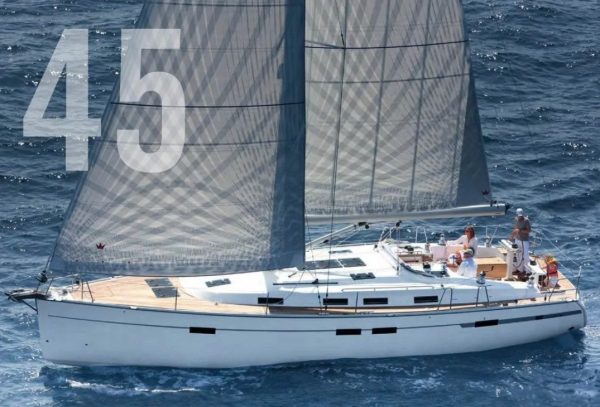
Introduced in spring 2010, the Bavaria Cruiser 45 sat at the heart of the German builder’s Cruiser range, between the Cruiser 36 and the flagship Cruiser 55. Designed by Farr Yacht Design and styled by BMW Group DesignworksUSA, it was intended to embody Bavaria’s renaissance after the 2008 crisis: a family cruising and charter yacht, conceived above all to offer the interior volume of a 50-footer on a 45-foot hull, without giving up genuine seakeeping qualities. Produced until around 2013, it remains today one of the most affordable used 45-footers on the market.
Key takeaways
The Cruiser 45 is a light, highly livable coastal and offshore cruiser (up to four cabins and three heads), fitted with twin wheels and twin rudders, an enormous fold-down swim platform and a well-behaved Farr hull. Its limits: physically demanding handling for a small crew, a high freeboard that complicates docking, and interior finish a step below pre-2008 Bavarias. It is an excellent choice for family cruising and charter; it will suit a two-person crew aiming for long, demanding passages less well, unless maneuvering is assisted by powered equipment.
History of the Bavaria Cruiser 45
The Bavaria Cruiser 45 was born of a collaboration begun in 2007 between Bavaria Yachts, Farr Yacht Design and the BMW Group DesignworksUSA studio, which had already produced the Cruiser 32, 36, 40, 50 and 55. The brief given to Farr’s designer Jim Schmicker was ambitious: concentrate the living volume of a 50-footer into a 45-foot hull while keeping respectable cruising performance. Farr applied the logic of its “bookends”, the Cruiser 40 and 55: maximum waterline length, full forward sections, moderate chines aft and, above all, twin rudders — a rarity at the time on a mass-production sailboat of this size.
The boat was designed in 2009, unveiled at the Düsseldorf Boat Show and then tested by the press in 2010 (Yachting World, October 2010; Yacht in Germany the same year). Construction is typical of Bavaria’s production of the era: hand-laid infused polyester sandwich with Coremat and Airex PVC core, Kevlar reinforcement at the bow and keel area, Germanischer Lloyd certification and CE design category A (offshore).
Two keel versions were offered, a deep 2.10 m draft and a shoal version at 1.72 m, both with a ballast ratio above 28%; Farr specified that the design brief was a boat sailing at less than 20 degrees of heel in 15 knots of true wind, without reefing before 20 knots. The standard engine was a 55 hp Volvo Penta D2-55 on saildrive, with a 75 hp option.
The commercial positioning was clearly twofold: a four-cabin version for charter (two convertible forward cabins, two doubles aft) and a three-cabin “owner’s” version with a large forward cabin and en-suite head. The launch price, around 173,000 euros in Germany, made it one of the most aggressive price-to-volume ratios on the market. Production ended around 2013-2014, and the boat was replaced in the range by the Cruiser 41 and then the C45 (2017). Its direct competitors of the time were the Beneteau Oceanis 45, the Jeanneau Sun Odyssey 439/44, the Dufour 435 and the Hanse 445, all more expensive with comparable equipment, but generally better finished inside.
Interior layout
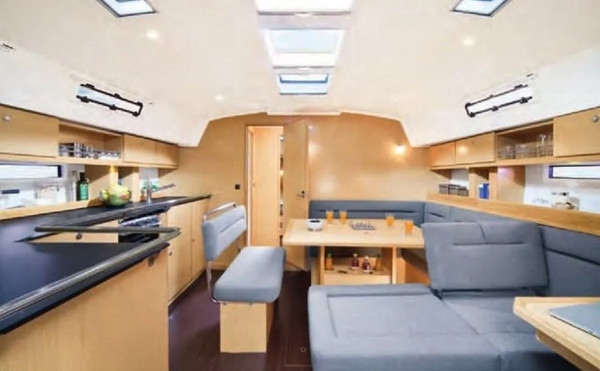
The interior is the very reason for this boat’s existence. Headroom exceeds 2 meters in the saloon, lit by long windows in the deck sides and an all-glass roof, giving remarkable brightness for a 2010 boat. Bavaria adopted a single-level layout merging galley, saloon and chart table into one continuous space — a choice praised by Yachting World for family life aboard, even if purists will find the atmosphere a little bland.
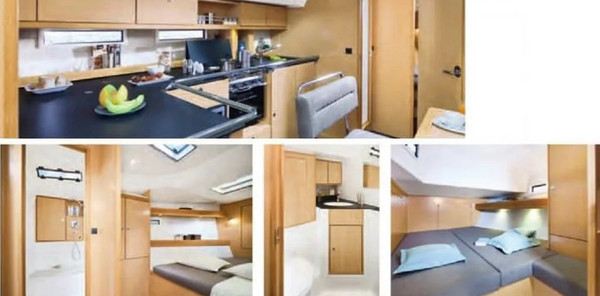
The galley runs fore-and-aft, to port as you come below, with a double sink, a voluminous refrigerator and real worktops. The forward cabin or cabins (your choice: one large owner’s cabin or two doubles for charter) offer an immense walk-through berth; Yachting World notes, however, that while the volume under the berth is adequate, the side stowage is poor, a finding shared by the German press. The two aft cabins each have their own head, one of them en-suite for the owner in the three-cabin version, with separate showers.
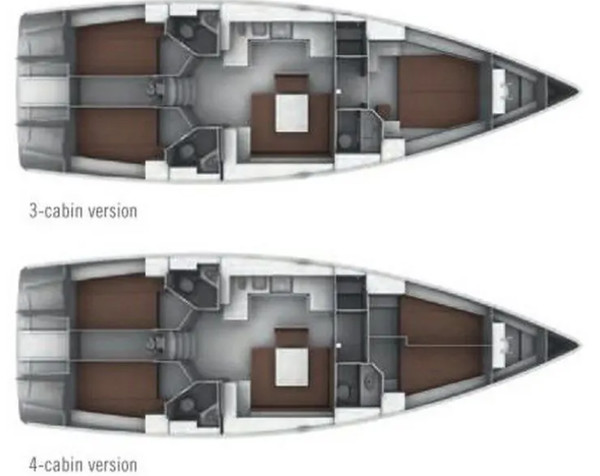
The yard offered three wood species and two deckhead shades, an unusual level of choice in this price bracket. The recurring complaint from long-term owners concerns the joinery: simple veneers and lighter woodwork than on pre-2008 Bavarias, even though everything ages reasonably well if it has been properly maintained.
Seakeeping qualities
Paradoxically, it is at sea that this family boat surprises most. The twin rudders, combined with two wheels and a wide stern hull, deliver steering of remarkable precision and smoothness: the boat does not broach, even gybing in a choppy sea, and course-keeping is secure. Yachting World, testing the boat in 15-20 knots and 1.5 to 2 meters of swell in the Bay of Palma, praised its docile, stable behavior; Yacht confirmed that the Cruiser 45 could be steered without difficulty in the desired direction, even close-hauled in conditions where a reef should long since have been taken. The sail area to displacement ratio of about 18.3 places the boat in the respectable average for production cruisers: not a flyer, but an honest performer that reaches hull speed without effort (about 8.6 knots) downwind as soon as the wind settles in.
The GL-certified sandwich hull and the 3.49-tonne iron keel provide adequate stiffness for a boat of this volume. Under engine, the D2-55 delivers around 7 knots at an economical rpm; the 75 hp option is recommended for heavily loaded charter boats. The known points of attention: the very high freeboard makes the boat hard to handle in crosswinds during harbor maneuvers (hence the value of a bow thruster, rarely fitted as standard on the early boats), and a two-person crew will find the fractional Selden rig physically demanding — hoisting the full mainsail is hard work without an electric winch. Several charter skippers systematically recommend the electric winch option, and long-distance sailors advise a heavy-weather jib on a detachable stay for rough conditions.
Owners’ reviews
Feedback from forums, notably Hisse et Oh, agrees with the press. A skipper who twice sailed a Cruiser 45 in New Caledonia — a boat that had made its own way there from metropolitan France — describes it as “a reassuring boat that I never saw fail” in the New Caledonian trade winds; he emphasizes “very comfortable and very safe” sailing, never once feeling he had exceeded the boat’s capabilities, while admitting that coming from a Bavaria 37, handling is more physical and that “hoisting the mainsail is a good warm-up”.
The Bavaria threads on Hisse et Oh also show a broadly satisfied owner community (several accounts of 18,000 miles without structural incident on Cruisers of a similar generation), along with the recurring criticism of the joinery quality of the 2008-2010 period compared with earlier generations, and a few warnings about commissioning work rather than about the yard itself.
The negative reviews concern less the boat itself than its unsuitable use: too small a crew, no electric winches, performance expectations misplaced for a coastal cruiser. In its defense, owners point to the immense swim platform, the twin-wheel cockpit that frees up a central family space, the reliability of the Volvo Penta and an unbeatable price-to-equipment ratio on the used market — 2010-2012 units now sell far below their equivalent French competitors.
Bavaria Cruiser 45 specifications
| Specification | Data |
|---|---|
| Builder | Bavaria Yachts (Germany) |
| Naval architect | Farr Yacht Design (design no. 695, 2009) |
| Interior design | BMW Group DesignworksUSA |
| Launch / end of production | 2010 / ~2013 |
| Intended use | Family cruising and charter, CE category A |
| Length overall | 14.27 m (46.1 ft including pulpit) |
| Hull length | 13.60 m |
| Waterline length | 12.74 m |
| Beam | 4.35 m |
| Draft (standard) | 2.10 m |
| Draft (shoal version) | 1.72 m |
| Displacement | 12,600 kg |
| Ballast (iron) | 3,490 kg (~28% ratio) |
| Headroom (saloon) | > 2.00 m |
| Rig | Fractional Selden sloop, twin wheels |
| Mast height (I) | 17.91 m |
| Sail area | ~107 m² (full mainsail + genoa) |
| SA/D | ~18.3 |
| Rudders | 2 (twin rudders) |
| Engine | Volvo Penta D2-55, 55 hp diesel, saildrive (75 hp option) |
| Engine speed | ~7 knots (2,200 rpm) |
| Fuel tank | 208 L |
| Freshwater tank | 360 L |
| Cabins | 3 or 4 (including version with 2 convertible forward cabins) |
| Heads | 3 (including 1 en-suite in owner’s version) |
| Berths | 8 to 10 |
| Construction | Polyester sandwich with Coremat and Airex PVC core, Kevlar reinforcement at bow and keel area, Germanischer Lloyd certification |
| Direct competitors (2010) | Beneteau Oceanis 45, Jeanneau Sun Odyssey 439, Dufour 435, Hanse 445 |
| Launch price (2010, ex-VAT Germany) | ~173,000 € |