
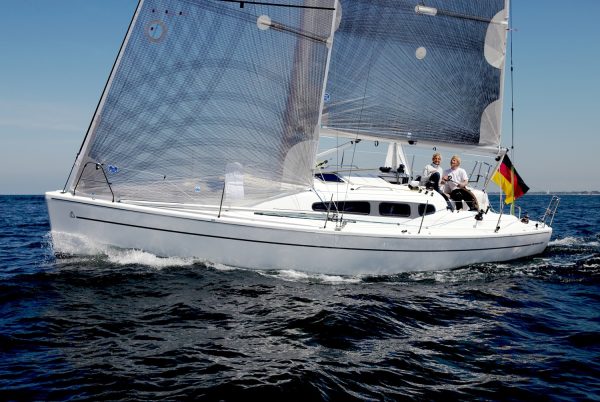
The Dehler 32 is a 32-foot race-cruiser built by the shipyard of the same name and designed by the Bremen-based firm judel/vrolijk & co. Stiff, fast and forgiving, this yacht is a genuine success.
Introduced in 2010, the Dehler 32 was the first model from the Dehler shipyard after the bankruptcy of the family business founded by Willi Dehler and its acquisition by the Hanse Yachts group in 2009. Designed by the Bremen firm judel/vrolijk & co, also the architects of the Hanse range, this 9.80-metre yacht positions itself as a high-performance cruiser of around four tonnes, CE certified in category A (offshore). The name “Dehler 32” covers two distinct boats: the Dehler 32 TOP of the 1990s, derived from the Duetta 94, and the 2010 model examined here.
History of the Boat
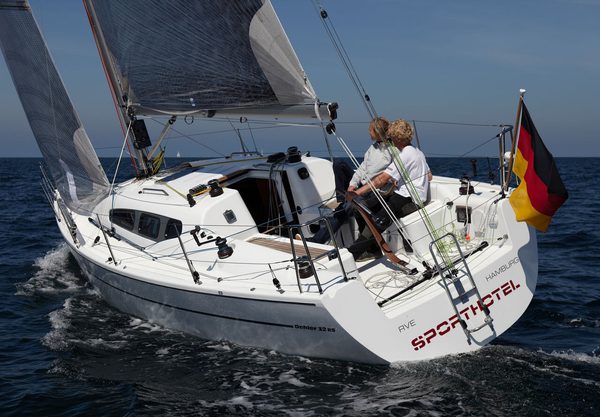
The context surrounding the birth of this model was one of rebirth: Dehler, indebted and with no order book, filed for bankruptcy in the midst of the 2008 crisis, and the Hanse group bought the shipyard in the spring of 2009, keeping the historic Sauerland factory going for some time before concentrating production in Greifswald. The Dehler 32, introduced in 2010 — the Varianta 18 excepted — was therefore the first-born of this Hanse era, and marina.ch hailed it at the time as “an impressive opening move”.
The lines were drawn by judel/vrolijk & co, the German office founded by Fietje Judel and Rolf Vrolijk, which took over from van de Stadt at Dehler in the mid-1990s while also designing the entire Hanse range in parallel. This dual role explains the boat’s philosophy: where other shipyards bloat their hulls to offer volume, Dehler kept a relatively fine hull with a length-to-beam ratio of 3.01, on the understanding that Hanse would cater to those seeking space, as Practical Boat Owner explained.
The construction is classic Dehler: a sandwich hull with end-grain balsa core, laminated with unidirectional and multidirectional fabrics using a hydrolysed polyester resin, a “biscuit-tin” style hull-to-deck joint covered with an alloy rubbing strake, a complete inner liner, and a robust floor matrix around the cast iron T-keel. The boat is fully CE certified category A. Three cast T-keels were offered: standard (1.74 m), shallow draft (1.43 m) and racing (1.98 m). The model remained in the catalogue from 2010 to 2018, in Standard, Competition and Shoal draft versions.
The target programme is clearly that of the family owner who cruises and sails the occasional club race. The competition of the era came from shipyards such as Beneteau with its First range (First 30, the X Yachts and the Elan 310.
Interior Layout
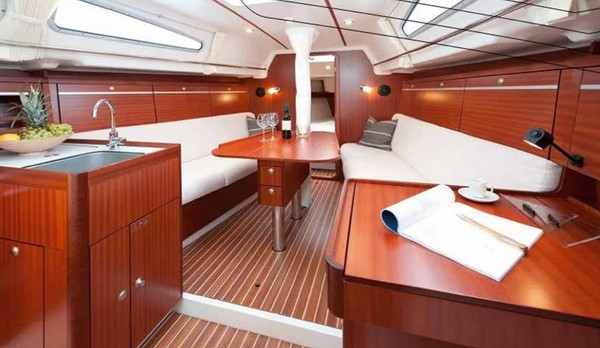
The interior aims for completeness rather than volume: four berths split between a forward V-cabin closed off by a door — the absence of any stem overhang provides decent footroom in the bed, although marina.ch found it a little narrow — and a large aft quarter-berth double closed off under the cockpit, spacious but accessed in a contorted fashion. Lockers are hung just aft of the forward berth, and the period presentation highlighted elongated berths, enlarged worktops and tall cupboards inherited from the larger models.
The galley is acknowledged to be small — one of the recurring criticisms in tests — but functional, while the chart table is surprisingly generous for a 32-footer, though with little stowage for navigation documents. Some fine details of construction were noted: sculpted bunk boards for sitting comfort, a self-draining washboard, solid wood companionway steps, and three deck hatches that bring beautiful light into the saloon. Access to the engine — a Volvo D1-20 of 21 horsepower on the boats of the period — is judged good, with the hot water tank mounted above. Among the irritants: the heads entrance becomes unusable when heeled on a starboard tack, and the main hatch slides freely.
Sailing Qualities
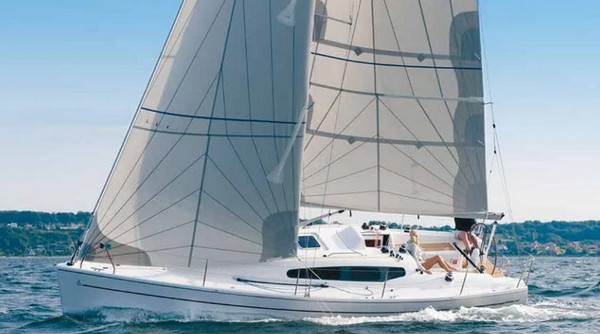
It is under sail that the Dehler 32 justifies its reputation. The 9/10 fractional Seldén rig stepped on the keel, sweepback spreaders at 19 degrees, a backstay in Dyneema cascaded 32:1 and a 107% jib give a finely adjustable boat. The deck hardware, essentially Harken, includes six winches as standard, allowing all halyards to be led aft to the helm, and the mainsheet traveller across the cockpit places the mainsail under direct control.
The most revealing episode in the boat’s qualities was the modification of the rudder: following the distributor’s insistent feedback, the blade was redrawn with a shorter chord and greater depth, transforming a helm judged too heavy into one “as light as a finger’s touch” that continues to grip on the wind even with the lee rail submerged at 40 degrees of heel.
Thanks to the keel and the large, raked-back rudder, the boat turns very quickly on its own axis. In 19 knots of wind, it holds a little over 6 knots hard on the wind and tacks through a little over 70 degrees; on a beam reach it reaches 8 knots and surfs willingly on small quarter waves, with a very slight weather helm. David Harding, writing in Practical Boat Owner, summed up the balance as “just right”: the boat carries the lightest of weather helms, which gives feel through a precise and friction-free linkage, and he described it as “a boat that is hard to unsettle” — pending becoming a good all-rounder and a strong performer downwind.
On this type of boat, the tiller is more relevant than the wheel, on two counts. First, feel: with such a contained displacement and such a well-balanced rudder, the tiller transmits directly, without linkage or reduction, the information from the blade — the first hint of heel, the onset of stall, the work of the water — precisely what one seeks on a racer-cruiser.
This is a finding on which the tests and the owners agree: racing sailors and helmsmen coming from smaller boats prefer the tiller version, better suited to the boat’s nature. Then there is the space in the cockpit: the Dehler 32 has a short cockpit, structured around the mainsheet traveller; a wheel pedestal there eats into usable space, complicates access to the mainsail and the winches, and places the helmsman behind the traveller instead of leaving him at the heart of the arrangement with all the ropes within reach. On this boat, the wheel is more of a sales argument than a sailing choice; conversely, the tiller version extends, without any intermediary, the coherence of judel/vrolijk’s design.
The design data confirm this approach: a displacement of 4,310 kg with 1,480 kg of ballast (ballast ratio of 34%), a D/L of 168, an SA/D of 19.47 and a modest comfort factor (20.7), which places the boat among fast cruisers rather than floating boxes. The tanks, on the other hand, are small: around 80 litres of diesel and 100 litres of water — a choice consistent with a sporty coastal cruising programme.
Dehler 32 Owners’ Views
Owners’ reviews are rare, as you have yourself noted, which is explained by the confidential production and a discreet Northern European clientele, but those we found converge.
On the French forum Hisse-et-Oh, in the autumn of 2010, a prospective buyer compared it to the Sun Fast 3200 and the Elan 310 after visiting the boat show, judging the boat “really not bad at all”, and reported prospective owners attracted by its race-cruiser profile for occasional racing. The thread also reveals a genuine question among buyers of the period about build quality after the Hanse takeover — a legitimate concern, the yard having just changed hands.
Practical Boat Owner reports the most valuable feedback: that of the first British owners, whose remarks on the heaviness of the helm led to the rudder modification — a case where the yard’s attentiveness corrected the boat’s main fault. The magazine also notes that the wheel, on this boat, forces one to lean forward to reach the mainsail and leaves the helmsman isolated at the aft end, far from the winches and halyards: a further argument in favour of the tiller, which the same test judged perfectly suited to the boat’s nature.
Finally, the second-hand market says something about owners’ loyalty: a 2012 unit recently offered for sale in Spain showed a new engine, refurbished upholstery and a hull “free of osmosis”, and the model enjoys a solid reputation for holding its value among racer-cruisers of its size. The irritants reported are concentrated on the original deck hardware: the jib snagging the bow pulpit during bear-aways, the absence of non-slip on the coachroof behind the mast, and the freely sliding main hatch.
Dehler 32 Technical Specifications
| Specification | Value |
|---|---|
| Designer | judel/vrolijk & co (Germany) |
| Builder | Dehler (HanseYachts production, Greifswald) |
| Year of launch | 2010 (production until 2018) |
| Length overall | 9.80 m |
| Waterline length | 8.94 m |
| Maximum beam | 3.25 m |
| Draught — standard | 1.74 m |
| Draught — racing | 1.98 m |
| Draught — shallow | 1.43 m |
| Displacement | 4,310 kg |
| Ballast (cast iron T-keel) | 1,480 kg (34%) |
| Keel type | Cast iron T-keel, three versions |
| Steering | Tiller as standard (single wheel optional) |
| Rig | 9/10 fractional sloop, Seldén mast stepped on keel |
| Spreaders | two swept-back (19°) |
| Sail area (mainsail + jib) | approximately 61 m² |
| Jib | 107% LP |
| Backstay | Dyneema, cascaded 32:1 |
| SA/D ratio | 19.47 |
| D/L ratio | 168 |
| CE certification | Category A — offshore |
| Hull | End-grain balsa sandwich, hydrolysed polyester resin |
| Engine | Volvo D1-20, 21 hp (Yanmar 3YM20 depending on market) |
| Fuel | approximately 80 L |
| Fresh water | approximately 100 L |
| Berths | 4 to 6 |
| Cabins | 2 (forward V-cabin + enclosed aft quarter-berth) |
| Heads | 1 |
| Deck hardware | Harken, 6 winches as standard |
| Direct competitors (of the era) | HR 310, Jeanneau Sun Fast 3200, Elan 310, First 30 |