
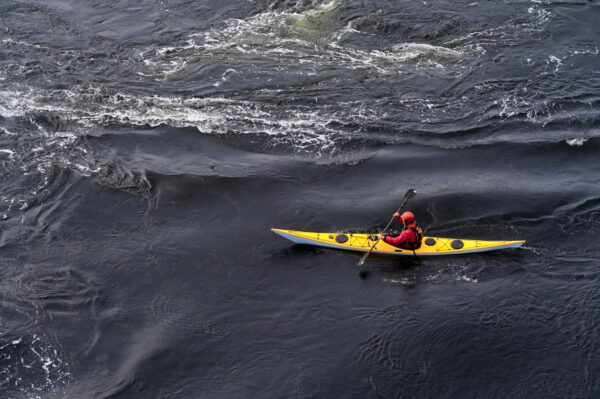
Kayaking is a water sport accessible to everyone. And that’s its primary appeal. But choosing the right model can radically change your experience on the water. Among the two main categories of kayaks, we can distinguish the decked kayaks (Or sit-ins sit-on-top kayaks. The first, closed and technical, appeals to purists and adventurers, while the second, open and reassuring, attracts beginners and families.
While sit-on-top kayaks are the most common type, decked kayaks also deserve attention. They offer a better protection against the elements, a more speeds and one a more engaging browsing experienceBut he also asks more technique and one better control than its cousin, the sit-on-top.
In this article, we explain , his major differences with the sit-on-top, the level of expertise required to practice it, and its behavior on the waterFinally, we present to you the main manufacturers to know in 2026.
What is a decked kayak?
Definition and main characteristics
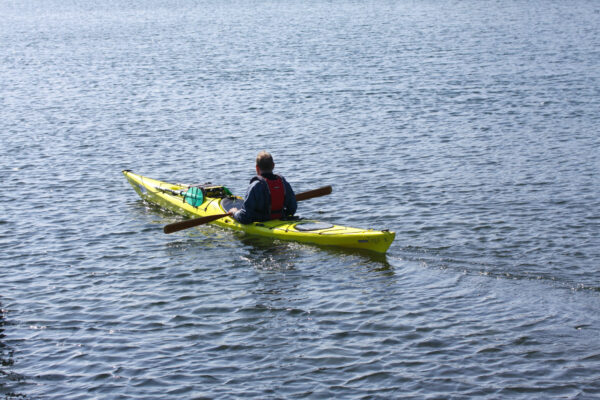
A decked kayak (Or sit-ins) East a kayak farmwhere the paddler sits inside the hull, legs under a bridge. Access is via a coaming (central opening), which can be equipped with a skirt (Or ) to prevent water from entering the boat.
The decked kayak is distinguished by several major advantages:
- Splash and cold protection : Ideal for cold waters or sea outings, where the water temperature may be low.
- Directional stability Thanks to its elongated shape and low center of gravity, the decked kayak stays on track better and is more maneuverable in waves.
- Storage space The watertight hatches allow for the storage of equipment (food, spare clothes, safety equipment) dry.
Who is it aimed at?
The decked kayak is recommended for :
- THE experienced kayakers
- THE outings at sea or on exposed bodies of water
- THE long-distance hikes or expeditions, where protection and efficiency matter.
- Les paddlers seeking thrills and more technical navigation.
However, it is less suitable:
- To beginners
- To children or to people who have difficulty entering/exiting a confined space.
- To very warm waterswhere ventilation is limited (except with a suitable skirt).
To make the right choice, let’s compare the two types of kayaks on several essential criteria.
Comparison of decked and sit-on-top kayaks
| Criteria | Decked kayak | Sit on top |
|---|---|---|
| Access | Entry via the coaming, less easy | Sat Kayaking, extremely easy access |
| Protection | Excellent (waterproof skirt possible) | None (direct water and wind) |
| Stability | Stable in a straight line, but sensitive to lateral imbalances | |
| Speed | Faster (better hydrodynamics) | Slower, but very maneuverable |
| Security | Requires training (righting, Eskimo roll) | Self-bailing, ideal for beginners |
| Thermal comfort | Keep dry and warm | Permanently wet |
| Typical use | Leisure, fishing, calm waters, families | |
| Required level | Intermediate to advanced | Beginner to intermediate |
The basic skills to master
Paddling in a decked kayak is not innate. Here are the essential skills Things to acquire before setting off, especially at sea or on rough waters:
- Eskimo roll Righting technique after a capsize, without getting out of the kayakIt requires gradual learning and good physical condition.
- Wearing a skirt : Know quickly put on and take off the skirt in case of capsizing to avoid getting trapped.
- Wind and wave management A decked kayak is more sensitive to weather conditions. It’s important to know anticipate the waves And correct your trajectory.
- Group navigation At sea, it is highly recommended not to paddle alone, especially for beginners.
Advice : Take some lessons with an instructor or a kayak club to learn these basics safely.
Essential equipment
To enjoy decked kayaking with complete peace of mind, here is the equipment minimum to be expected:
- A waterproof skirt (adapted to the size of your coaming).
- A life jacket (mandatory at sea).
- A neoprene wetsuit (depending on the water temperature).
- A water pump (to drain the water if it catches).
- A whistle and a waterproof lamp (to indicate your position).
- A paddle leash (so as not to lose it in case of capsizing).
Behavior on the water: what to expect
In calm waters (lake, river, sheltered bays)
The decked kayak behaves very differently depending on the type of water you are paddling on.
In calm waters, you will be able to appreciate the following qualities:
- Maneuverability The decked kayak is reagent and allows precise turns thanks to its rudder or steering bar (on some models).
- : Faster than a sit-on-top of equivalent size, especially over long distances.
- Comfort Low seated position, less exposed to the windwhich reduces fatigue.
At sea or in bad weather
At sea or in bad weather, the behavior of a decked kayak changes radically:
- Stability : Less laterally stable than a sit-on-top, but better heading thanks to its pronounced keel.
- Behavior in the waves : Can stuff (planting its nose in the wave) if poorly piloted. It is necessary. anticipate the waves And actively paddle to maintain control.
- Security : Higher risk of capsizing than with a sit-on-top. Hence the importance of mastering the Eskimo roll and of wear a suitable skirt
On a hike or expedition
For long distances, the decked kayak reveals its full potential:
- : Thanks to his watertight hatchesyou can take away more material (food, tent, clothing) dry.
- Efficiency : Less tiring over time, because the kayak glides better and requires less effort to maintain cruising speed.
- Versatility : Suitable for long distances and to varied conditions (wind, current, swell).
In summary: The decked kayak, for whom and for what?
| Profile | Decked kayak | Sit on top |
|---|---|---|
| ❌ No (except with training) | ✅ Yes | |
| Family/children | ❌ No | ✅ Yes |
| Long hike | ✅ Yes | ❌ No |
| Sea/cold waters | ✅ Yes | ❌ No |
| Speed/performance | ✅ Yes | ❌ No |
| ❌ No | ✅ Yes |
A decked kayak is for you if:
✔ You are looking for greater speed and efficiency.
at sea, over long distances or in cool weather.
✔ You are ready to learn basic techniques (Eskimo roll, skirt management).
✔ You want bring equipment to a dry place.
Choose a sit-on-top if:
✔ Are you a beginner or paddling? with children.
✔ You prefer simplicity and security
✔ You are browsing on calm and warm waters.