
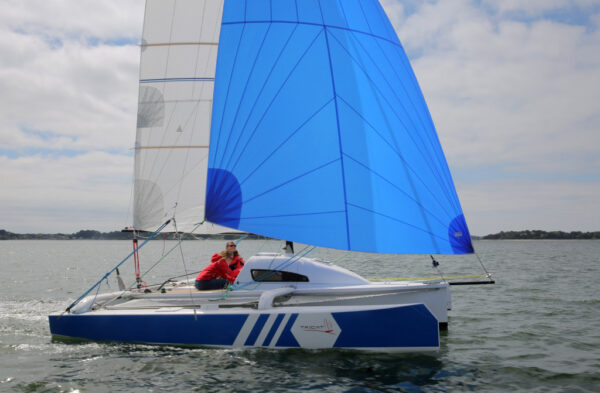
Small trimarans are excellent sailboats for nautical expeditions and short family cruises along our coasts, in a coastal camping style. What are the advantages of these small, transportable trimarans with their folding arms, and which are the best models?
When we think of nautical raids, we generally think of… small transportable sailboats. And often, small catamarans or transportable monohulls are the preferred choice. These sailboats are excellent options for exploring our coastlines for a day or a few days, camping-style. However, it’s possible to have much more fun on other types of multihulls. The trimaran is often overlooked. Yet it has many advantages that make it, undoubtedly and in my opinion, the best sailboat for short coastal cruises.
We will look together at the advantages of its small, foldable trimarans for easy transport, of 5 or 6 meters, capable of offering enormous sensations in complete simplicity and safety.
Small, easy-to-use sailboats
Trimarans are fairly easy-to-use boats. When I say easy to use, I’m mainly referring to… transport and launchingIndeed, behind these three shells which may seem technical, lies a formidable simplicity of preparation.
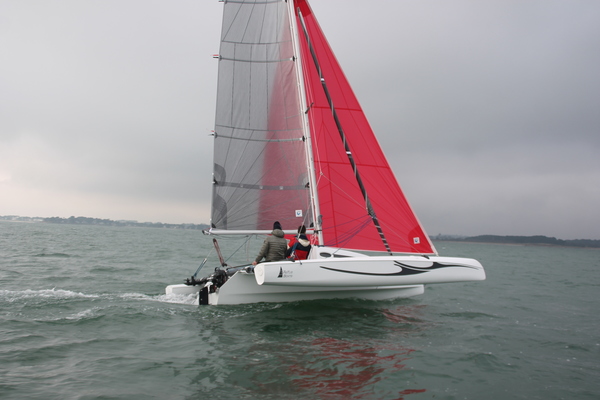
To begin with, trimarans are easily. Unlike a catamaran, which must be dismantled for each transport, trimarans are often equipped with folding armsThese will fold along the central hull, allowing the boat to be transported on a trailer without being disassembled. They can even be moored to a dock. They can be wedged between two pontoons. Moreover, it seems to me that professionals have adapted, like this pontoon manufacturer. The objective is to maintain a road gauge in this configuration.
Then, just like their counterparts, catamarans and other monohulls, they can be launched very quickly, even more easily than a catamaran in practice. Indeed, beyond the fact that most of the transportable trimarans Equipped with a simplified mast-raising system, these multihulls have the advantage of being able to be launched on their trailer. The arms can then be unfolded while the boat is in the water. In short, an excellent choice for to do coastal raiding.
The trimaran, champion of living space
The trimaran is undoubtedly the most habitable boat for short cruisesGenerally, a catamaran of this size is simply not habitable. You end up with two floats and a net. Smaller monohulls, on the other hand, will have a small cabin that can accommodate two people and their belongings.
Cruising trimarans, thanks to their central hull and two floats, will be able to offer significantly more volume. Initially, the central hull is sometimes equipped with a roof allowing for a small living space with four berths, and perhaps room for a table or other items. Of course, this isn’t the case for all trimarans.
Next, in addition to this central shell, you will benefit from This surface area provides additional living space. While sailing, these nets become sunbathing areas. But the best part is at anchor. As night falls, it becomes entirely possible… to equip these nets with a tent
The pleasure of sailing on three hulls
While trimarans offer numerous advantages for transport and provide ample living space, their greatest strength lies in their performance under sail. Trimarans have a reputation for being technically demanding, which is a misconception.
These multihulls, in this size range, are as easy to maneuver and adjust as a catamaran or monohull. Where they truly stand out is in speed. Indeed, they are very faster than a catamaranand especially that it’s a monohull. They will therefore allow families to enjoy themselves sailing fast and… in complete safety.
Safety is also one of the major advantages of trimarans. While a catamaran can capsize, a trimaran cannot. But even without capsizing, sailing will be much more pleasant for a family than on a monohull. The monohull’s heeling can quickly make sailing tiring. The trimaran is much more stable.
Summary table of the trimaran’s advantages
| Criteria | Benefits |
|---|---|
| Stability | Significant width thanks to the floats: less heeling, increased comfort in rough weather. Ideal for long voyages or changing conditions. |
| Speed | Thin and light central hull + floats: superior speed compared to monohulls of the same size, especially downwind. Time savings on coastal passages. |
| Security | Unsinkable (watertight floats), self-righting in case of capsizing (depending on the model). Suitable for challenging navigation. |
| Reduced draft | Access to shallow areas (bays, estuaries, beaches), ideal for exploring the coast and restricted anchorages. |
| Maneuverability | Responsiveness at the helm, tight turns, ease of maneuvering in confined spaces (ports, channels). |
| Space on board | Wide platform between the floats: more living and storage space than a monohull of the same length. |
| Versatility | Suitable for both coastal cruising and sporting raids, with the possibility of different rigging (light sails for performance, or more sailed for cruising). |
| Lightness | Reduced weight = ease of launching, towing, and responsiveness to weather conditions. |
| Autonomy | Less drag = fuel savings for motorized versions, or better range in sailing. |
| Comfort | |
| Access to isolated spots | Possibility of beaching (depending on model), access to coves inaccessible to deep keels. |
| Sensations | Dynamic navigation, fast gliding, increased helming pleasure for thrill-seekers. |
There are several shipyards specializing in the production of trimarans, and even transportable trimarans. Among them, four share the bulk of the market, including two shipyards in Brittany.
, from 6 meters to 9 meters. The shipyard is renowned for the reliability of its boats, their performance, while maintaining a very family-oriented atmosphere. Tricat 6.90 ( See article on the Tricat 690) And Tricat 25 These are sailboats that will adapt very well to our programs.
is the other Breton shipyard that holds a prominent position in this sector. The shipyard offers 5 trimarans ranging from 5 meters to 7.50 meters. Its trimarans share the same program as Tricat, except that the system for folding the arms is different. The Astus 20.5, 22.5 and 24 will be excellent raid trimarans.
Navy corsair He also offers two trimarans: The Corsair 760 and Pulse 600.
Finally, a young Frenchman proposes the Triptych 23.2 For several years now, it has been JYPlast Composites
Technical specifications of the main transportable trimarans:
| Trimaran | Length | Width | Weight | Sail area | Living side |
|---|---|---|---|---|---|
| Tricat 6.90 | 6.90 m | 800 kg | 44 m² | Basic cabin, sleeps 2-3 people | |
| 7.60 m | 5.50 m | 1250 kg | 63 m² | Spacious cabin, sleeping for 4-5 people, kitchen and toilet | |
| Astus 20.5 | 4.80 m | 450 kg | 26 m² | No cabin, open, ideal for coastal navigation | |
| Astus 24 | 7.35 m | 5.49 m | 750 kg | 41 m² | Single cabin, sleeps 2-3 people |
| Corsair 760 | 7.60 m | 5.50 m | 1100 kg | 41.5 m² | Comfortable cabin, sleeping for 4 people, kitchen and toilet |
| Tricat 6.90 XL | 6.90 m | 850 kg | 48 m² | Upgraded cabin, sleeps 3-4 people | |
| Astus 14.5 | 4.45 m | 3.50 m | 220 kg | 14.5 m² | No cabin, designed for light and fast sailing |
| Astus 16.5 | 4.98 m | 300 kg | 18 m² | No cabin, open space for coastal navigation | |
| Astus 22.5 | 5.50 m | 650 kg | 38 m² | Basic cabin, sleeps 2, ideal for weekends |