
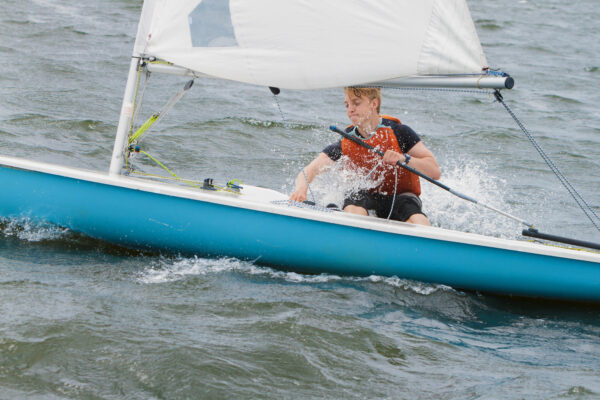
Single-handed dinghies are small sailboats that have the advantage of being able to sail completely independently and usually very easily. Here is our selection of the 10 best solo dinghies, according to MersetBateaux.
Do you love solo sea outings but also enjoy sailing with complete autonomy on small dinghies that are easy to prepare and maneuver, without transport or logistical constraints? Solo dinghies are the ideal solution for combining pleasure, performance, and simplicity. Whether you are a beginner or an experienced sailor, these boats will allow you to glide on the water with complete freedom, from a peaceful cruise to a more sporty session.
In this article, discover 10 solo dinghies suitable for all projects, each with:
- Their DNA and qualities
- A detailed technical sheet
- Their advantages for solo sailing
Key Points
- Autonomy: All these dinghies are designed to be easy to transport, prepare, and maneuver alone.
- Versatility: Suitable for both cruising and racing, they offer varied sensations depending on the model.
- Accessibility: Some are perfect for beginners, others for experienced sailors seeking performance.
Optimist
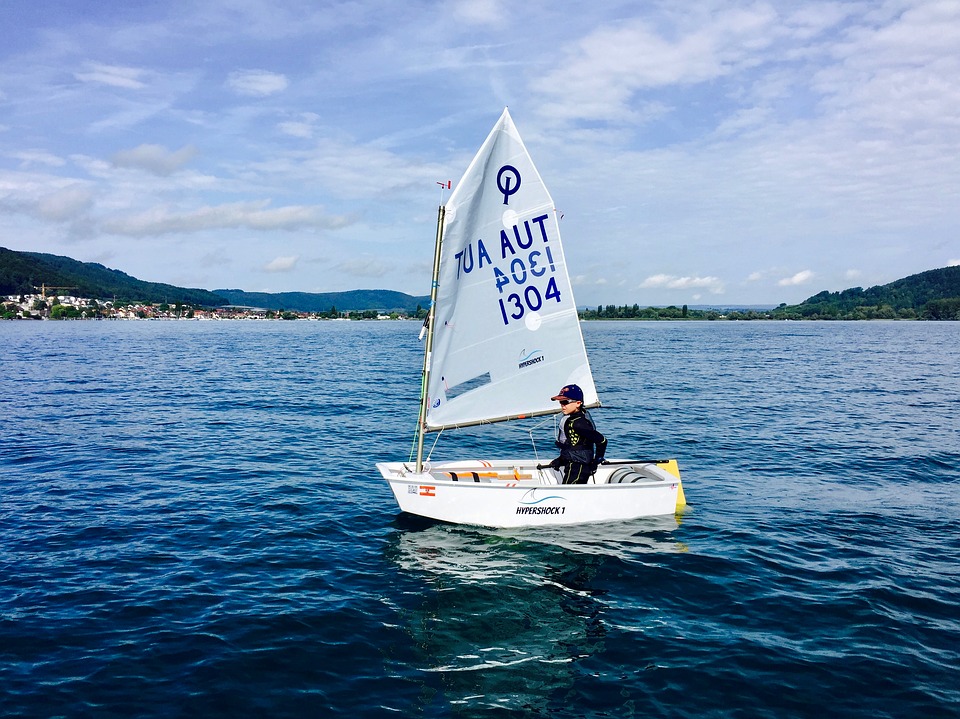
DNA: The Optimist is the ultimate beginner’s dinghy, robust, simple, and safe, ideal for young people (and lightweight adults) who want to learn the basics of solo sailing.
Qualities:
- Stability thanks to its wide hull and flat bottom.
- Easy to maneuver: single sail, no jib, no trapeze.
- Portable: lightweight, it can be placed on the roof of a car.
- Educational: used in all sailing schools, it trains the champions of tomorrow.
Technical Sheet:
- Length: 2.30 m
- Width: 1.13 m
- Weight: 35 kg
- Sail area: 3.5 m²
- Material: Fiberglass or polyester
- Crew: 1 (up to 55 kg)
For whom? Children, teenagers, lightweight adults, sailing schools.
Gazelle des Sables

DNA: A traditional, self-righting, and unsinkable dinghy, inspired by Sardinian fishing boats, perfect for safe and versatile sailing.
Qualities:
- Exceptional stability thanks to its ballast and side compartments.
- Evolving sail plan: start with one sail, add up to three depending on your level.
- Portable: can be towed by bike, lightweight, easy to launch.
- Comfort: ergonomic cockpit, multiple seating positions.
Technical Sheet:
- Length: 2.70 m
- Width: 1.20 m
- Weight: 65 kg
- Sail area: 5 to 10 m² (modular)
- Material: Foam polyester
- Crew: 1 to 2
For whom? Beginners, families, lovers of traditional and safe sailing. We could also have mentioned the other model, the Morgat 320.
Topper

DNA: A fun and planing dinghy, designed for pleasure and performance, with a flat hull that allows you to surf the waves.
Qualities:
- Easy to transport: can be placed on the roof of a car.
- Responsive and maneuverable: ideal for thrills.
- Robust: simple and resistant rigging.
- Versatile: suitable for both cruising and racing.
Technical Sheet:
- Length: 3.40 m
- Width: 1.30 m
- Weight: 55 kg
- Sail area: 5.3 m²
- Material: Polyethylene
- Crew: 1
For whom? Teens and adults seeking thrills and simplicity.
420 (solo)

DNA: Originally a double-handed dinghy, the 420 can be sailed solo with a few adaptations (catboat rig). Technical and tactical, it requires precision but offers great versatility.
Qualities:
- High-performance: fast and responsive, even solo.
- Evolving: possibility to add a crew member for double-handed outings.
- Robust: polyester hull, reliable rigging.
- Educational: excellent for progressing in tactics.
Technical Sheet:
- Length: 4.20 m
- Width: 1.63 m
- Weight: 110 kg
- Sail area: 10 m² (mainsail only in solo)
- Material: Polyester
- Crew: 1 (or 2 in double-handed)
For whom? Confirmed or progressing sailors who enjoy technical challenges.
Laser

DNA: The Olympic and universal dinghy, fast, technical, and demanding, but accessible to all sizes thanks to its three sail versions.
Qualities:
- Performance: easy planing, exceptional responsiveness.
- Portable: lightweight, can be placed on a trailer or roof.
- Competitive: used in racing from club to international level.
- Versatile: three sail sizes (4.7 / Radial / Standard).
Technical Sheet:
- Length: 4.23 m
- Width: 1.37 m
- Weight: 59 kg
- Sail area: 4.7 to 7.06 m²
- Material: Fiberglass
- Crew: 1 (35 to 90 kg depending on the sail)
For whom? All levels, from beginner to confirmed racer.
Tiwal

DNA: The inflatable, nomadic, and ultra-light dinghy, which can be transported in two bags and assembled in 15 minutes.
Qualities:
- Exceptional transport: fits in a car trunk, on a plane, or on a bike.
- Stable and safe: drop-stitch hull, inflatable wings.
- Versatile: equally at home on the sea or lake.
- Easy to maneuver: carbon mast, boomless sail.
Technical Sheet:
- Length: 2.80 m (Tiwal 2) / 3.20 m (Tiwal 3)
- Width: 1.50 m
- Weight: 40 kg (Tiwal 2) / 60 kg (Tiwal 3)
- Sail area: 5.6 to 7.5 m²
- Material: High-pressure inflatable PVC
- Crew: 1 to 2
For whom? Travelers, city dwellers, families, lovers of simplicity.
Guépard
DNA: A traditional and elegant dinghy, inspired by the boats of the Gulf of Morbihan, stable, maneuverable, and versatile.
Qualities:
- Stability: V-shaped hull, gaff rig.
- Coastal navigation: goes anywhere, even in shallow waters.
- Aesthetic: classic lines, wood, and noble materials.
- Self-righting: safe for solo outings.
Technical Sheet:
- Length: 5.30 m
- Width: 1.80 m
- Weight: 150 kg
- Sail area: 12 to 15 m²
- Material: Wood or composite
- Crew: 1 to 3
For whom? Lovers of traditional sailing, families, local racers.
WASZP

DNA: The accessible foiling dinghy, designed to fly over the water without the complexity of racing boats.
Qualities:
- Easy foiling: takes off from 8 knots, stable in flight.
- Portable: disassembles to fit on a trailer.
- Versatile: suitable for beginners and experienced sailors.
- High-performance: high speeds, thrilling sensations.
Technical Sheet:
- Length: 3.35 m
- Width: 1.80 m (wings deployed)
- Weight: 65 kg
- Sail area: 6.2 to 8.5 m²
- Material: Polyester, aluminum foils
- Crew: 1 (50 to 90 kg)
For whom? Speed and new sensation enthusiasts, all levels.
RS Neo

DNA: An ultra-versatile dinghy, designed to be easy, durable, and high-performing, with no compromises.
Qualities:
- Stable and safe: wide hull, hard chines.
- High-performance: carbon mast, optimized sail.
- Maintenance-free: 3-layer polyethylene hull.
- Evolving: suitable for beginners and racers.
Technical Sheet:
- Length: 3.53 m
- Width: 1.40 m
- Weight: 55 kg
- Sail area: 6.5 m²
- Material: Polyethylene
- Crew: 1
For whom? All audiences, clubs, sailing schools, families.
Gavrinis (Plasmor)

DNA: An unsinkable, uncapsizable, and self-righting dinghy, designed for safe sailing, accessible to all, including people with disabilities. Ideal for intergenerational and inclusive practice.
Qualities:
- Maximum safety: designed not to capsize and to right itself.
- Accessible: suitable for children, adults, and people with disabilities (physical, sensory, etc.).
- Easy to use: forgiving of mistakes, ideal for learning and solo or double-handed sailing.
- Versatile: allows for family, friends, or educational sailing.
- Customizable: choice of hull colors for a unique boat.
Technical Sheet:
- Length: 3.30 m
- Width: 1.32 m
- Hull weight: 65 kg
- Ballast: 35 kg
- Sail area: 6.7 m²
- Draft: 0.90 m
- Material: Polyester / Fiberglass
- Crew: 1 to 2
- Certification: D 2 pers. / C 2 pers.
For whom? Children, adults, people with disabilities, families, clubs, and associations looking for safe, inclusive, and friendly practice.
How to Choose Your Solo Dinghy? Practical Advice According to Your Profile and Project

Sailing solo on a dinghy is above all a matter of feeling, project, and level. Here are some tips to help you make the right choice, depending on your expectations, experience, and budget.
Define Your Sailing Project
Before choosing, ask yourself the right questions:
- What type of outing?
- Cruising/leisure: Prioritize stability, comfort, and ease of maneuvering (Gazelle des Sables, Tiwal, RS Neo).
- Racing/performance: Opt for boats that are responsive, technical, and fast (Laser, WASZP, 420 solo).
- Travel/nomadism: Choose a dinghy that is portable, lightweight, and easy to assemble (Tiwal, Topper, Optimist for small sizes).
- Where to sail?
- Sea/ocean: Prefer solid and stable hulls (Guépard, Laser, WASZP).
- Lake/sheltered water: Lightweight and maneuverable models are ideal (Optimist, Topper, RS Neo).
- Shallow waters: A retractable centerboard or reduced draft is a plus (Gazelle des Sables, Guépard).
Match the Boat to Your Level
- Beginner:
- Prioritize stability and simplicity: Gazelle des Sables, RS Neo, Tiwal, Optimist (for small sizes).
- Avoid overly technical boats (WASZP, Laser in strong winds, 420 solo without experience).
- Advice: Start with a pedagogical boat, with a sail adapted to your weight and local wind strength.
- Intermediate:
- Look for a balance between performance and ease: Laser (Radial or 4.7), Topper, Tiwal 3.
- Try evolving rigs (adding a jib, larger sail) to progress.
- Advice: A versatile boat will allow you to vary the pleasures (cruising/racing).
- Confirmed/Expert:
- Opt for pure performance: WASZP (for foiling), Laser Standard, 420 solo (with adaptations).
- Seek thrills: speed, responsiveness, advanced maneuvering techniques.
- Advice: Choose a boat suited to your size and objectives (racing, speed, extreme sailing).
Consider Logistics and Budget
- Transport and storage:
- Car/camper: Prefer dismantlable or inflatable models (Tiwal, Topper, Optimist).
- Trailer: Some dinghies (Laser, WASZP, 420) require an adapted trailer.
- Storage: Check the space required (a Tiwal fits in a closet, a Guépard needs shelter).
- Budget:
- Entry-level (less than €2,000): Optimist (used), Topper, Gazelle des Sables (used).
- Mid-range (€2,000 to €6,000): Laser (Radial or 4.7), RS Neo, Tiwal 2.
- High-end (€6,000 and above): WASZP, Laser Standard, Tiwal 3, Guépard (new).
- Advice: Consider used boats to start, and invest in new if you aim for competition or intensive use.
Test Before Buying
- Try at a club or rental: Many nautical bases offer initiation sessions or rentals (Laser, Optimist, RS Neo, Tiwal).
- Attend open days: At boat shows (Grand Pavois, Nautic de Paris) or local clubs.
- Meet owners: Class associations (Laser, WASZP, Guépard) often organize discovery outings.
Summary Table: Which Dinghy for Which Profile?
| Profile | Level | Budget | Recommended Models | Strengths |
|---|---|---|---|---|
| Beginner/child | Beginner | €€ | Optimist, RS Neo, Tiwal 2 | Stability, simplicity, educational |
| Beginner adult | Beginner | €€ to €€€ | Gazelle des Sables, RS Neo, Topper | Easy to maneuver, portable |
| Occasional racer | Intermediate | €€€ | Laser (Radial), 420 (solo) | Performance, versatility |
| Adventurous nomad | All levels | €€€ | Tiwal 3, Topper | Ultra-easy transport, quick assembly |
| Speed lover | Confirmed | €€€€ | WASZP, Laser Standard | Foiling, thrills |
| Tradition/cruising | All levels | €€€ | Guépard, Gazelle des Sables | Aesthetic, stability, coastal navigation |
In Summary
- For beginners: RS Neo, Gazelle des Sables, Tiwal 2.
- For progression: Laser (Radial), Topper, 420 solo.
- For foiling: WASZP.
- For travel: Tiwal 3, Topper.
- For tradition: Guépard.
Final advice: The best solo dinghy is the one that makes you want to sail often. So, don’t hesitate to try several models before deciding, and let yourself be guided by your feelings!