
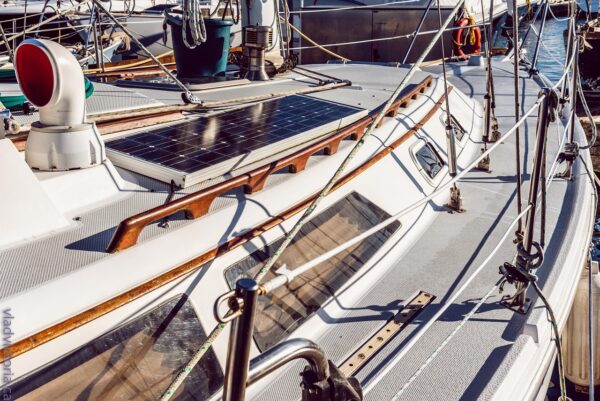
Sailing is an excellent way to learn how to conserve energy. One of the most efficient ways to generate electricity on board is to install solar panels. But how do you choose the right power output for your sailboat’s solar panels?
Navigating independently and managing one’s energy are habits we quickly adopt. These habits are necessary for sailing to the other side of the world, but also for coastal navigation, which is the case for many of us recreational boaters. produce your energy, aboard his sailboat, Solar panels are one of the most effective solutionsThey are quite simple to install, and the different models adapt to many situations. But for these panels to be effective, it is essential to choosing the right power for your boat’s solar panelsWe will therefore try to understand how to choose the power of your solar panels for your sailboat. Several factors must be taken into account when choosing the power of your solar panels for your boat.
Energy Calculator for Sailboats (12V)
Check the equipment on board and adjust its power and usage time. Then select your battery type and hours of sunlight.
Lighting
Comfort
Electronic
Results
Remarks :
- The default values are based on your documents.
- Modify the fields to suit your configuration.
- For lead-acid batteries, do not discharge below 50%.
- For Lithium batteries, discharge up to 95%.
- Adjust the hours of sunlight according to your navigation area.
Calculate the sailboat’s electricity consumption
The first element to consider is, of course, its electricity consumption. This consumption is made up of several elements:
- Navigation equipment
- VHF
- Onboard electronics
- lighting,
- The pressurized water pump and the refrigerator,…
Once you have taken inventory of your equipment, Determine the electrical power of each piece of equipmentThis information is usually available on equipment information labels or in user manuals. Power is measured in watts.
Afterwards, Calculate the usage time of each piece of equipment Multiply the power consumption of each device by its usage time to obtain the energy consumption for each device in watt-hours (Wh). Finally, add up the energy consumption of each device to obtain the total energy consumption in watt-hours (Wh) for your entire system.
It is important to know your average daily consumption in order to estimate the capacity required for solar panels. Once this estimate has been made, you will be able to determine the power needed to compensate for this consumption.
What is the available surface area on your sailboat?
Depending on the size of your boat, you will have more or less space for install your solar panels. Of course, the maximum power you can obtain will largely depend on the available surface area. It is therefore advisable to measure the area you have available and estimate the power that can be installed on that surface. You can install your panels on the roof, if they are flexible, on a mast, or on a gantry at the rear of the boat.
The amount of sunshine in your sailing area
Depending on the regions of the world you sail in, the amount of sunshine varies, and with it, the production of solar energy. It is therefore essential to take into account the average amount of sunshine in your sailing area. in order to determine the power required for your solar panels.
Types of solar panels available

There are several types of solar panels, offering different performance levels and characteristics:
Monocrystalline solar panels
Monocrystalline solar panels offer the best performance, but are also the most expensive. Monocrystalline cells are made from a single silicon crystal, which gives them very high energy efficiency.
Polycrystalline solar panels
Polycrystalline solar panels are made up of multiple silicon crystals. They generally offer slightly lower efficiency than monocrystalline panels, but their cost is also lower.
Thin-film solar panels
These panels use a thin layer of semiconductor material to produce electricity. Their efficiency is lower than that of other technologies, but they have the advantage of being lightweight and flexible, which can be beneficial for sailboats. It is important to choose the type of solar panel that suits your situation, taking into account the available surface area, your budget and your energy needs.
The steps for calculating the required power
Here is a simple method to determine the power required for your solar panels:
- Calculate your boat’s daily electricity consumption: add up all electrical equipment and multiply by the number of hours of daily use.
- Determine the average sunshine in your sailing area: check online or with local tourist offices to find out the average number of hours of sunshine per day.
- Divide your daily electricity consumption by the average number of hours of sunshine to obtain the minimum power required for your solar panels.
Example :
Let’s say your boat consumes an average of 2000 Wh of electricity per day. You mainly sail in a region where the average sunshine is 5 hours per day. The minimum power required for your solar panels will therefore be: 2000 Wh / 5 h = 400 W. In this example, you will need to install solar panels with a total power output of at least 400 W to offset your daily electricity consumption.
Other elements to consider
Other factors can also be considered when choosing the power output of your solar panels:
The efficiency of solar panels
It is important to consider the efficiency of the panels you choose, as this allows you to optimize your installation and minimize the space required.
The desired autonomy
If you want to be able to sail for several days without recharging, you will need to increase the power of your solar panels to compensate for this additional consumption. If you are sailing for the day, or for a weekend on a small sailboat, without much equipment, portable solar panels will probably be sufficient.
The boat’s batteries
Batteries are an element not to be overlooked when choosing the power of your solar panels. Indeed, they store the energy produced by the panels for use when the panels aren’t producing enough (at night or on cloudy days). It’s therefore essential to choose batteries that match the production capacity of your solar panels. But you also need to… maintain your batteries regularly.
In summary, choosing the right power output for your sailboat’s solar panels depends on several factors. It’s therefore essential to carefully consider your daily electricity consumption, the available surface area on the sailboat, the amount of sunshine in your sailing area, and your desired autonomy before making your choice.