
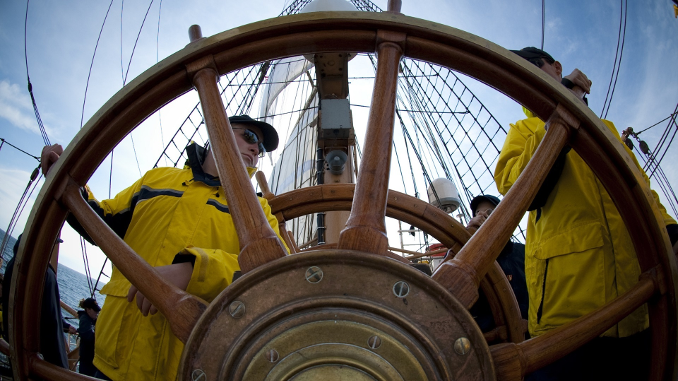
Whether sailing solo or with a small crew, during long voyages, how do you stay on course for hours on end? Can you let go of the helm and attend to other tasks? So many questions that people often ask themselves.
If the existence autopilot While this is obvious to all solo sailors in maritime navigation, it remains largely unknown to the general public. The public watching major races has come to believe that our skippers are chained to their helms, like the popular image of a pirate skeleton. However, there is Several methods exist for releasing the helm, including windvane self-steering and electric autopilots..
Speed regulators
In May 1933, Marin Marie Paul Emmanuel Durand Couppel de Saint-Front, a writer and painter better known by the pseudonym Marin-Marie, crossed the Atlantic solo on a Norwegian cutter, the Winibelle II. He was the second Frenchman, after Alain Gerbault, to achieve this feat.
Unable to be at the helm constantly, he opted for the twin staysail technique, whose sheets were connected to the tiller by a system of pulleys and blocks, inspired by the Braine system. The boat, thus rigged, was “pulled” from the bow and found itself in a stable equilibrium position, easily maintaining its course.
Three years later, Marin-Marie used the automatic rudder with weather vane, created in 1935 by the Swede Sam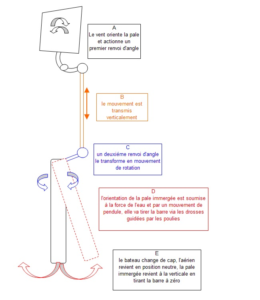
This regulator technology It was widely popularized in the 1960s by the exploits of sailors like Bernard Moitessier and Éric Tabarly. The process uses the force of the wind, and possibly ocean currents, allowing the boat to stay on its course, maintaining a constant heading relative to the wind, sometimes better than a crew member could.
In 1983, the navigator Yves Gélinas, aboard Jean-du-Sud, a nine-meter-long sloop with a displacement of 4 tons, and thanks to a windvane regulator of his own design, but on the same principle as the automatic windvane rudder, covered 28,000 nautical miles, in conditions sometimes extreme, but also effective in light winds, “without steering for more than an hour”, in his own words.
Numerous variations exist, some specially designed for the boat and installed directly, others purchased commercially. Common features include being independent of any power source, robust and simple (and therefore easily repairable), silent operation by taking natural currents into account, high power output, and the ability to provide precise and consistent adjustments despite variations in currents.
Electric pilots
Hermann (Franz Joseph Hubertus Maria) Anschütz-Kaempfe, a German inventor and industrialist, is the creator (patent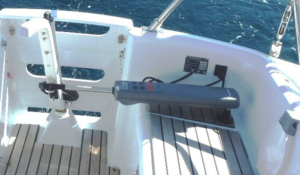 DRP No. 182855 of March 27, 1904) of the gyroscopic compass, insensitive to magnetic anomalies. Subsequently, Elmer Ambrose Sperry, an American industrialist, implemented the first autopilots by an application derived from gyroscopic compass.
Indeed, by interfacing the gyrocompass with the control of the rudder servo motor, it was then quite easy to automatically maintain a heading. Autopilot This technology appeared on large ships as early as the 1920s. The first ship to be equipped with a Sperry autopilot was a Standard Oil tanker, the J.A. Moffett. Furthermore, “automatic” torpedoes, invented by the Austro-Hungarian engineer Luppis and the Englishman Whitehead, were equipped from the beginning of the 20th century with a gyroscope that maintained heading and depth, acting on the pitch and yaw axes.
In 1936, a French inventor, Mr. Casel, unexpectedly appeared in New York, shortly before Marin-Marie’s departure for his Atlantic crossing with Arielle, and offered him, free of charge, to compensate for the inoperability of his automatic wind vane rudder in light winds, an electric pilot, a precursor to today’s electric autopilots for small boats.
This device, however, used photoelectric cells to detect deviations from the course on the compass rose of a magnetic compass equipped with reflecting mirrors. The signal was processed by relays and controlled an electric motor acting on the steering cables, and a system of indicator lights warned the skipper of course deviations and the operation of the autopilot.
Generally speaking, An electric autopilot is a system that allows sailboats to maintain a heading, a course over ground, or a speed upwind.It receives information either through manual adjustment or via a computer interface. It therefore fulfills three functions: to measure, to act, and to communicate.
Through its servo system, the autopilot takes a setpoint, calculates the error between the measured heading and the setpoint, and adjusts the boat’s rudder to maintain the setpoint. An electric autopilot is therefore directly dependent, in addition to its mechanical components, on electricity and its onboard computer.
We therefore owe to Marin-Marie, and to all these inventors, designers, industrialists and engineers, the existence of autopilots, true additional crew members and often indispensable for our long crossings.
Frédéric Daeschler, CAPAJUT (www.capajut.com)