
AIS is a navigational instrument that is increasingly common on our boats. What is an AIS system, and what is its purpose? Finally, should you equip your boat with one?
Definition of the AIS system
AIS stands for “Automatic Identification System“, Or automatic identification system In French. This navigation instrument, increasingly common on our boats, allows you to view maritime traffic in your area on a screen. To be more precise, a AIS system This screen allows you to view all the information about a transmitting vessel. These transmitting vessels are often commercial boats. They include, among others, fishing boats, or larger vessels such as container ships, which are systematically equipped with this system.
This information will identify the boat and send it to another boat. The goal is to avoid collisions.This tool is therefore very useful, even essential, on a pleasure sailboat. It will help avoid collisions, especially on busy shipping lanes. I’m thinking, for example, of recreational boaters sailing in the English Channel.
AIS operates on VHF frequencies (frequencies 161.95 MHz and 162.025 MHz). It can therefore operate with a dedicated antenna or a standard VHF antenna. This will depend on the desired objective.
The functions of the AIS system

THE The AIS system allows information to be transmitted to other ships via a transmitter.These devices must, of course, be equipped with a compatible receiver. In fact, the information transmitted can prove very useful in certain navigation areas. This information, transmitted continuously, is as follows:
- The ship’s identity via its MMSI number and name
- Its characteristics (length, width, draft)
- Its location, thanks to a connection with a GPS.
- His speed
- His cape
Its usefulness is undeniable.
We can immediately note some information that will be of interest to certain boaters navigating in specific areas, such as the English Channel. This is especially true for boaters sailing at night. Knowing that a cargo ship or fishing vessel, which has right of way and is not maneuverable, is in the area can be crucial. At the same time, knowing your position, heading, and speed can quickly become essential. Ultimately, it is you who can avoid a collision, not the cargo ship.
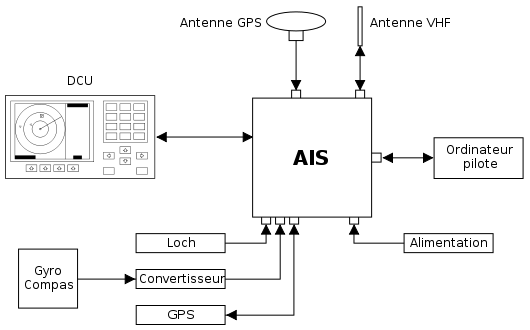
However, AIS does not replace radarwhose range is much greater. Indeed, this information is transmitted in both coastal and offshore areas. However, the range of this information is that of a VHF radio. That is to say, approximately 20 nautical miles for type A breakage transmitters.
There are two types of transmitters. Class A transmitters, which are mandatory equipment on vessels subject to the SOLAS Convention (cargo ships, passenger ships, etc.), have the greatest range. Class B transmitters are reserved for recreational boating. Their power is lower. AIS receivers, however, pick up messages from all AIS transmitters (Class A and B).
Which AIS model should I choose?
The first question to ask is what you are looking for. Indeed, two possibilities are available to the boater.
- An AIS receiver This will allow you to be informed of the presence of other ships, their position/heading/speed. However, you will remain invisible to other boats. This solution has the advantage of being simple, since it can use the antenna of the VHF. and does not consume too much electricity.
- An AIS transceiverA Class B radio will do the same thing but will also transmit your own information. This is an added benefit, but these devices are more expensive and require their own VHF antenna. Not to mention the energy consumption.
Independent AIS systems

Initially, you can easily equip yourself with a AIS receiver moduleThese receivers are sold at very good prices almost everywhere. They are available as black box AIS units or with an integrated screen. However, prices can quickly increase depending on the options. Black box AIS systems, to be usable, must be connected to a chartplotter or a computer with a GPS.
Thanks to an NMEA output, which transmits the signal, they will display the information on a mapOptionally, the card reader, or the device, will sound an alarm if another vessel is present. These devices can also be offered in a transponder (transmitter-receiver) version, but at much higher prices.
VHS with integrated AIS system
Another type of model that is also very interesting is the VHF radios that integrate the AIS functionThese VHF radios are DSC and AIS compatible. In this case, the AIS uses the same antenna as the VHF radio. This solution has the major advantage of simplifying installation. Indeed, you simply connect the VHF radio to a GPS, and you’re all set. However, the information is displayed on the VHF radio’s screen, which isn’t very large, unless you send the information, via NMEA, to a chartplotter.
Finally, there’s the option with a screen, offered by NASA, among others. Not much more expensive, they do require a more complex installation. Alternatively, there are transponders with a screen and dedicated antenna (VHF and GPS). However, these are mainly used by fishermen or for offshore projects.
Nomad, the AIS transponder for PC and tablet
Digital Yacht offers a portable Class B AIS transponder with a wireless interface for PCs, tablets and smartphones.
THE Digital Yacht Nomad AIS transponder is a portable solution for PCs, tablets, and even smartphones. This compact Class B AIS transponder offers a Wi-Fi and USB interface, a GPS antenna integrated and comes with a compact 25cm VHF antenna equipped with suction cups.
An AIS transponder that is easy to install
This new AIS transponder allows for simple installation and the use of a tablet, PC or even a smartphone as an interface. The Nomad allows you to receive AIS targets and GPS data in real time. on navigation applications and software while transmitting its position to other AIS users.

Nomad integrates a USB solution allowing the Nomad to be powered from any USB source. The GPS is integrated into the casing and the whole package comes with a compact 25cm external VHF antenna which is equipped with suction cups for mounting but can also be connected to any VHF antenna.
In short, the question remains open. It will mostly depend on your sailing area, I think. And you, what do you think?