
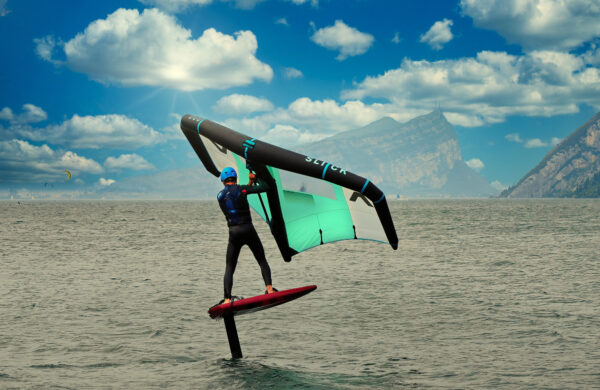
For the past few years, a new discipline has been electrifying action sports spots around the world: the wingfoilThis hybrid sport, born from the evolution of windsurfing, kitesurfing and surfing, appeals with its simplicity, freedom and unique sensations. Accessible, intuitive, and compactIt attracts both beginners and experienced riders looking for new thrills.
But where does wingfoiling come from? How does it work? And how does it differ from other water sports like windsurfing or kitesurfing?
Deciphering a rapidly expanding discipline that could well revolutionize the way you navigate.
Key takeaways: the key points of wingfoiling
- Accessible No prior experience in sailing or kitesurfing is required to begin.
- Versatile : Suitable for use on the sea, lakes, or even in shallow water.
- Space-saving Compact and easy to transport equipment.
- Unique sensations : Combination of gliding, flying (with foil) and freedom.
- Quick learning : Progression curve often shorter than windsurfing or kitesurfing kiteworldshop.com+2.
What is wingfoiling?
A clear definition
THE wingfoil (or wingsurfing) is a water sport that combines:
- A board (often short and wide, equipped or not with a foil);
- An inflatable wing (called wing), held with two hands via handles or a wishbone;
- A foil (optional but very common), which allows you to take off above the water and to reduce friction, providing a sensation of flight.
Unlike kitesurfing, no lines or harnesses : the wing is directly manipulated by the practitioner, which makes the discipline more intuitive and less technical to grasp fun-and-fly.com+2.
Origin and history: from the 1980s to the global explosion
The beginnings: an old idea
The idea of sailing with a hand-held wing is not new. From the beginning the 1980spioneers like Jim Drake (co-inventor of windsurfing) in the United States and Roland Le Bail In Brittany, they are imagining similar concepts. The latter is even filing a patent for the Bird Sail, a wing inspired by the flight of seagulls.
However, at the time, windsurfing dominated the market, and these innovations struggled to gain traction.
The Renaissance: The Foil Era
Everything changes with the arrival of the foils (hydrofoils) in the 2010s. These underwater wings, initially developed for kitesurfing and windsurfing, allow for lift the board above the waterreducing friction and providing a flying sensation.
In two thousand nineteen, the brand Duotone launches the first consumer wingfoil, equipped with a wishbone for optimal handling. The sport then explodes, driven by athletes like Titouan Galea Or Balz Müller, which popularize the discipline through spectacular videos and competitions.
Today, wingfoiling is one of the most popular water sportswith a growing community and ever more powerful equipment.
How does it work? The equipment and the practice
The 3 essential elements
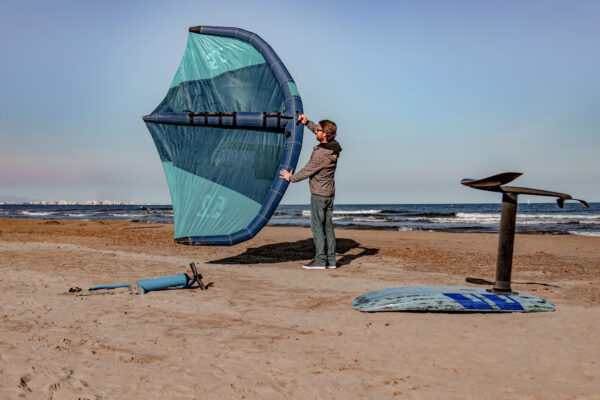
To practice wingfoiling, you will need:
- A wing :
- Inflatable, lightweight and easy to handle, it can be held with two hands.
- Variable sizes (from 2 m² to 8 m²) depending on the wind and the skill level of the user.
- Two types of sockets: handles Or wishbone (central bar).
- A board :
- Shorter and wider than a windsurf board, for better stability.
- With or without a foil (for beginners, a classic SUP-type board may suffice).
- A foil (optional but recommended) :
- Composed of a mast, a fuselage and an underwater wing.
- Allows you to take off above the water from 10-12 knots of speed.
Useful accessories
- Leash (so as not to lose the board or wing in case of a fall);
- Combination (depending on the water temperature);
- Helmet and impact vest (for safety).
How it works in practice
- Takeoff The practitioner positions themselves facing the wind, wing in hand, and lets the wind inflate the wing.
- Propulsion : By tilting the wing, a pull is generated which propels the board.
- Slide Once in motion, the foil (if present) lifts the board, reducing friction and providing a sensation of flight over water.
- Control : Steering is achieved by adjusting the angle of the wing and the body weight.
Wingfoil vs windsurfing: what are the differences?
Wingfoiling: the revolution in watersports
| Criteria | Wingfoil | Windsurfing |
|---|---|---|
| Material | Hand-held wing + board + foil | Sail attached to a mast + board |
| Learning | More intuitive, fast curve | More technical, requires strength |
| Sensations | Freedom, flight (with a foil), smooth gliding | Direct contact with the wind, more physical |
| Transportation | Compact and lightweight | Bulky (mast, sail, board) |
| Wind conditions | Works in low wind | Often requires more wind |
| Versatility | Sea, lakes, flat water | Sea, lakes, waves |
| Cost | Recent equipment, sometimes expensive | More affordable equipment (used) 19-20, 21, 22, 23 |
The advantages of wingfoiling compared to windsurfing
- Less physical : No arm strength is needed to hold a sail attached to a mast.
- Freer : No mast or wishbone, the wing is independent of the board.
- More accessible : Learning is often faster, even for beginners.
- Less bulky : Equipment that is easier to transport and store.
Wingfoil vs kitesurfing: two different philosophies
Comparison of Wingfoil and Windsurfing
| Criteria | Wingfoil | Kitesurfing |
|---|---|---|
| Material | Hand-held wing + board + foil | Wing connected by lines + harness |
| Control | Direct, without lines | Indirectly, via a bar and lines |
| Sensations | Smooth glide, flight (with foil) | Jumps, speed, thrills |
| Security | Less risk (no lines) | Risk of falls or collisions |
| Learning | Easier for beginners | Longer learning curve |
| Terms | Works in low wind | Often requires a stronger wind 23-21, 25, 27 |
Why choose wingfoiling over kitesurfing?
- No lines : Less risk of snags or knots.
- More intuitive No need to manage a harness or lines.
- More versatile : Can be practiced in areas where kitesurfing is prohibited (e.g., some lakes).
- Less physical : No need to force anything to control the wing.
Other water sports compared to wingfoil
- SUP Foil Similar to wing foiling, but without a wing (a paddle is used). Wing foiling adds the dimension wind And propulsion.
- Surf Foil : Uses waves for propulsion, whereas wingfoiling uses the wind.
- Kitefoil A combination of kitesurfing and foiling. More technical, with spectacular jumps, but less accessible for beginners.
Who is wingfoiling suitable for?
Wingfoiling is aimed at a large audience :
- Beginners Thanks to its rapid learning curve and intuitive hardware.
- Windsurfers or kitesurfers : To vary the pleasures and discover new sensations.
- Snowboard enthusiasts Surfers, paddlers, or simply lovers of the sea.
- Families : Some wing and board models are suitable for children (under supervision).
Where can I practice wingfoiling?
Wingfoiling is practiced wherever there is wind and water :
- At sea : Windsurfing or kitesurfing spots (e.g.: La Torche, Quiberon, Leucate, Dakhla).
- On the lakes : Ideal for beginners (flat water, few waves).
- In shallow water Thanks to the foil, it is possible to sail even in shallow water.
Advice : Favor spots with a steady wind (10-20 knots) and water without obstacles (rocks, seaweed).
How much does wingfoiling cost?
Wingfoiling is a sport recentAnd the equipment can represent a significant investment. Here is an estimate of the prices (new):
- Wing €500 to €1,500 depending on size and brand.
- Plank €800 to €2,000 (with or without foil).
- Foil €600 to €1,500.
- Accessories (leash, wetsuit, etc.): €200 to €500.
Trick : It is possible to find used equipment or rent it to test before buying.
Conclusion: Wing foiling, a revolution worth trying
Wing foiling is much more than just a trend: it’s a true revolution in the world of water sports. Accessible, intuitive and versatileIt is appealing because of its simplicity and its unique sensations of gliding and flying.
Whether you are a beginner or an expert, young or old, wingfoiling offers a new way to navigate, freer and closer to the water element.
So, ready to get started? The wind and the waves are waiting for you!