
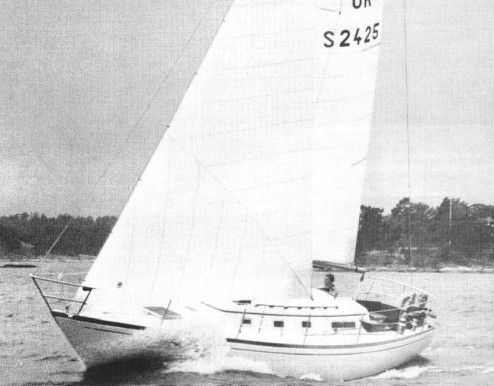
The Carter 33 is a performance cruising sailboat designed by the American Richard “Dick” Carter. This racer-cruiser was built from 1971-1973 by the Greek yard Olympic Yachts, in Lavrio. Descended from the Carter 30 line and derived from the Ydra racer-cruiser, it belongs to the first generation of European production fiberglass sailboats. About 200 units were produced, a rather respectable figure for the time, which also explains its relative rarity on the French second-hand market, where only about 50 units were sold. This is precisely what makes it interesting: for a budget of around 10,000 to 20,000 euros, this rare sailboat today offers a sound hull, a generous interior volume, and seakeeping behavior that many modern productions of equivalent size cannot match.
Key takeaways
The Carter 33 is a credible and undervalued alternative to the classics that are the Beneteau First 30, the Contessa 32, or the Wauquiez Centurion 32. Against the Contessa 32, which is finer, stiffer, but noticeably more spartan, it offers seven berths and a genuine family program. Against the First 30, it displays a more seaworthy hull and a distinctly superior upwind ability. Against the Centurion, it offers a sometimes inconsistent Greek build quality, but a more favorable volume/performance ratio. Its two points of vigilance: the variable build quality of the earliest examples (plywood in the cockpit, possible osmosis) and the short-rig version, under-canvassed in light breeze. A boat to buy surveyed, but whose potential remains very interesting at this price.
History of the Carter 33
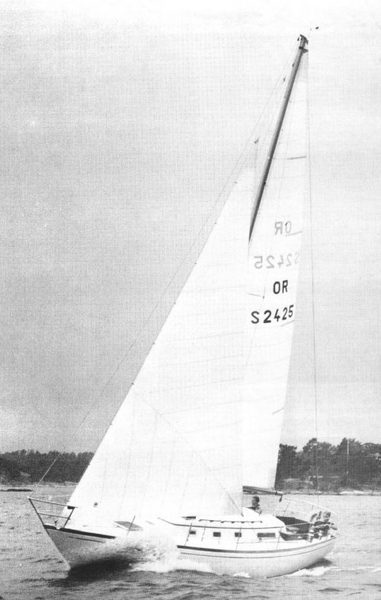
The Carter 33 was born in the early 1970s, in the context of the explosion of European fiberglass production. Dick Carter, settled in Europe after his offshore racing successes, was looking for a yard capable of industrializing his designs. It was Olympic Yachts, in Greece, that took up series production, making the Carter 33 one of the very first production sailboats built in Europe on a large scale. The design story is almost novelistic: Carter had the first two units built in Finland. But these versions proved too heavy at launch, the waterline sitting below the water surface; the molds were then transferred and the project finalized elsewhere, with series production starting in Greece around 1971-1973.
Technically, the hull follows the principles that made Carter’s reputation: a narrow and deep keel, a hung rudder. Two rigs were offered: a 50 m² racing rig, very high-performance, and a shorter 45.5 m² cruising rig, simpler to handle but under-canvassed. The earliest models used significant amounts of plywood in the cockpit area; the later units were entirely fiberglass.

The original program was clearly that of the IOR-era racer-cruiser. The Carter 33 was notably the best-placed production sailboat in its category at the 1976 World Championships, while offering seven berths and genuine cruising habitability. Its direct competitors of the time were the Contessa 32, the Nicholson 32, the Wauquiez Centurion 32, the Beneteau First 30, and also the Rival 32, the latter being more oriented toward heavy cruising.
As for the architect, Richard “Dick” Carter, born in 1928 in New Hampshire, is one of the most original figures of his time. An art-history graduate from Yale and a self-taught designer, he made his name in 1965 by winning the Fastnet Race with Rabbit, his first own design, against 151 competitors. He followed up with victories at the One Ton Cup (Tina in 1966, Optimist in 1967), won the Fastnet again in 1969 with Red Rooster and its lifting keel, then contributed to the victorious American Admiral’s Cup team. He is credited in particular with popularizing narrow keels separated from the rudder, clean deck surfaces inherited from the Bauhaus, and concepts later taken up in the Southerly lifting-keel boats. At the height of his career, in the late 1970s, he left the profession almost abruptly to restore an English manor with his wife.
Interior layout
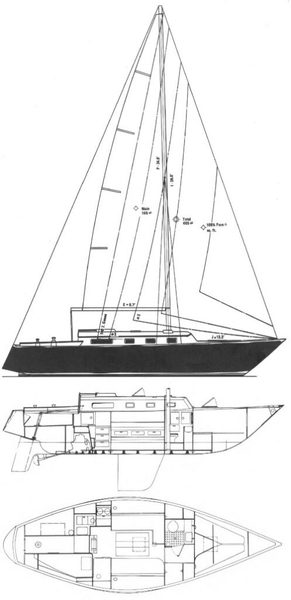
The Carter 33’s layout is typical of the best practices of the 1970s, with a remarkable volume requirement for a 10-meter boat of the era. The plan is classic: the galley to port, the chart table to starboard, and the heads forward of the mast, an arrangement then reserved for larger boats.
Seven berths are provided: a forward cabin with a double V-berth, a linear saloon with a central table and a double settee berth, a “coffin” berth aft, and an additional berth on the settee. The roof, whose earliest units featured large glazed surfaces, provides acceptable brightness for the period. The materials, mahogany and painted marine plywood, generally age well, but the damp areas around the hatches and the mast step should be carefully inspected.
The storage volume is honest for a boat of this length, and the relatively flat bottom of the hull, with no marked sump, gives a spacious saloon but demands rigorous bilge-water management.
Seakeeping qualities
The Carter 33 is recognized for its genuine seakeeping qualities, a direct inheritance from its architect’s offshore experience. Upwind, it points well with a stable trim; the “egg-shaped” hull is initially a bit tender, but stiffens markedly at maximum heel angle, which gives it very reassuring behavior in medium and strong conditions.
The moderate freeboard limits windage, which makes harbor maneuvers and motoring easier. Owners describe it as an excellent “70s offshore racer”, manageable with a crew of two, easy to handle under engine in marinas, and capable of safe long-distance passages. The tall racing-rig version is distinctly livelier; the short-rig version, on the other hand, suffers in light airs and may show a slight tendency to heel downwind, corrected by a well-trimmed genoa. In racing, the record of the series remains honorable for a production boat of this era.
Owners’ opinions
Feedback converges toward a very positive assessment, with a few recurring reservations. On the YBW forum, one owner describes the cruising Carter 33 as a boat “that sails very well”, while regretting the earliest versions with a very woody cockpit, later corrected by an all-fiberglass construction. Another, who sailed from Rhodes to the United Kingdom, calls it “a very good boat to sail, easy with two, very manageable under engine in marinas, with acceptable habitability for the era”. A third judges it “a bit tender at first, but very stable at maximum heel, very good upwind, not excessively wet — a true good 70s offshore racer”.
On the French side, on Hisse et Oh, owners’ exchanges confirm the image of a passage-making sailboat recognized for its seakeeping qualities, with however a warning about the undersized original engines (10 to 25 horsepower depending on the unit, sometimes replaced) and essential vigilance regarding the lead keel bolts, whose cross-section can shrink over time and whose replacement requires specific expertise. One owner also testifies, with humor, to the necessity of the bucket and sponge on a flat-bottomed boat with no sump. Prices observed on the French market today range from 11,000 to 25,000 euros depending on condition and equipment, making it one of the best value-for-money propositions in the segment.
Carter 33 technical specifications
| Characteristic | Value |
|---|---|
| Designer | Richard “Dick” Carter (Carter Offshore) |
| Builder | Olympic Yachts, Lavrio (Greece); first units in Finland |
| Launch year | 1971 (series production about 1971-1974) |
| Units produced | About 200 |
| Program | Racer-cruiser, IOR Three-Quarter Ton |
| Hull type | Fiberglass monohull, hung rudder |
| Length overall | 9.93 m (32 ft 7 in) |
| Waterline length | 7.90 m (25 ft 9 in) |
| Beam | 3.35 m (11 ft) |
| Draft | 1.67 to 1.70 m |
| Displacement | About 3,400 kg (7,500 lb) |
| Ballast | About 38% of displacement (lead) |
| Length/beam ratio | 2.98 (voluminous hull for the category) |
| Rig | Masthead sloop, two spreader tiers |
| Sail area (racing) | 50 m² |
| Sail area (cruising) | 45.5 m² |
| Sail dimensions (I/J/P/E in feet) | 39.6 / 12.1 / 34.0 / 9.9 |
| Original engine | Inboard diesel, 10 to 25 hp depending on the unit (often replaced) |
| Capacity | 6 to 7 berths; 1 forward cabin; heads forward of the mast |
| Layout | Central saloon, galley to port, chart table to starboard, aft coffin berth |
| Tanks (typical) | About 80 l of water; fixed diesel tank |
| Observed second-hand price | 11,000 to 25,000 € depending on condition and year |
| Contemporaries | Contessa 32, Wauquiez Centurion 32, Nicholson 32, Rival 32, Beneteau First 30 |
The Carter 33 perfectly illustrates the best that the first generation of European production had to offer: a hull drawn by an architect of great talent, astonishing habitability for the length, and an ability to hold its own at sea that today’s broader, flatter hulls do not reproduce. Its limited distribution in France is a matter of distribution networks, not of intrinsic quality. For a sailor looking for a robust, seaworthy second-hand sailboat, capable of taking a family on cruise while remaining competitive in classic racing, the Carter 33 deserves a place on the shortlist, alongside the Contessa 32s and other Centurions, and quite often at a lower price.