
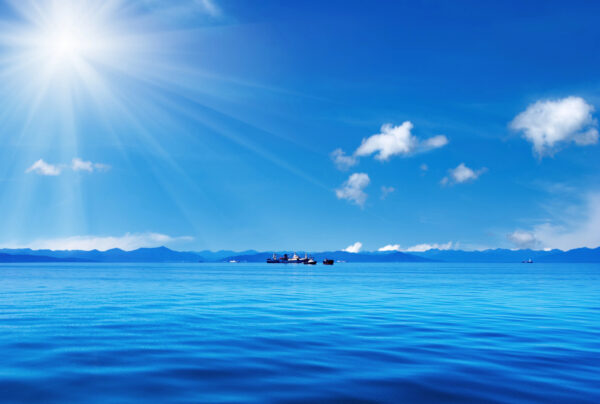
As France swelters under increasingly intense heat waves, one thing is clear: Without the ocean, these heat waves would be much worse.Yet, this blue giant, which absorbs 90% of the excess heat due to greenhouse gases and 25 to 30% of our CO₂ emissions, is today out of breathThe Sea Foundation is sounding the alarm: Protecting the ocean means fighting against tomorrow’s heatwaves..
The Ocean, a climate bulwark in danger
An unsung but vital role
Every day, the Ocean acts as a natural air conditioner for the planet. By capturing some of the CO₂ emissions and storing excess heat, it limits atmospheric warming. Without it, global temperatures would already be unbearable.
However, this ability comes at a price:
- Water warming : the Ocean is warming, which reduces its capacity to absorb CO₂.
- Acidification : the absorption of CO₂ acidifies the water, threatening marine life.
- Deoxygenation : heat reduces the available oxygen, suffocating ecosystems.
- Marine heat waves : these increasingly frequent episodes cause the mass mortality of species (corals, shellfish, fish).
A vicious circle
The more heat and CO₂ the ocean absorbs, the weaker it becomes. By 2100, it may have to absorb 2 to 7 times more, according to warming scenarios the Sea Foundation. Result : a gradual loss of its ability to regulate the climate, and therefore even more intense and frequent heat waves on earth.
Key takeaway: The Ocean, both victim and solution to climate change
✅ The ocean absorbs 90% of the excess heat due to human activities.
✅ It captures 25 to 30% of the CO₂ emitted, thus limiting atmospheric warming.
✅ Without it, temperatures would be much higher. than today.
⚠️ But its role as a climate regulator is weakening due to warming, acidification and pollution.
⚠️ Protecting the ocean is therefore protecting our climate and mitigate the effects of heat waves.
Preserving the Ocean to mitigate tomorrow’s heatwaves
The urgency to act
L’Paris Agreement sets a goal: to limit warming to 1.5°C to avoid irreversible damage (disappearance of corals, melting of glaciers, etc.). To achieve this, reducing CO₂ emissions is essential, but restoring marine ecosystems is just as important..
Concrete solutions
The Sea Foundation supports projects for:
- Protect and restore seagrass beds and mangroves These ecosystems store 3 times more carbon than a tropical forest.
- Preserve coral reefs although they only cover 0.1% of the Oceanthey house 25% of marine biodiversity and protect the coasts from erosion.
- Raising public awareness to the importance of the Ocean in regulating the climate.
“ The ocean is both a victim and an ally in the fight against climate change. It is the planet’s air conditioner. Today, it is reaching its limits, and we are suffering the consequences. Protecting the ocean means protecting our climate and the future of humanity. » Alexandre Iaschine, Director General of the Sea Foundation
What can we do on our own scale?
Everyone can contribute to protecting the Ocean, and therefore to fighting heatwaves:
- Reduce your carbon footprint (transport, food, energy).
- Limit plastic pollution which suffocate marine life.
- Supporting associations like the Sea Foundation, which takes concrete action.
- To inform and raise awareness his entourage on the key role of the Ocean.
Conclusion: A call for collective action
The heatwaves hitting France this summer are a stark reminder: The climate is becoming unstable, and the Ocean, our best defense, is running out of steam.. Protecting the seas and oceans is not just a matter of biodiversity, it is a matter of climate survival.
As the Sea Foundation points out, there is still time to actRestoring marine ecosystems, reducing our emissions, and becoming aware of our dependence on this blue giant are steps essential to mitigate the heatwaves of tomorrow.
And you, what are you doing for the Ocean?