
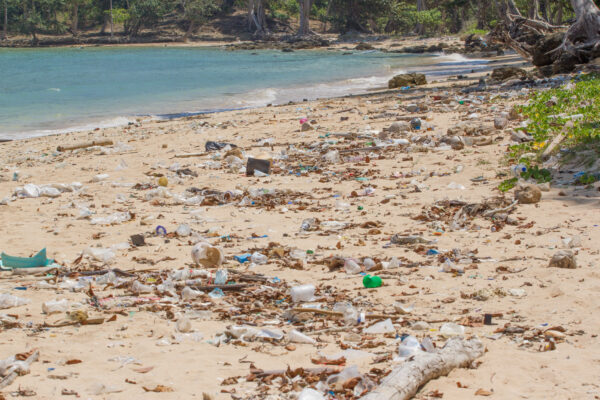
At the third United Nations Ocean Conference (UNOC), held in Nice from June 9 to 13, 2025, 95 countries signed an ambitious declaration to end plastic pollution. This call comes a few weeks before the resumption of negotiations in Geneva (INC-5.2) from August 5 to 14 and marks a diplomatic turning point in the fight against plastic waste.
I hesitated for several hours before publishing this article, based on a press release. Grand intentions are all well and good. Words are something, at least… but then what? And I could have stopped there, said that politicians always have big mouths and that would be that. But the reality is much more bitter.
I go for a run twice a week, one of those runs being a trail run in the forest. And my observation is that we can’t complain if we’re not setting a good example. Every time, I could run with a trash bag and pick up litter:
- cake packaging
- cans
- bottles of orange juice and soda
- Indescribable plastics
- Butts
- Cans of oil or something like that
And that’s not the fault of our politicians, but our own. So let’s back up these fine words with actions, all of us, individually. But let’s return to these intentions.
A five-point call for an ambitious plastics treaty
The “Nice Wake-Up Call” is organized around five major commitments:
- Binding global goal reduction in the production and consumption of primary plastic polymers.
- Phase-out the most problematic plastics and concerning chemicals, with the creation of a global list.
- Design Improvement plastic products to reduce their environmental and health impact.
- Financial mechanism solid and dedicated to the implementation of the treaty.
- Evolving text processingcapable of adapting to the evolution of scientific evidence and techniques.
Diplomatic and scientific context
- The resolution adopted in March 2022 by the United Nations Environment Assembly mandated the creation of an intergovernmental negotiating committee (INC) to develop a comprehensive treaty covering the entire life chain of plastics.
- Between 2022 and 2024, five sessions (Uruguay, France, Kenya, Canada, South Korea) led to the development of a working document. The INC-5.2 session is scheduled to take place in Geneva from August 5 to 14, 2025.
- The Nice Declaration aims to strengthen the position of high-ambition countries, particularly in the face of petrochemical lobbies, by supporting a goal of reducing plastic production at the source.
Opposition and issues
| Actor(s) | Position | Issues/Challenges |
|---|---|---|
| Plastic-producing countries (e.g., United States, Saudi Arabia) | They promote recycling and waste management, rejecting a production cap | Risk of deadlock, industrial interests |
| NGOs (CIEL, GAIA, Pew) | Strong support for a binding approach at all stages of the plastics cycle | Pressure on consensus in Geneva |
| Scientific community | Warning about the health, climate and biodiversity impacts, with a global recycling rate of only 9% | Scientific urgency to limit production |
Impact and added value for the reader
- Health and environmental issues : 460 million tonnes of plastic produced each year, with only 9% recycled; projections predict 1 billion tonnes in 2050.
- Concrete effects in the Mediterranean Plastic pollution alters marine habitats, directly threatens coastal biodiversity and potentially affects human health.
- Diplomatic calendar The Nice Declaration serves as a springboard for the Geneva discussions, which could lead to a final agreement by the end of the year. It illustrates the commitment of many states, including small island nations and several African countries.
Voices from Nice
- Agnès Pannier-RunacherFrench minister:
“Without ambiguity… we reiterate the urgent need to act, by acting at the root of the problem.” - Jean-Noël BarrotMinister of Foreign Affairs:
“The Mediterranean Sea… is suffocating under the weight of this pollution.” - Barbara Pompili, environmental ambassador:
“This is a powerful sign of hope.”
Outlook before Geneva
- The session INC-5.2 in Geneva (August 5–14, 2025) will be decisive: it will have to define the legal terms, control mechanisms, financing and reduction thresholds.
- The diplomatic mobilization, supported by civil society and scientists, seeks to overcome the blockages by establishing a qualified majority, rather than a strict consensus.
- States will also need to prepare to implement national measures: legislation on source reduction, design and traceability of plastics, and mandatory reporting.
The declaration signed in Nice is much more than a symbolic gesture: it strengthens the position of states in favor of an ambitious plastics treaty, one month before the Geneva negotiations. It highlights the urgent need for a binding, evolving text with adequate funding to address the growing challenges of plastic pollution worldwide.