

Far from any landmass, lost in the vastness of the South Pacific Ocean, lies a place as fascinating as it is mysterious: point nemoThis name, inspired by the famous captain of Jules Verne, designates the point in the ocean farthest from any land on our planet. But why was this point identified, precisely located, and above all, what is its significance for science and humanity?
To remember
- Point Nemo is the maritime pole of inaccessibility : the point in the ocean furthest from any land.
- It is located in the South Pacific, approximately 2,700 km from the nearest coasts.
- Its name comes from the Latin “nemo”, which means “person”, in reference to Jules Verne’s Captain Nemo, a symbol of isolation and maritime adventure.
What is point Nemo?
A precise definition
THE Stitch Nemo is officially called maritime hub of inaccessibilityBy definition, this is from the point in the ocean furthest from any landmass, and therefore of any human presence.
An extreme location
Located in the South Pacific, its precise coordinates are 48° 52’ 32’’ S, 123° 23’ 33’’ WThe nearest land is:
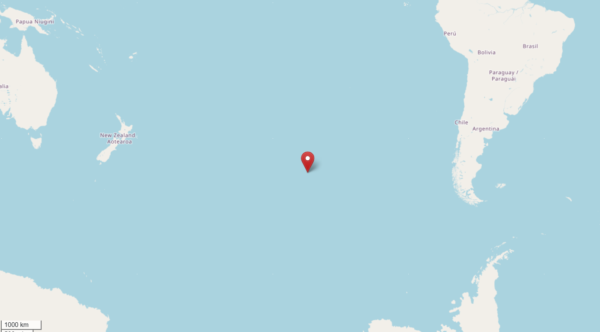
- Ducie Island (an uninhabited atoll in the South Pacific)
- The islet of Motu Nui (at the southwestern tip of Easter Island)
- Maher Island (in Antarctica)
Each of these lands is located at approximately 2,688 kilometers from Point Nemo. To give you an idea of its isolation, the nearest inhabited place is Easter Island, itself located more than 2,000 kilometers away.
In this location, the closest humans would be the astronauts on the International Space Station.whose orbit sometimes passes over point Nemo, at an altitude of approximately 400 km.
Why was this point identified and named?
A geodetic challenge
The identification of point Nemo is the result of a geodetic calculation created in 1992 by the Croatian-Canadian engineer Hrvoje LukatelaUsing computer simulations, he determined this point as the solution to the mathematical problem of largest empty circle : find the largest possible circle that contains no land.
A scientific and practical interest
A natural laboratory
Point Nemo and its surrounding region form a oceanic zone among the least biologically productive of the planet. Due to its remoteness and weak ocean currents, nutrients are scarce therelimiting the development of marine life. Scientists are therefore studying it the limits of life in extreme conditions, as well as the oceanic mechanisms and seabed of this still little-known region.
A space cemetery
One of the most practical advantages of the Nemo point is its use as space graveyardSpace agencies, such as NASA or ESA, are involved in this. to bring down satellites and spacecraft at the end of their life (like the International Space Station, which is slated for decommissioning). Indeed, its extreme isolation minimizes risks to human populations in the event of falling debris. Since the 1970s, more than 250 satellites are believed to have found their final resting place there.
A cultural and symbolic reference
Point Nemo also inspires the collective imagination. Its name, its isolation, and its mystery make it a subject of fascination for writers, filmmakers, and adventure enthusiasts. It is notably associated with… modern legends, such as the mysterious sound “The Bloop”, captured in 1997 in this region, or even to works of fiction like those of H.P. Lovecraft.
Conclusion: a point that transcends geography
Point Nemo is not just a simple geographical landmark. It is a symbol of absolute isolation.a place where science, technology, and imagination meet. Its identification and naming respond to certain issues scientific, practical and cultural, while reminding humanity of the vast, still unexplored expanses of our planet.