
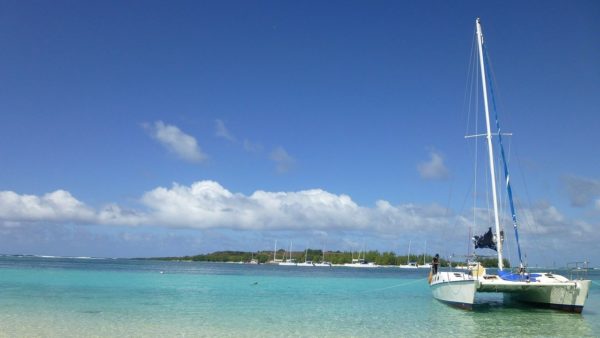
The multihull is increasingly popular among boaters looking for a boat for a long offshore cruise. At the same time—and this is less obvious—small catamarans are also an excellent choice for coastal sailing trips of a few days with the family.
While a multihull may not seem the obvious choice for family coastal cruising, some catamarans offer a completely different way to explore our coasts compared to monohull sailing. These small catamarans, under 9 meters, allow you to discover the sea and our coastlines in simplicity and close to nature. Below, you’ll find a small selection of used—and even new—catamarans that have accompanied, and continue to accompany, many boaters.
Which catamaran for coastal cruising?
Obviously, you wouldn’t choose the same catamaran for a transatlantic race with 8 people as you would for sailing along the Breton coast with a family of 4 or 5. I know we often see large 12-15m catamarans on our waters, but I don’t think they’re ideal. Sailing a large catamaran requires careful preparation to manage your stops. While you can anchor almost anywhere, you won’t have access to all the small fishing ports. The beam of a cruising catamaran requires plenty of space, and even in the largest marinas, in the middle of summer, the catwalks are quickly occupied.
It will be very difficult, after a certain hour, to find a space at the end of a ponton to moor your multihull. And I can tell you that if you want to shelter for the night in a port like Le Palais on Belle-Île or Port Tudy on Groix, you risk sleeping outside the harbor.
Finally, let’s be realistic and reasonable: do we really need a flybridge with a sunbathing area that can accommodate 10 people, and 4 double cabins with en-suite bathrooms for a week-long cruise? I think the ideal catamaran size for sailing with the family for a few weeks or weekends a year is under 10 meters. The boat remains manageable, and the maintenance budget is consistent with its use.
On a small multihull, cruising becomes raiding or coastal camping
Unlike large 14-meter catamarans, which offer much more volume than monohulls, small multihulls are the opposite. An 8-meter sailboat, like the Arcadia for example, can offer two closed double cabins, a closed bathroom, and a saloon that can comfortably accommodate 6 people. On an 8-meter catamaran, this is no longer the case.
Indeed, on a small habitable catamaran, the hulls are not tall or wide enough to install spacious cabins and heavy fittings. At the same time, the deck, to avoid spoiling the boat’s aesthetics, must remain low, if it exists at all. As a result, comfort and habitable volume are reduced.
What might seem like a disadvantage for cruising is, in fact, an advantage for others. Cruising on a small catamaran takes on a different meaning and mindset. Cruising becomes a raid, closer to nature. Cruising turns into coastal camping and fast sailing, closer to the elements.
As with small sailboats, sailing on a small multihull is not just a budgetary choice. It’s above all a choice of navigation and sailing practice.
Since the 1970s, the production of small habitable catamarans has not been very significant. Yet, some multihulls are references in their category. These multihulls occasionally appear on the used market. But we must admit that catamarans for sale in this size are not numerous. They will obviously require special attention to maintenance, which I won’t discuss here—I wouldn’t be qualified. Consult a professional.
Edel Cat 26, the coastal camping catamaran
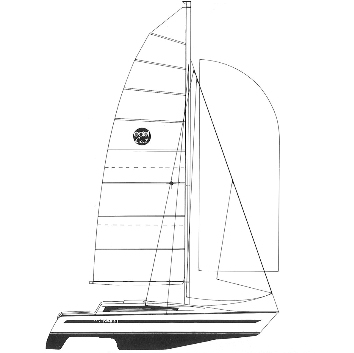
The Edel Cat 26 is the first catamaran offered by the Maurice Edel shipyard. For the occasion, he partnered with another renowned naval architect, Sylvestre Langevin. 70 units were produced between 1982 and 1985. The Edel Cat 26 perfectly fits the program described above. It is well-built, simple to sail, and safe at sea, if not particularly high-performance.
At the same time, the boat can be disassembled for trailer transport. The Edel Cat 26 offers 4 berths in the two hulls.
- Hull length: 8.30m
- Width: 4.10m
- Draft: 0.55m
- Berths: 4
- Weight: 750kg
Rackam 26, the sportiest
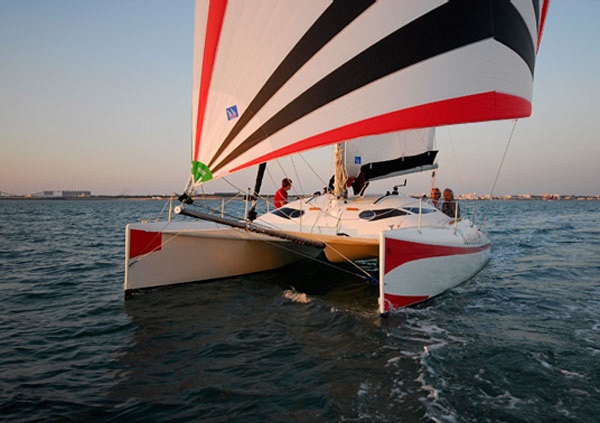
Here’s a name that will speak to speed enthusiasts. The Rackam 26 is a design by Erik Lerouge. The architect is known for his boats, which have their own following. This catamaran is undoubtedly one of the most high-performance in its size. It was built by the Breton shipyard Tregor Composites in 2009.
The boat was offered in several versions, more or less sporty. The most modest version features a deck with a saloon and four single berths. The Rackam 26 is a somewhat technical boat that quickly becomes addictive for the most sporty sailors.
- Hull length: 7.99m
- Width: 5.30m
- Draft: 0.70m
- Berths: 4
- Weight: 950kg
Punch 850, the catamaran according to Harlé
The Punch 850 is a Harlé design, usually built in epoxy plywood. It was in the mid-1980s that the architect became interested in catamarans. The Punch 8.50 is the smallest in a range that includes a 10m and a 12m. Designed in collaboration with Alain Mortain in 1988, the Punch 8.50 was Philippe Harlé’s personal boat for several years.
This catamaran is very seaworthy, lively, fast, and easy to handle. Some units have a deck with a roof, but it was originally designed without one. Each hull houses 2 berths, a chart table in one, and a galley area in the other.
- Hull length: 8.60m
- Width: 4.90m
- Draft: 0.66m
- Berths: 4
- Weight: 800kg
Edel Cat 28, the UFO
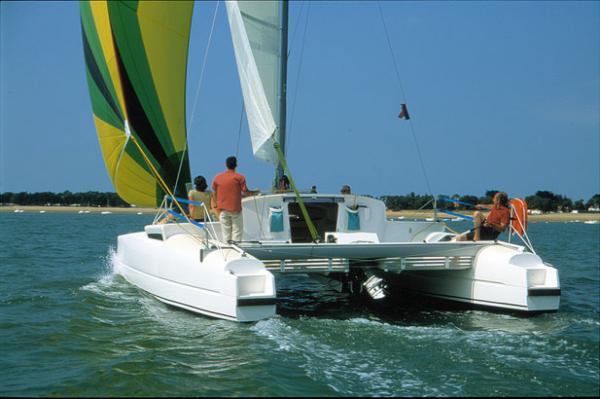
This catamaran is the most recent in the selection. The Edel Cat 28 was offered for a few years by the ADN shipyard and the new owners of the Edel Catamarans brand, Mr. Lelievre and Mr. Vigner. The latter attempted to revive the brand with unconventional catamarans. The Edel Cat 28 is the perfect multihull for comfortable raiding. It offered two double berths framing a saloon in the deck area. The boat performed well, and a few units were built.
- Hull length: 8.50m
- Width: 5.30m
- Draft: 0.60m
- Berths: 6
- Weight: 800kg
Maldive 32, the most habitable
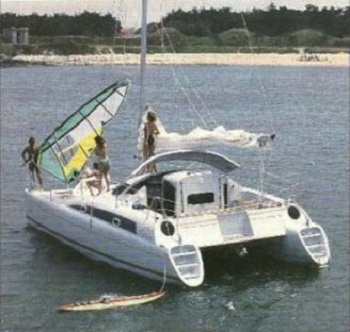
When talking about small habitable catamarans, the Maldive 32 inevitably comes to mind. This catamaran from the Fountaine Pajot shipyard, designed by the Joubert-Nivelt office, is a reference in its category. It was built from 1987 to 1993, with over 100 units produced. In its two 9-meter hulls, it offers two double cabins at the rear of each hull. At the same time, a bathroom is located in one of the hulls, and a spacious saloon is on the deck. The deck was equipped with a clever, removable roof that provides headroom at anchor.
At sea, the Maldive 32 is quite lively despite its weight and always remains safe.
- Hull length: 9.60m
- Width: 5.33m
- Draft: 0.90m
- Berths: 6
- Weight: 800kg
- Category: B
Wharram Tiki 26 and 8m
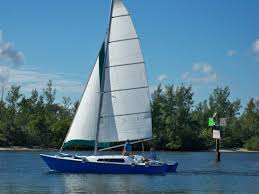
Here’s a catamaran that doesn’t leave anyone indifferent. British architect James Wharram made a name for himself in the 1950s with catamarans inspired by Polynesian boat concepts. He has become a (living) legend among many adventurers. The Tiki 8m is neither the fastest nor the most spacious, but it is a very seaworthy boat and can be disassembled for transport.
It comes in an amateur version (Tiki 26) and a production version (Tiki 8m).
- Hull length: 8.00m
- Width: 4.33m
- Draft: 0.55m
- Berths: 4
- Weight: 750kg
- Category: B
Aventura 28
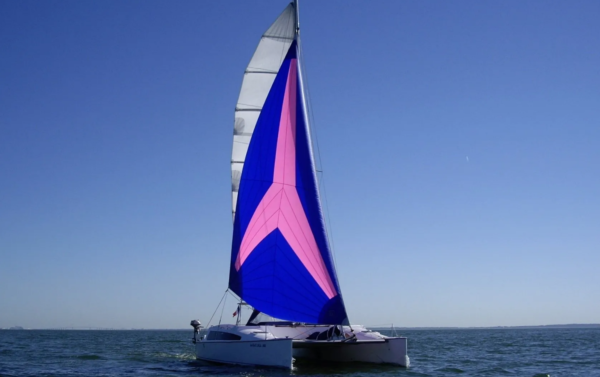
The Aventura 28 remained in the Aventura Catamarans shipyard’s catalog for 17 years. This multihull, designed by Jacques Fioleaum, had the merit of reviving the trend of simple and fast catamarans for comfortable coastal camping. The boat was offered with a canopy and an awning on the deck. Inside, the hulls are truly spacious and well-laid out. The Aventura 28 offers two double cabins and a real saloon.
- Hull length: 8.50m
- Width: 5.25m
- Draft: 0.68m
- Berths: 4
- Weight: 1400kg
- Category: B
There are other models of coastal camping or raiding catamarans. I don’t know them all. Many models are available as plans, for example. I also haven’t mentioned the English catamarans from the 1970s, Catalac, which, in my opinion, are far from the spirit of these lines. Feel free to add to this list in the comments.