
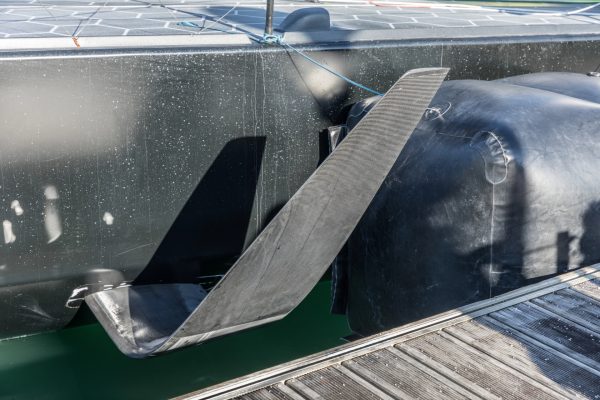
They fly above the water, defying the laws of physics and time. These sailboats impress by even being able to lift Ultim class trimarans and circumnavigate the globe. Foils, these underwater wings that lift the hulls of sailboats, have already transformed competitive sailing. But what if tomorrow they also changed the way you cruise? Between technological dreams and economic realities, the debate is on. What if we told you that everything is possible… but nothing is that simple?
To remember
- Theoretically, foils could be fitted to cruising sailboats, offering unparalleled performance.
- Naval architects temper this enthusiasm: cost, fragility and technical constraints hinder their adoption.
- Hybrid solutions, inspired by foils, could emerge to combine performance and accessibility.
- Cruising is also a matter of philosophy: what if the pleasure was precisely in taking your time?
Foils: the promise of a revolution at sea
On paper, everything seems possible. our sailboats are already capable of going faster than the wind Faster, smoother, and even more fuel-efficient cruising for motorboats. Some prototypes of cruising sailboats equipped with foils are already emerging, proving that the idea isn’t far-fetched. So, why not make this technology more widespread?
The downside: cost, complexity and constraints
“A foil is like an airplane underwater.”“That’s what one of them explains. And an airplane is expensive. Between the price of materials (carbon, titanium), increased maintenance, and the need for an ultra-reinforced boat structure, the bill quickly becomes hefty. Not to mention that the foils are…” fragile : a collision with an unidentified floating object (UFO) can seriously damage them, or even break them.
Another major problem: Foils are only effective above a certain speed.They need to be going fast to lift the boat. However, when cruising, you don’t always sail at full speed. As a result, their usefulness becomes limited, or even nonexistent, under certain conditions.

What if we found a compromise?
So, should we abandon the idea? Not necessarily. Some are already imagining… , appendages Inspired by foils but adapted to the constraints of cruising. For example:
- Of the retractable foils to navigate in “classic” mode when conditions are not ideal.
- Of the semi-supporting appendagesless efficient than pure foils, but more robust and more affordable.
- Of the allowing an existing boat to be equipped without tearing everything apart.
a good compromise between performance and practicality, without the major drawbacks of traditional foils.
Cruising is also a matter of philosophy
But ultimately, the real question may not be technical. Why do we go to sea? For some, it’s adventure, speed, adrenaline. For others, it’s calm, time stretching out, the pleasure of feeling the wind and the waves without rushing.
In this case, foils are not essential. Quite the contrary: they could even spoil some of the charm of the cruiseWho wants to spend their time monitoring high-tech gadgets when they could simply enjoy the scenery, a good book, or drinks with friends?
So, foils or no foils?
The answer is not binary. Foils have their place in the world of sailing, but their widespread adoption in cruising still seems a long way off. Between dream and reality, there is a sea to cross.
One thing is certain: innovation never stops. And while foils may seem reserved for an elite few today, who knows what tomorrow will bring? Perhaps a simplified, robust, and affordable version will emerge. In the meantime, one thing is certain: Sailing remains above all a story of passion, freedom… and common sense.