
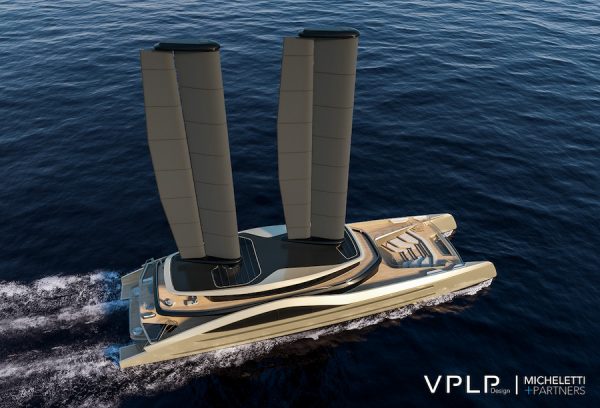
The VPLP firm has unveiled Tyrena, a 121-meter mega-catamaran powered by rigid wings. While we rarely discuss these mega-yachts, this luxury vessel is also a showcase of French expertise and perhaps a glimpse into the future of boating.
VPLP Design, the French architectural firm, is a pioneer in rigid wing propulsion. Its commitment to this technology dates back to the victory of the trimaran USA 17 in the 2010 America’s Cup. Since then, the technology has been tested and validated on concrete projects, such as the Canopée cargo ship (121 meters) or the MODX 70 yacht. With OceanWings®, VPLP offers an automated, retractable, and foldable solution, tailored for large yachts and compatible with hybrid propulsion (thermal or thermo-electric).
Quentin Lucet, associate naval architect at VPLP Design, emphasizes:
“For the past ten years, we have demonstrated that wing propulsion is a reliable solution. What we need now is the first visionary client to launch this revolution in superyachting.”
A sustainable alternative to traditional mega-yachts
Comparable performance, reduced footprint
Tyrena positions itself as a response to the environmental challenges of the industry. Thanks to its OceanWings® rigid wings, the catamaran can:
- Reduce fuel consumption by 40% in hybrid mode.
- Achieve a range of 6,400 nautical miles (compared to 3,800 for a conventional mega-yacht), thanks to wind assistance.
- Sail at 12 knots under sail alone, with winds of 17 knots or more, without relying on fossil fuels.
A multihull more efficient than a monohull
VPLP Design is betting on the multihull as an alternative to monohull mega-yachts. At equivalent size, a 76-meter catamaran offers as much space as a 130-meter monohull, with major hydrodynamic advantages:
- Thinner hulls → reduced drag.
- Increased stability → optimal comfort.
- Modular layouts → flexibility for owners.
Design serving experience and aesthetics
A Franco-Italian collaboration
- VPLP Design: naval architecture, performance, and exterior design.
- Micheletti & Partners: exterior design, interior layout, and general arrangement.
This synergy combines French precision (clean lines, performance) and Italian elegance (automotive heritage and Mediterranean yachting).
Yann Prummel, exterior designer at VPLP, describes:
“Tyrena’s sleek silhouette blends natural elegance with aerodynamic performance. The screen-printed solar panels, the roof’s skylights, and the hull glazing create a dynamic aesthetic, like a frozen wave.”
Architecture inspired by the Mediterranean
Tyrena adopts the codes of Mediterranean living:
- Protected spaces (atrium, peristyle) for privacy.
- Openings to the outside (loggias, belvederes) for contemplation.
- Cascading terraces and a rear mobile platform (bridge between hulls) for continuity between the sea and living spaces.
A rapidly evolving yachting market
The Monaco Yacht Show 2026, a showcase of trends
The show, held from September 23 to 26, 2026 at Port Hercule, confirms several trends:
- Growing demand for large yachts (up to 100 meters), customized, and technologically advanced.
- Scarcity of new models → wait times until 2028-2029 in shipyards.
- Focus on sustainability: electrification, energy management, and eco-friendly solutions (such as OceanWings®) are at the heart of innovations.
The catamaran, a booming architecture
- Market share: sailing catamarans represent 40% of new pleasure boats in 2026, with sustained growth expected until 2035.
- Advantages: energy efficiency, superior living space (+50% compared to a monohull), and access to shallow areas (lagoons, bays).
Tyrena by the numbers
| Feature | Value |
|---|---|
| Length | 76 meters |
| Type | Wind-powered mega-catamaran |
| Propulsion | OceanWings® (rigid wings) |
| Fuel savings (hybrid mode) | Up to 40% |
| Range | 3,800 to 6,400 nautical miles |
| Cruising speed (sail only) | 12 knots (from 17 knots of wind) |
What’s next?
Tyrena embodies a break from the gigantism of traditional mega-yachts. Its success will depend on the emergence of a pioneering client, ready to adopt a more sustainable approach without sacrificing luxury or performance. With a yachting market increasingly focused on technological innovation and carbon footprint reduction, this concept could well mark a turning point.