
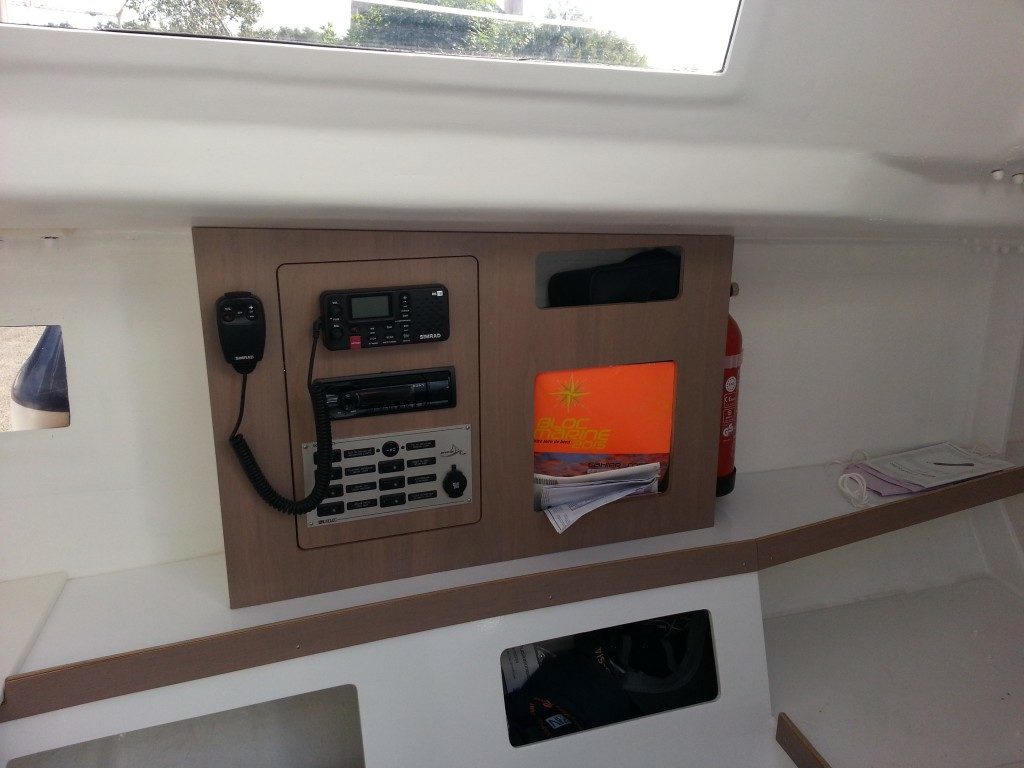
VHF radio is an essential communication tool on board a sailboat. Choosing between a fixed or portable VHF radio depends on your sailing plans.
Whatever the boat, the program, and…the mobile phone we own, it is imperative to have a fixed or portable VHF radio See mandatory. This communication system is the preferred means of communicating with rescue services, other boats, to get weather and safety information at sea, and with harbor master’s offices.
There are two types of solutionsfixed VHF radios and portable VHF radios. The choice between the two will depend of the navigation program. Since January 1, 2017, A fixed VHF radio is mandatory for semi-offshore navigation, that is, beyond 6 nautical miles. At the same time, boats navigating in “Offshore” zone (more than 60 miles from shelter) must supplement this equipment with a Waterproof portable VHF and one EPIRB distress beacon.
In any case, beyond the VHF regulations. For summer sailing, whether coastal or semi-offshore, which VHF radio should you choose depending on your plans?
The advantages of a portable VHF radio
To start, A portable VHF radio is very useful on small sailboats.You keep them with you in the cockpit, within easy reach in case of emergency. These handheld VHF radios are very often waterproof (up to IPX7), or even buoyant. At the same time, they don’t draw power from the boat’s electrical system, which is important. Indeed, their battery life is now very good. Their range is approximately 3 to 9 nautical miles at most. And some low-cost portable VHF models They do the job very well.
This range may be more than sufficient for those cruising along the coast for several days in certain regions (Brittany, Charentes, etc.). Finally, they do not require any certification to use. The new models offer very interesting options such as DSC/ASN(Digital Selective Calling)* integrated and the GPS, a flashlight,…

But a portable VHF radio will also be very useful as a complement to a fixed VHF radio.Indeed, if you regularly sail solo or with a family crew, you need to be reactive in certain situations. This starts with being able to communicate quickly.
On used sailboats with a tiller, you won’t be able to install a fixed VHF radio externally. In this case, it’s practical to have a handheld VHF radio so you don’t have to go down to the chart table to call a boat approaching from your direction or the harbor master’s office when the channel is full of boats. The other solution is to have a fixed VHF radio paired with two portable transmitters.
The advantages of a fixed VHF radio
The fixed VHF radio, being more powerful, offers greater autonomy as it is connected to the 12V circuit. Its range is sufficient to cover the entire coastline without any issues (25W, or about forty nautical miles). Unlike handheld VHF radios, which lack DSC (Digital Selective Calling), these VHF radios require a CRR (Swiss Radio Operator’s Certificate) or, failing that, a boating license. At the same time, it will be mandatory to obtain a license and an MMSI number.

Fixed VHF radios are now all equipped with DSC/ASN (mandatory since 2007, but older models are still accepted). Some fixed VHF radios also offer this service. AIS System (Automatic Authentication System(which allows a boat’s position and speed to be determined when equipped for transmission). The advantage The advantage of these VHF radios is the ability to connect them to a GPS chartplotter, a PC, etc., and to use them as a receiver/transmitter of a wide range of information. (position of boats on map,…). Some fixed VHF models have a remote handset allowing you to have your VHF in the cockpit.
And you, what choice did you make between a fixed VHF and a portable VHF?
*DSC (Digital Selective Calling) or
DSC (Digital Selective Calling) is part of the international system of
GMDSS safety and distress. By pressing
A “Distress” button on your VHF radio, connected to a GPS, sends
automatically the date, time, position and number
vessel identification (MMSI) on channel 70.