
In all civilizations, throughout the history of the world, the sea and oceans have both fascinated and terrified men and women alike. Between sea monsters and gods whose will must not be defied, the sea inspired fear. Today, I invite you to revisit the main gods of the sea and oceans from antiquity.
It’s true that the sea and oceans have always fascinated men and women. Their vastness, power, and mystery have given rise to myths and legends across all civilizations. Peoples often worshipped marine deities to explain maritime phenomena and protect sailors. I invite you to rediscover these sea gods across different cultures, each with their own unique characteristics and stories.
Poseidon, the Greek god

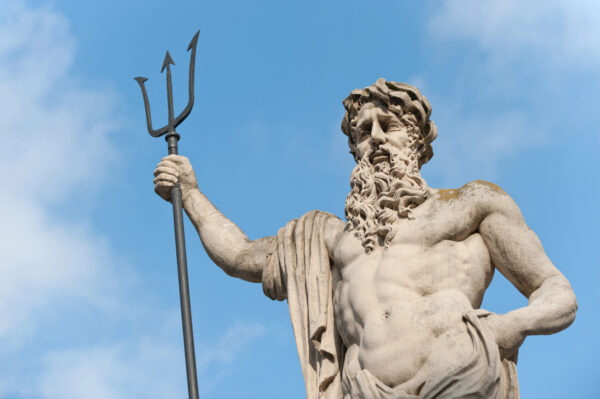
Poseidon, brother of Zeus and Hades, rules over the seas and oceans. With his trident, he controls storms and earthquakes. The ancient Greeks prayed to him for the safety of their maritime journeys. Poseidon is often depicted as a majestic, bearded man riding the waves on a chariot pulled by sea horses. Myths recount his tumultuous love affairs and quarrels with other gods, reflecting the capricious nature of the sea.
Neptune, the Roman god

Neptune, the Roman equivalent of Poseidon, plays a similar role in Roman mythology. Often associated with horses, he is honored during the Neptunalia, a festival celebrated in July to ask for favorable and abundant waters. Neptune also wields a trident, a symbol of his power, and governs not only the seas but also freshwater and springs. His image as a majestic and imposing god embodies the power of the aquatic element in the Roman imagination.
Tangaroa, the Polynesian god

In Polynesian mythology, Tangaroa is the god of the sea, fish, and sailors. He is one of the main deities in the Polynesian pantheon and plays a crucial role in the creation of the world. Tangaroa is often invoked for the protection of fishermen and to ensure bountiful catches. His influence extends across the many islands of the Pacific, where each local culture attributes specific legends and rites to him.
Njord, the Scandinavian god

Njord, in Norse mythology, is the god of the sea, winds, and wealth. He belongs to the Vanir, a group of deities associated with nature and fertility. Njord is worshipped by Viking sailors seeking to calm the tumultuous seas during their expeditions. He is also known for bringing prosperity, symbolized by the treasures he retrieves from the marine depths. Njord resides in Nóatún, a place by the sea, where he embodies the connection between man and the ocean.
Ryujin, the Japanese god

Ryujin, the dragon king of the sea, is an important figure in Japanese mythology. He resides in a magnificent underwater palace made of coral and crystal. Ryujin controls the tides with magical jewels and can take the form of a dragon or an old man. Fishermen and sailors offer prayers to him for safe journeys and successful catches. Ryujin is also associated with stories of courage and wisdom, illustrating the depth and complexity of the waters he rules.
Lir, the Celtic god

Lir, or Ler, is a Celtic deity of the seas. He is the father of Manannan mac Lir, another important sea god. Lir is often mentioned in Irish myths, where he symbolizes the vastness and mystery of the ocean. Celtic legends describe him as a powerful being, master of the waves and sea creatures. Lir embodies the raw power of the sea, but also its beauty and unexplored wealth.
Yam, the Phoenician god
Yam, in Phoenician mythology, is the god of the sea and rivers. Often depicted as a dragon or sea serpent, Yam is in perpetual conflict with Baal, the god of storms and fertility. This struggle symbolizes the eternal battle between order and chaos. The Phoenicians, great navigators of antiquity, honored Yam to appease his wrath and secure their commercial voyages across the Mediterranean.
Nun, the Egyptian god

Nun, in Egyptian mythology, represents the primordial waters of chaos from which all creation emerges. He is one of the oldest gods in the Egyptian pantheon and symbolizes the infinite ocean surrounding the world. Nun does not have a fixed human form, often depicted as a vast expanse of water or a dark, amorphous figure. He embodies the idea of pure potential and renewal, central themes in Egyptian cosmology.
Through the ages and civilizations, the gods of the sea and oceans have embodied the power, beauty, and mysteries of the vast expanses of water. Whether Greek, Roman, Polynesian, Scandinavian, Japanese, Celtic, Phoenician, or Egyptian, these gods reflect humanity’s deep connection with the seas. By honoring these deities, ancient peoples sought to understand and tame the untamed forces of nature—a quest that still resonates in our modern world.