
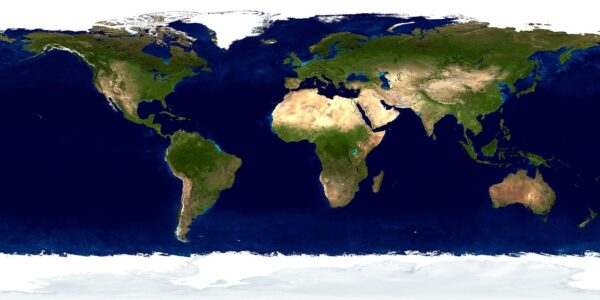
We all know that there are many more seas than oceans, and that they are smaller. But how can we differentiate a sea from an ocean? And more concretely, what characterizes seas, and what characterizes oceans? In short, I invite you to understand the difference between a sea and an ocean.
When we go to the sea, we are not very precise about our destination. Are we talking about the English Channel, the Mediterranean, or the Atlantic Ocean? When we set sail or simply navigate near the coast, we tend to say we are “going to sea.” We don’t ask ourselves too much whether we are sailing on an ocean or a sea. We just know.
But do we really know the difference between a sea and an ocean? What makes a saltwater body a sea or a vast ocean? We will answer this question and realize that, far from being a scientific study, the answer is quite simple and unexpected. We will start by defining oceans, then seas, while giving a small geography lesson.
What is an ocean?
First, let’s revisit the definition of an ocean. What are the characteristics of oceans? If we refer to definitions from Le Petit Robert or Larousse, they describe it as a “vast expanse of saltwater that covers a large part of the Earth’s surface.” Okay, so we already knew that. But more concretely?
First, the question of size is obvious. Indeed, an ocean is much larger than a sea. For example, the Mediterranean Sea is much smaller than the Indian Ocean or the Atlantic. And the smallest ocean, the Arctic, covers 14.09 million km², compared to 3.6 million km² for the largest sea, the Arabian Sea. But when we dig a little deeper (not in depth, but in our reasoning), we will highlight another characteristic:
One of the characteristics of an ocean, besides its size, is that it borders two continents. Indeed, no matter which ocean you look at, they all border two continents, which is not the case for all seas. However, there are 3 exceptions to this rule. Three seas border two continents:
- The Mediterranean Sea
- The Black Sea
- The Red Sea
But they cannot be considered as “vast expanses” of water.
So, we have the geographical definition of an ocean…
But what if I told you that the definition of an ocean has nothing to do with geography? Indeed, the definition of an ocean is not geographical but simply conventional. In fact, geographers agreed to declare that a particular body of water was an ocean or not. And that’s how we ended up with 5 oceans.
What are the 5 oceans of the planet?
Since it is humans, by convention, who decided what an ocean is, they identified 5.
- The Pacific Ocean, which borders Asia, Oceania, and the Americas
- The Atlantic Ocean, which borders Europe, Africa, and the Americas
- The Indian Ocean, which borders Asia and Africa
- The Arctic Ocean, which borders Europe and the Americas
- The Southern Ocean, which borders the Antarctic continent, the Americas, and Oceania

What characterizes a sea?
Now that we have seen what an ocean is, it is easier to define a sea and revisit the general characteristics of seas. A sea is everything that an ocean is not. It is smaller, and, with a few exceptions, it does not border two continents. The depth of seas is also less significant. Oceans win in this regard with their oceanic trenches.
But you should know that seas have other specific characteristics:
- They are saltier than oceans. Indeed, they are more subject to evaporation, so the salt content is higher, and as a result, the salinity of oceans is lower. However, there is one exception: the Baltic Sea, which has very low salinity.
- They are richer in biodiversity. For example, the Mediterranean Sea is home to more than 10% of the planet’s marine species, while it represents less than 1% of the ocean’s surface.
What are the largest seas?
The largest seas are as follows:
- The Arabian Sea with 3.8 million km²
- The China Sea with 3.5 million km²
- The Sargasso Sea with 3.5 million km²
- The Mediterranean Sea with 2.9 million km²
- The Weddell Sea with 2.8 million km²
The different types of seas
To go further, you should know that there are different types of seas. Indeed, between the Caspian Sea, the Red Sea, or the China Sea, there are some differences. Oceanographers refer to marginal seas and enclosed seas. What does this mean?
- A marginal sea borders an ocean and is delimited by a peninsula, islands, or shallow waters, for example. This is the case for the English Channel, the Caribbean Sea, or the Sea of Japan.
- An enclosed sea is surrounded by emerged land and is connected to the ocean by a strait, like the Mediterranean.
But there are two other types of seas:
- Totally enclosed seas like the Caspian Sea, the Dead Sea, or the Aral Sea.
- Seas that are not connected to any ocean, such as the Aegean Sea or the Sea of Azov.
And there you have it! I hope this article has taught you a few new things. For me, it certainly did while researching for this piece. In any case, respect the sea, its fauna, and its flora. Already, climate change is affecting ocean currents and water temperatures, leading to more severe natural disasters than before. And will the landscapes we see today be the same tomorrow? We can already doubt it.