

Think you’ve mastered your boat’s sail trim? Think again. Even experienced sailors sometimes fall into technical traps that, instead of optimizing their performance, hold them back without them even realizing it. What if your “good instincts” were actually mistakes that cost you speed, power, and precision? Discover the 3 most insidious traps—and, more importantly, how to avoid them to sail smarter.
To remember
⚡ Too much trim = less power: a sail that is too flat loses lift.
⚡ The backstay, that forgotten adjustment that can change everything in strong winds.
⚡ True wind ≠ apparent wind: confusing the two is like sailing blind.
Over-sheeting: the flat sail, enemy of lift

This first error concerns mainsail adjustment and the foresail.
The trap You will tighten the sheets completely to “hold the wind” and avoid shelter. The result? A sail that’s too flat, without camber, and no longer generates enough lift. The sail loses power, your boat moves less, slides sideways, and you lose up to 20% of your speed.
Why isn’t it working?
- A sail is like an airplane wing: its curvature is essential to create lift. Over-trimming it is like flattening the wing of an airplane in flight.
- Airflow becomes turbulent instead of laminar, which increases drag and reduces propulsion.
- When sailing downwind, a sail that is sheeted in too tightly can even cause vibrations (the “pumping” phenomenon), which prematurely wears out the fabric.
The technical solution
- Turn off the listening devices until the sail takes on a slightly concave shape (visible to drainage channels on sailing).
- Observe the pennons If they’re dancing chaotically, your sail is sheeted in too tightly. If they’re stable and parallel to the sail, that’s a good sign. Look at our pennon adjustment guide.
- Golden rule : “A sail that trembles is a sail that isn’t working.”
Forgetting to adjust the backstay when the wind picks up: the mast bends, performance collapses
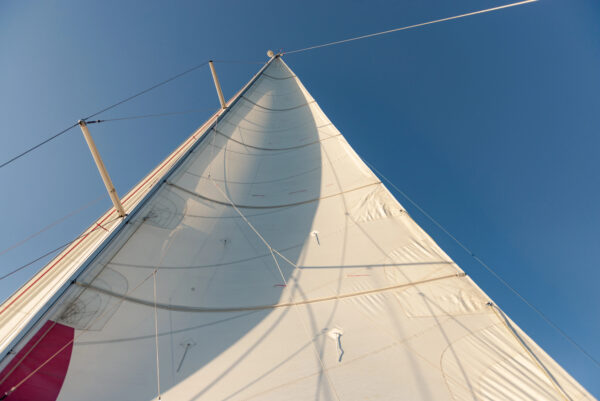
The trap The wind is picking up, you’re concentrating on the listening… but you’re forgetting the backstay. The result: the mast bends excessively, the mainsail deforms, and your boat loses efficiency.
Why isn’t it working?
- THE backstay controls the vertical tension of the mastIf it is too loose, the mast will arrow under the effect of the wind, which:
- Shift the mainsail’s tensioning point forwards, reducing its power.
- Increases the accommodation, which increases lateral drag.
- Unbalance the boat, especially in strong winds.
- Conversely, a backstay too tense can break the mast or damage the shrouds.
The technical solution
- With light to moderate winds : a slightly loose backstay allows a natural camber of the mast, optimizing the shape of the mainsail.
- In strong wind : tighten the backstay To reduce mast sweep and maintain a flatter, more stable sail, see venting air in the upper sections.
- Pro tip : Use a blood pressure monitor for precise adjustment. In the absence of this tool, observe the mast curvature : it must be gradual, without a sudden break.
Confusing true wind with apparent wind: sailing blind and losing VMG
The trap You adjust your sails according to the real wind (the one measured at the fixed anemometer)… whereas it is the apparent wind (the one you feel on board) which determines the strength and angle of the wind on your sails. Result: you’re heading too far upwind, losing power. VMG (Velocity Made Good), and waste energy.
Why isn’t it working?
- THE apparent wind = real wind + wind generated by your speedIf you are sailing at 6 knots with a true wind of 10 knots, the apparent wind can reach 12-14 knots depending on your appearance.
- Concrete example :
- Downwind speed (tailwind) The apparent wind is weaker than the true wind. If you adjust your sails for the true wind, they will be too closedand you will lose speed.
- Close-hauled speed (headwind) The apparent wind is stronger than the actual wind. Sails that are too open will make you fell and lose ground.
- Consequence : YOU don’t get the most out of your speed fleeceand your route becomes less efficient.
The technical solution
- Use an apparent wind anemometer (wind vane + airspeed indicator) to adjust your settings in real time.
- Practical rule :
- If the apparent wind increase, border slightly to maintain the optimal angle.
- If the apparent wind decreases, let go the sheets to avoid closing the sail too much.
- Observe the waves and the pennants : they will give you clues about the direction and strength of the apparent wind.
Conclusion
These three errors — Over-trimming, neglecting the backstay, confusing the winds — are among the most common mistakes made by boaters, including the most experienced. Yet, they are easily corrected once understoodSo, the next time you’re on the water, take 2 minutes to check these settings… and gain in speed, comfort and precision!
And you, what is the setup error that cost you the most time (or races)?