
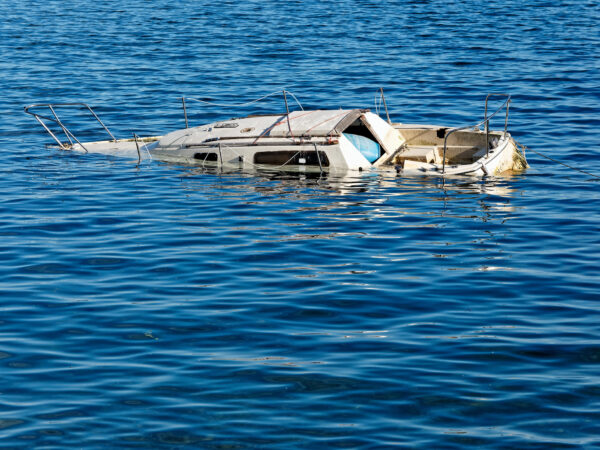
The bilge pump is the safety instrument we tend to forget. And the fact is, the goal is for it to be forgotten. But precisely because we forget it, we take risks. Here, I suggest we revisit the different types of bilge pumps, the regulations, and a list of the most well-known and recognized models.
When I say a bilge pump can be forgotten, I know what I’m talking about. Twenty-five years ago, I was sailing ahead of my father on our Kelt 7.60. We had a water ingress near the centerboard trunk. When we tried to start the bilge pump… nothing. No reaction. The water was rising, and we didn’t even have a manual bilge pump—just a hand pump, which was insufficient. Fortunately, we were in the Bay of Quiberon and managed to reach Port Haliguen very quickly.
In short, often relegated to the background when equipping a boat, the bilge pump is nonetheless a mandatory maritime safety element in many cases. Manual or electric, automatic or backup, it must be adapted to the type of vessel and its navigation program to handle water ingress effectively.
Regulations: What does the law say about bilge pumps?
In France, the drainage equipment on board pleasure vessels is governed by the Division 240 regulations, which pertain to safety at sea and mandatory equipment. Article 240-2.15 specifies the obligations in this regard, depending on the size of the boat and its navigation program.
The obligation of a drainage system on board
In accordance with Article 240-2.15, every pleasure vessel must be equipped with a manual drainage system, whether fixed or mobile. The choice of this device depends, in particular, on the boat’s design category and its navigation area.
- For boats under 6 meters, manual equipment is generally considered sufficient. This can be as simple as a bailer or a manual bilge pump.
- For vessels over 6 meters, regulations require the installation of a fixed bilge pump. This automatic device must be supplemented by a manual means to ensure drainage in case the main system fails.
This regulation aims to ensure the safety of boaters by guaranteeing the crew’s ability to remove water in all circumstances.
The different types of bilge pumps
Manual bilge pumps: reliability and autonomy

Independent of any power source, manual bilge pumps operate via a lever. They are:
- Reliable in all circumstances
- Mandatory as a backup on all types of vessels
- Inexpensive and simple to install
Their flow rate varies depending on the model but remains limited by the physical effort of the boater. However, they are essential in the event of an electrical failure.
Electric bilge pumps: efficiency and comfort

Electric bilge pumps are the most common on modern boats. Connected to the boat’s 12V circuit, they allow for the rapid removal of large volumes of water.
- Manual operation via switch
- Flow rate that can reach several thousand liters per hour
- Must be installed with a dedicated fuse and a control switch
However, they require regular maintenance (filter, priming) and are inoperative in the event of a power outage.
Automatic bilge pumps: responsiveness and safety
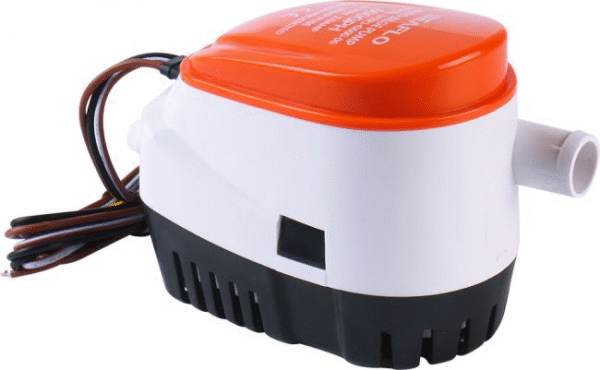
Some electric models are equipped with integrated level sensors. The pump then starts automatically as soon as the water reaches a defined threshold.
- Ideal for boats left at anchor or in port
- Reduces the risk of passive filling of the bilge
- Requires a reliable battery or a backup solar panel
Warning: These systems must be tested regularly to ensure they are working properly.
What flow rate for your bilge pump?
The flow rate of a bilge pump is expressed in liters per hour (L/h) or gallons per hour (GPH). To choose the right one, consider:
- The size of the boat: the larger it is, the greater the bilge volume
- Usage: coastal cruising, offshore, fishing, prolonged anchoring…
- The discharge head: vertical distance between the bilge and the outlet outside
| Boat type | Recommended minimum flow rate |
|---|---|
| Sailboat 6 to 8 m | 2,000 to 3,000 L/h |
| Sailboat or boat 8 to 10 m | 3,000 to 5,000 L/h |
| Motorboat 10-12 m | 5,000 to 8,000 L/h |
| Offshore navigation | + 8,000 L/h + powerful manual pump |
Some manufacturers indicate “theoretical” flow rates, without accounting for head losses (hose length, bends, height). Therefore, a safety margin should be planned.
Best practices on board
Dual system: manual and electric
Even if an electric pump is installed, a manual pump remains essential. In the event of an electrical failure, rough seas, or an emergency, only a manual system will allow for rapid water removal.
Always useful accessories
Experienced boaters know: you should never rely solely on an electric pump. On board, it is highly recommended—and in fact, mandatory—to always have:
- A bailer: simple and quick
- A bucket: for manual transfer
- A bung: to plug a hull breach or water ingress
These accessories, when properly stored and accessible, often save the day in an emergency.
Main bilge pump brands and models for boats
Here is a selection of brands recognized by boaters and marine professionals:
| Brand | Flagship models | Type | Max. flow rate |
|---|---|---|---|
| Rule | Rule-Mate, 500GPH, 2000GPH | Auto. electric | Up to 7,500 L/h |
| Whale | Gusher Titan, Supersub, Orca | Manual/Electric | 2,000 to 8,000 L/h |
| Attwood | Sahara, Tsunami | Auto. electric | 2,500 to 4,000 L/h |
| Osculati | 12V Auto/Manual | Entry-level | 1,500 to 3,000 L/h |
| Seaflo | Seaflo 750/2000 | Electric | Up to 7,500 L/h |
For manual pumps, Whale remains a benchmark. For automatic pumps, Rule and Seaflo offer a good quality-to-price ratio.
Choosing a bilge pump is not a minor detail. It is a safety choice that must be based on objective criteria: type of navigation, boat size, required flow rate, and system redundancy. Well-maintained, regularly tested, and accompanied by the right accessories (bailer, bucket, bung), a bilge pump is a discreet but essential ally for any trip at sea.