
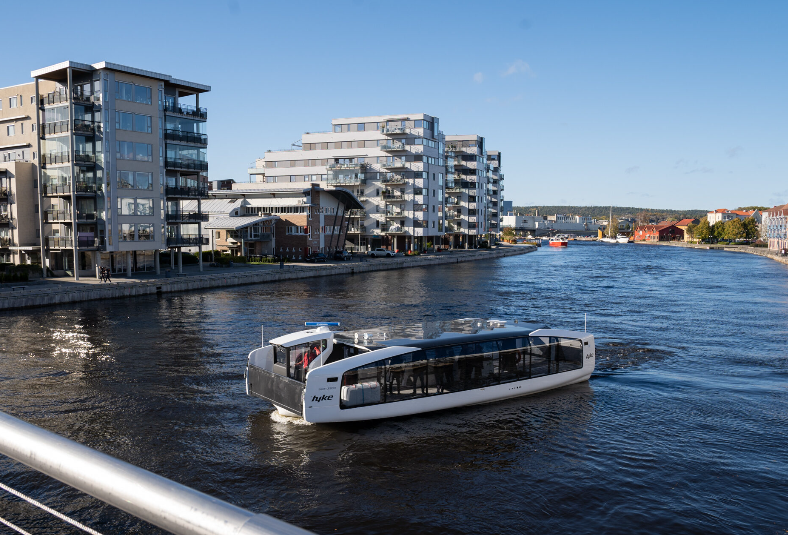
As traffic jams choke European cities and road infrastructure reaches its limits, Norway is leading the way with an innovative solution: the Hyke F-15 electric ferry. After 14 months of intensive operation in Fredrikstad’s public transport network, this 50-passenger vessel has proven it can not only outperform diesel ferries but also provide a more cost-effective and sustainable alternative to building bridges or tunnels. This breakthrough could inspire other cities across Europe and beyond.
An Unequivocal Success: Efficiency, Savings, and Satisfaction
Between April 2024 and July 2025, the Hyke F-15 Shuttle operated a daily route between Bekkhus and Vaterland, covering a 225-meter stretch across the Glomma River. With an average crossing time of just two minutes, the ferry transported over 41,000 passengers, seamlessly integrating into Fredrikstad’s public transport system.
Key results of the project:
- Energy consumption 8 times lower than diesel ferries, using just 10 kWh per hour—equivalent to five household hair dryers.
- Passenger satisfaction score of 4.72/5, with a 100% loyalty rate.
- No safety incidents reported during the 14-month operation.
- Extremely low operational costs, thanks to a 196 kWh battery providing 10 hours of autonomy per charge.
“This project shows that our urban waterways can be used far more efficiently. Instead of building expensive, time-consuming tunnels or bridges, electric ferries can be quickly deployed to transport large numbers of passengers.”
— Halvor Vislie, CEO of Hyke
Why Fredrikstad? A Pioneer in Sustainable Mobility
Fredrikstad, Norway’s fifth-largest city, is recognized for its commitment to sustainable transport. The municipality has implemented a Sustainable Urban Mobility Plan (SUMP) aimed at reducing car dependency (currently 59% of trips) in favor of public transport, cycling, and innovative solutions like electric ferries. The Hyke project aligns with this vision and is supported by the EU’s Horizon Europe SUM (Seamless Urban Mobility) program, which helps cities transition to cleaner, smarter transport systems.
“Fredrikstad demonstrates a willingness to use new knowledge and methods to promote urban development. The free city ferry service is an innovative step to increase the popularity of public transport.”
— Norwegian Ministry of Local Government and Modernization
A Replicable Model for Europe?
The success of the Hyke F-15 is part of a broader European trend where electric ferries are gaining traction. According to the European Environment Agency, the transport sector accounts for 27% of the EU’s greenhouse gas emissions, with 72% coming from road transport. Electric ferries like Hyke’s could play a key role in decarbonizing urban mobility.
Inspiring examples:
- Denmark: The E-ferry Ellen, launched in 2019, carries passengers and vehicles over 40 km on a 4.3 MWh battery, avoiding 2,000 tons of CO₂ emissions per year.
- Netherlands & Norway: Multiple electric ferries are already in service in urban areas and archipelagos, gradually replacing diesel vessels.
- France: In Paris, projects like Sea Bubbles and electric shuttles on the Seine highlight growing interest in sustainable waterway mobility.
“Electric ferries are not just an alternative to bridges or tunnels—they’re a way to reduce road congestion and urban pollution.”
— EU Sustainable Mobility Report
Challenges Ahead
Despite these advances, several hurdles remain:
- Charging infrastructure: Cities must invest in fast, ferry-compatible charging stations to support widespread adoption.
- Upfront costs: While operational expenses are low, the initial investment for electric ferries remains high, though EU subsidies can help offset this.
- Public acceptance: Encouraging users to switch from cars to water-based transport requires effective communication and seamless integration with existing networks.
Hyke F-15: Technical Features and Innovations
| Feature | Detail |
|---|---|
| Length | 14.9 m |
| Width | 5.7 m |
| Passenger capacity | 50 people |
| Weight | ~11 tons |
| Battery | 196 kWh |
| Energy consumption | 10 kWh/h |
| Range | ~10 hours per charge |
| Charging | 150 kW DC / 22 kW AC |
Designed for short, frequent urban trips, the ferry’s lightweight architecture and 100% electric propulsion make it a zero-emission, quiet, and city-friendly solution.
Next Steps: Toward Widespread Adoption?
Fredrikstad’s project, backed by the EU and local government, could serve as a blueprint for other European cities. Hyke is already developing larger, more autonomous ferry models, while programs like Horizon Europe continue to fund similar initiatives.
“By 2030, we hope at least 15 European cities will have adopted electric waterway mobility solutions inspired by projects like Fredrikstad’s.”
— SUM Project (Horizon Europe)
Conclusion: A Viable Alternative to Road Infrastructure
The Hyke F-15 proves that urban electric ferries are not just a future concept—they’re an operational, cost-effective reality today. With minimal energy costs, high passenger satisfaction, and a reduced environmental footprint, this model could become a cornerstone of sustainable public transport in Europe.
The question now is whether other cities will follow Fredrikstad’s lead and harness their waterways to ease road congestion and green their transport systems.