
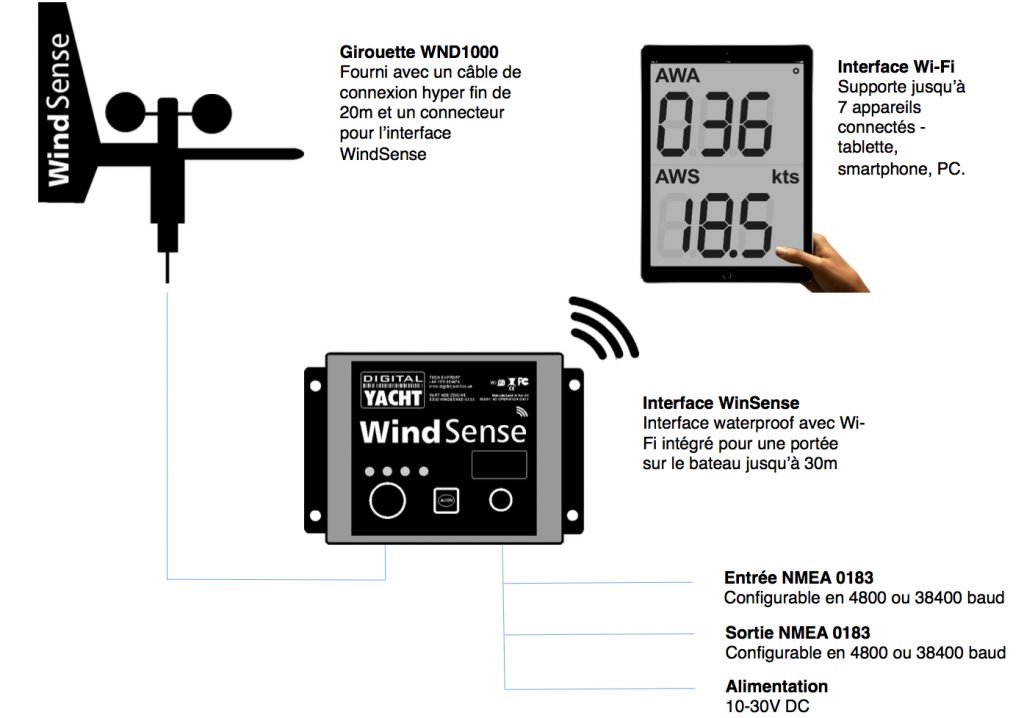
WindSense, from Digital Yacht, is a connected wind vane anemometer. It allows tablets, smartphones and PCs to accurately display wind speed and direction.
THE WindSense is equipped with wind vane anemometer with a 20m cable that connects to theDigital Yacht interfaceThis interface will thus provide the data through a Wi-Fi and/or NMEA0183 connection to different devices such as a PC, a tablet, see a smartphone, via a applicationThe data is compatible with a wide variety of mobile applications and software. The integrated Wi-Fi system typically allows a range of up to 30 m.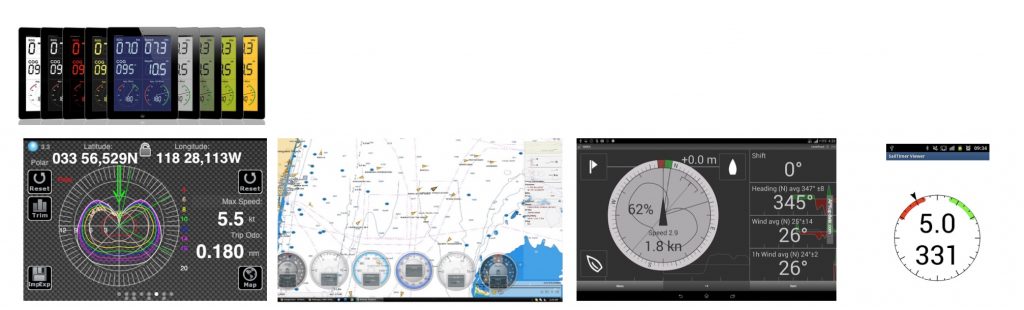
The price (595 euros on the Digital Yacht website) is in line with market prices and compares favorably with conventional anemometers.
WindSense Features
- Standalone wind sensor or one equipped with a precision wind vane anemometer
- Wired connection with a thin cable from the product to the interface under the bridge with an NMEA and Wi-Fi connection
- Ultra-resistant anemometer wind vane for exceptional durability
- Wide variety of applications for iOS, Android and PC/Mac
- Supports up to 7 Wi-Fi connected devices – Allows the use of multiple devices for different displays
- NMEA 0183 output
- Inputs 0183 (4800 and 38400 baud) with multiplexer to facilitate data sharing
- Wi-Fi can be standalone or connected to an existing network
- Minimum consumption
- Optional NMEA2000 interface (available late 2016)

How does a wind vane anemometer work?
A wind vane-anemometer is a meteorological instrument designed to measure wind direction and speed. It combines a wind vane, which indicates wind direction, and an anemometer, which measures wind speed. Here’s how a wind vane-anemometer typically works:
- Weather vane (or wind vane):
- The weather vane is mounted on a vertical axis allowing free rotation in the horizontal plane.
- It typically has a wider surface on one side, acting as a “tail”, and a narrower surface on the other side.
- When the wind blows, the weather vane rotates around its vertical axis, aligning the tail in the direction of the prevailing wind.
- Anemometer:
- An anemometer measures wind speed. It can take different forms, but one of the common types is the cup anemometer.
- A cup anemometer has three or four cups that capture the wind. The stronger the wind blows, the faster the cups rotate.
- The rotation of the cups is usually transmitted to an internal mechanism, which converts the rotary motion into a measurement of wind speed.
- Data recording:
- Wind direction and speed data are often recorded either mechanically using analog instruments or electronically using digital sensors.
- In more modern versions, information can be transmitted wirelessly or stored electronically for later analysis.
By combining a wind vane and anemometer, meteorologists and other professionals can obtain precise data on wind direction and speed. This information is essential in many fields, including meteorology, aviation, maritime navigation, construction, and even some agricultural applications, where knowledge of weather conditions is crucial.