
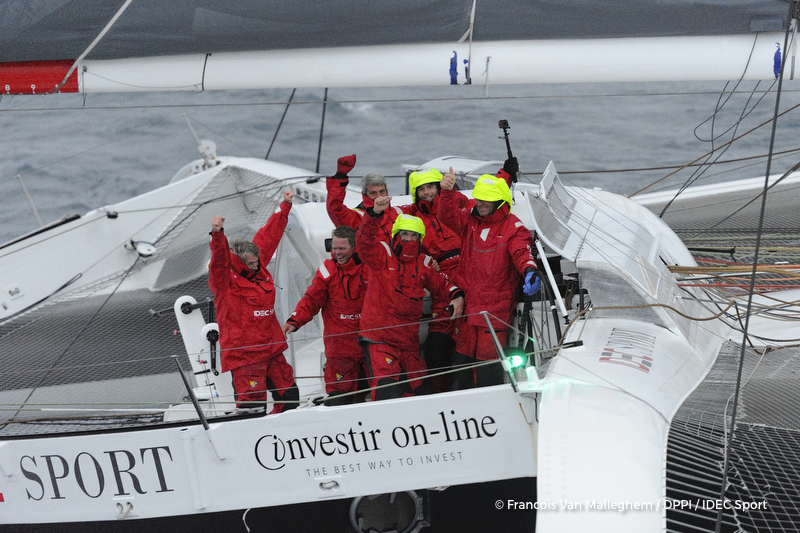
The Jules Verne Trophy is a challenge that pushes sailing crews to circumnavigate the globe as quickly as possible, without assistance. Originally, the goal was to sail around the world in less than 80 days. Today, giant trimarans like the Ultims can complete the journey in under 40 days.
Origin of the Jules Verne Trophy
The Jules Verne Trophy was born in 1990 from the imagination of two French sailors, Florence Arthaud and Yves Le Cornec. The concept of this race was simple yet ambitious: to sail around the world non-stop and unassisted in less than 80 days. This reference time was a nod to Jules Verne’s famous novel, Around the World in 80 Days.
The project took shape thanks to Titouan Lamazou and Philippe Monnet, who helped define the official framework for the race. Journalist Didier Ragot then convinced Jules Verne’s publisher, Éditions Jules Verne, to lend the author’s name to the challenge. In homage to the writer, the Jules Verne Trophy became a record-breaking race, embodying the values of adventure and performance in the tradition of maritime exploits. The Jules Verne Trophy is one of the greatest offshore racing events, alongside the Route du Rhum and the Vendée Globe.
Rules of the Jules Verne Trophy

The rules of the Jules Verne Trophy are relatively simple but strict. To attempt to win the Trophy, a crew must:
- Complete a circumnavigation under sail, non-stop and unassisted, passing the three legendary capes: Cape of Good Hope, Cape Leeuwin, and Cape Horn.
- Beat the previous record to claim the Trophy. If no record is broken, the Trophy remains with the current holder.
- Follow the course: The race starts and finishes at the same point, usually between the Créac’h Lighthouse on Ouessant Island in Brittany and Lizard Point in England.
The Jules Verne Trophy Committee is responsible for verifying and certifying the time achieved by each crew. This unique format has made the Jules Verne Trophy a benchmark challenge, attracting the most seasoned sailors and the highest-performing boats.
Latest News from the Jules Verne Trophy
History and Evolution of the Jules Verne Trophy
Since its creation, the Jules Verne Trophy has seen many records broken, pushing the limits of high-speed global sailing. In 1993, Bruno Peyron was the first to take up the challenge aboard his catamaran Explorer, setting the initial record at 79 days and 6 hours, just under the 80-day mark. Since then, many exceptional sailors have attempted to claim the Trophy, driving multihull engineering and navigation techniques ever further.
The Jules Verne Trophy record has been broken several times over the years, dropping below 50 days in 2002 with Olivier de Kersauson and under 40 days in 2012 with Loïck Peyron aboard Banque Populaire V. Today, the reference time, set by Francis Joyon and his crew on IDEC Sport in 2017, stands at 40 days, 23 hours, 30 minutes, and 30 seconds—a monumental achievement that reflects technological advancements in navigation and performance.
Crews Who Have Participated in the Jules Verne Trophy

Here is a list of the crews who have made their mark in the history of the Jules Verne Trophy, along with their times:
- 1993: Explorer, Bruno Peyron – 79 days, 6 hours, 15 minutes, and 56 seconds (first record)
- 1994: Lyonnaise des Eaux-Dumez, Peter Blake and Robin Knox-Johnston – 74 days, 22 hours, 17 minutes, and 22 seconds
- 1997: Sport-Elec, Olivier de Kersauson – 71 days, 14 hours, 22 minutes, and 8 seconds
- 2002: Orange, Bruno Peyron – 64 days, 8 hours, 37 minutes, and 24 seconds
- 2004: Geronimo, Olivier de Kersauson – 63 days, 13 hours, 59 minutes, and 46 seconds
- 2005: Orange II, Bruno Peyron – 50 days, 16 hours, 20 minutes, and 4 seconds
- 2010: Groupama 3, Franck Cammas – 48 days, 7 hours, 44 minutes, and 52 seconds
- 2012: Banque Populaire V, Loïck Peyron – 45 days, 13 hours, 42 minutes, and 53 seconds
- 2017: IDEC Sport, Francis Joyon – 40 days, 23 hours, 30 minutes, and 30 seconds (current record)
Each record represents a true technical and human feat, with crews sailing day and night, often in extreme conditions, to cross oceans and push the boundaries of what is possible.
A Challenge at the Crossroads of Achievement and Innovation
The Jules Verne Trophy is much more than a race: it is a challenge where technological innovation, courage, and navigational strategy intertwine. Since the first attempts, the boats involved have evolved from catamarans to giant trimarans, built for speed and capable of maintaining high averages over long distances. Today’s crews are equipped with advanced communication and weather forecasting tools, although the essence of the challenge remains unchanged: to break the sailing record around the world.
With crews ready to brave the seas to etch their names into legend, the Jules Verne Trophy continues to attract sailors and sea enthusiasts. This iconic record embodies the spirit of great maritime adventures, much like Jules Verne’s work, which has inspired generations to see further and dream bigger.