
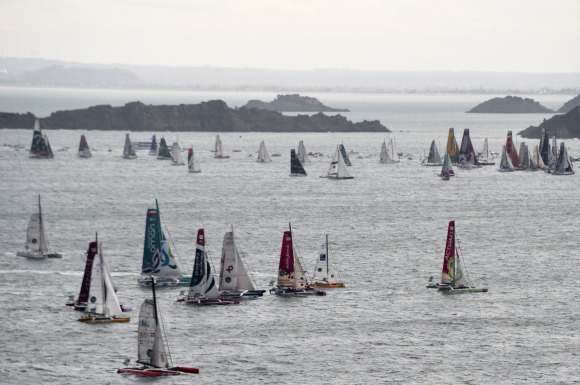
The Route du Rhum is the most popular offshore race, second only to the Vendée Globe. This transatlantic race, which will celebrate its 50th anniversary in 2028, is a legendary event that has created the legends of sailboat racing.
The story begins in 1978. Michel Etévenon decided to create a solo transatlantic race. The project aimed to allow freedom in boat choice. The race would start from Saint-Malo and finish in Pointe-à-Pitre, Guadeloupe. This was the birth of the Route du Rhum. But let’s delve deeper into the story of this queen of offshore racing.
History of the Route du Rhum
It all began in 1976. The idea for this solo transatlantic race came from a strong will and a meeting. The will came from the Guadeloupe rum producers’ union, which sought an event to promote its islands and expertise. At the same time, in mainland France, a man named Michel Etévenon, an advertiser and “inventor” of sports entertainment, wanted to create a sailboat race.
The meeting was, of course, one of shared aspirations, primarily between these men on either side of the Atlantic. Thus, the Route du Rhum was born. Designed by Etévenon, it was conceived with a simple philosophy and billed as the “Transat of Freedom.” Monohulls and multihulls were admitted without classification specifications or size restrictions, aiming to offer the opportunity to express oneself freely across a vast ocean of achievements.
Professionals and amateurs set off from the same starting line off Saint-Malo, benefiting from all external aids to navigation. In Guadeloupe, at Pointe-à-Pitre, the entire population awaited the heroes of the first edition of this race, not yet knowing that it would capture their hearts and minds for the next 40 years… and beyond.
The Route du Rhum and Its Sailors
Every four years, the Queen of solo transatlantic races sparks passion. Its legend comes from a race that, in each edition, experiences difficult early days, storms, breakages, and great winners. But the legend also comes from its skippers who have marked its history, like Mike Birch, who won the first edition, and Alain Colas, who disappeared at sea on with the trimaran Manureva. The year 1978 remains iconic due to these two events. At the same time, the skippers at the start would mark the history of offshore racing: Florence Arthaud, Philippe Poupon, Olivier de Kersauson, Bruno Peyron, Yves Le Cornec, Daniel Gilard, Marc Pajot, and Pierre Fehlmann.
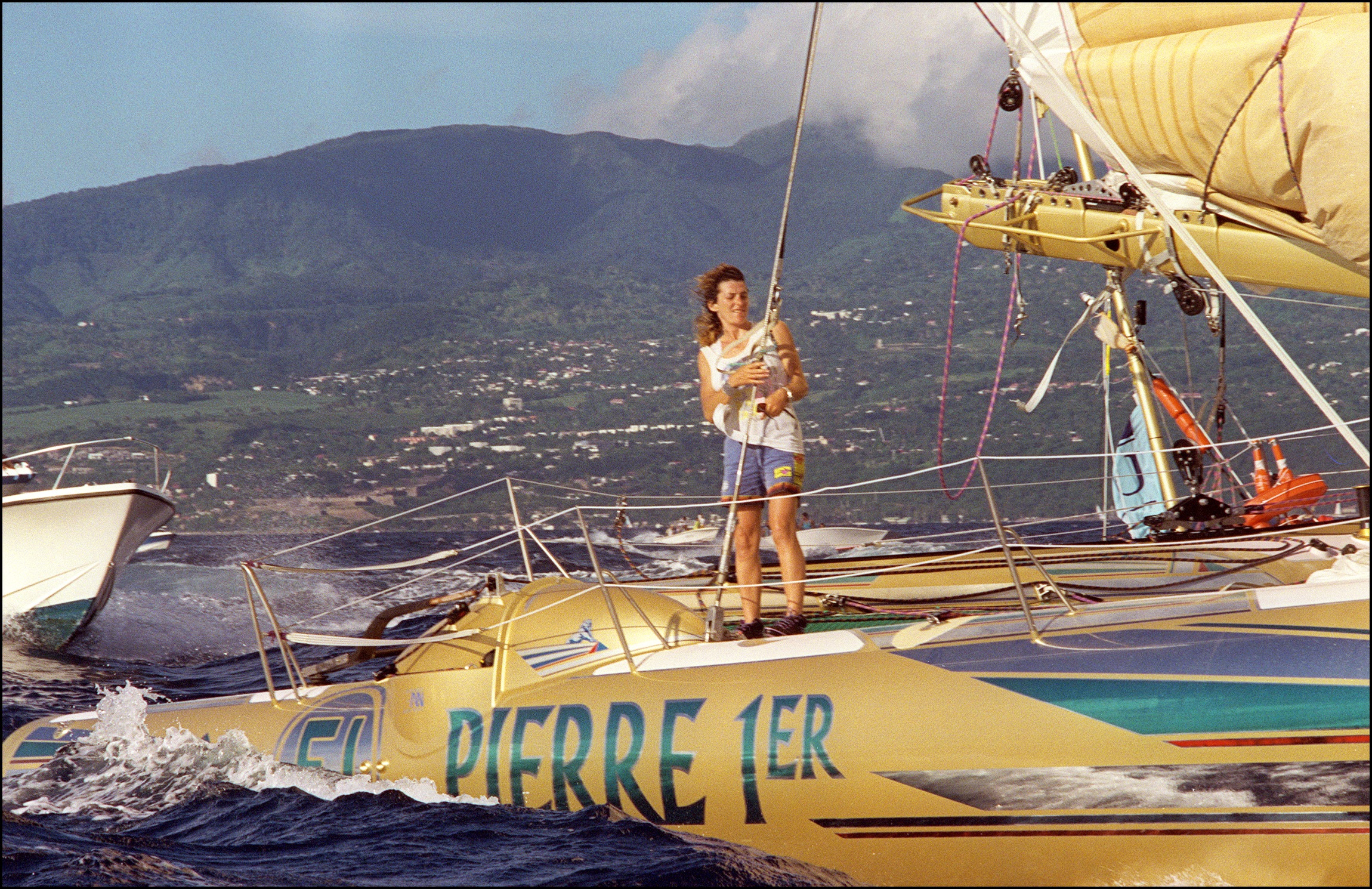
Only great sailors have won this race, such as Marc Pajot, Philippe Poupon, Florence Arthaud, Laurent Bourgnon, Ellen MacArthur…
With 91 competitors, over 2 million visitors, and a magnificent victory by Loïck Peyron (who holds the race record with the Maxi Solo Banque Populaire VII, in 7 days 15 hours 8 minutes and 32 seconds at an average speed of 22.93 knots). All categories combined, the 10th edition in 2014 left a lasting impression.
Six Categories to Write History
Now, more than 100 skippers take the start off the Pointe du Grouin in each edition. True to its values of openness, the Route du Rhum-Destination Guadeloupe

welcomes all sailboats from 39 feet. A small novelty in 2018: competitors were divided into six classes, compared to five in 2014. The Ultime category and its star skippers were present in Saint-Malo, as were the Imoca and their round-the-world skippers, the Multi 50, now equipped with foils, and the Class40, offering a delightful mix of professional and amateur racers.
These four categories follow strict rules or defy all dimensions. However, two more must be added without which the event would not be what it is. Some were part of the first edition in 1978, like the sisterships of Mike Birch’s small yellow trimaran, the first winner. Suffice it to say, they are part of the history of the Route du Rhum-Destination Guadeloupe. They embody the very essence of this “Transat of Freedom” envisioned by Michel Etévenon. The boats in the Rhum category are now divided into two families: multihulls on one side, which can no longer compete with the Multi50 and their new appendages, and monohulls on the other, offering racing enthusiasts—those who prepare for it as if for a romantic rendezvous—a reunion every four years.
Record Participation in 2018

The Route du Rhum welcomed 123 boats on the starting line in 2018. A true success for its 40th anniversary. The organizers of the Route du Rhum had set the number of participants for this legendary transatlantic race at 100. But the 2018 edition attracted a growing number of candidates. An unprecedented situation that led OC Sport Pen Duick, the organizer, to “open the ranks” of Class40 and Rhum Multi, among others.
That year, Francis Joyon achieved a historic victory that entered the legend of the Route du Rhum. Indeed, the skipper of the oldest multihull not only set a new reference time but also delivered one of the most beautiful finishes in the race’s history. After an incredible finish, he crossed the line 7 minutes ahead of François Gabart.
A margin that cements the legend of this 11th edition of the Route du Rhum-Destination Guadeloupe and its winner, Francis Joyon.
The skipper of the Class40 Veedol-AIC, Yoann Richomme, also won the Route du Rhum in his category that same year. He crossed the finish line in Pointe-à-Pitre after 16 days, 03 hours, 22 minutes, and 44 seconds of racing, setting the record for the event in Class40.
Increasing Success
Success of Class40 and Rhum Multi
While there was no issue with Ultimes, Imoca, Multi50, or Rhum Mono, the demand for Class40 and Rhum Multi far exceeded the supply. This situation led OC Sport Pen Duick, the race organizer, the race management, and the teams from Saint-Malo and Guadeloupe to make an exceptional decision. After studying the logistical capacity to accommodate additional boats at the start and finish, and ensuring the ability to monitor a larger fleet, the two most “crowded” categories saw their numbers increase.
With 10 additional spots each, the Class40 and Rhum Multi thus increased to 50 and 20 competitors, respectively. Good news for sailors who would not have missed this highly anticipated event for anything.
Class40, the Largest Fleet
With the exception of the Mini-Transat, no solo oceanic race can boast as many boats of the same size as this eleventh edition of the Route du Rhum-Destination Guadeloupe! Fifty-three contenders on the same starting line, including no fewer than three former winners of La Solitaire du Figaro (Kito de Pavant, Nicolas Troussel, Yoann Richomme), not to mention all those who have already participated (Sam Goodchild, Nicolas Jossier, Claire Pruvot, Halvard Mabire) or those who have completed the Transat Jacques Vabre or The Transat (Maxime Sorel, Antoine Carpentier, Louis Duc, Arthur Le Vaillant, Aymeric Chapellier, Bertrand Delesne, Loïc Fequet, Arthur Hubert, Hiroshi Kitada, Robin Marais, Miranda Merron, Olivier Roussey, Phil Sharp).
The boats have become increasingly demanding despite a limited sail area of 115 m² maximum upwind, a minimum displacement of 4,500 kg, and a draft of 3 meters. The architects were not mistaken, as seventeen of them will be represented in Saint-Malo with increasingly powerful designs: hulls are sleeker, bows are rounder, cockpits are more protected, and interiors are more austere… Some units are now faster than IMOCA monohulls from the 2000s.
Increasingly Powerful Multi50s
The Multi50 class brings together 15-meter-long and 15-meter-wide trimarans, subject to a restrictive rating but allowing some architectural freedoms that attract different designers. In its effort to structure itself and embrace the latest technological advancements, the class parted ways with its “vintage” section and authorized the addition of foils in 2017. Five of the six competing multihulls (all except Gilles Lamiré’s) are equipped with lifting foils. Three of them have added one-design kits to older platforms, while the two most recent trimarans, Ciela Village and Solidaires en Peloton Arsep, were entirely designed around this new “flying” dynamic.
Imoca, a Race Within the Race
The Route du Rhum-Destination Guadeloupe in IMOCA is always hotly contested, unpredictable, and thrilling. In just four years, the IMOCA class has undergone a transformation. Increasingly complex, spectacular, and demanding, these 60-foot monohulls have become “foiling” machines… But behind these fighter jets, the older-generation boats are far from obsolete. The most performant of these “vintage” boats can even hope to contend for top positions in Pointe-à-Pitre.
Ultim, the New Giants
These 32-meter-long and 23-meter-wide multihulls can, for the most aerial, take flight at 13/14 knots of wind, advance twice as fast as the wind, and exceed 45 knots at top speed.
They are predicted to cross in six days. Maybe less, if the weather is very favorable! Whether aboard the reconfigured old maxis (Sodebo Ultim’, Idec Sport, MACIF) or the two 2017-generation trimarans designed to fly (Maxi Edmond de Rothschild, Maxi Solo Banque Populaire IV), the sailors had to relearn how to navigate, adjust all the parameters that condition flight, and connect with new sensations. “We are experiencing a period of technological disruption,” confides Thomas Coville. “It’s magical. It’s a universe that everyone is discovering.“
Rhum Multi and Rhum Mono, for All Budgets
For the first time in 2018, all monohulls that do not fit into the IMOCA or Class40 series were grouped into a single class: Rhum Mono gathers seventeen solo sailors in Saint-Malo who will retrace the steps of Kriter V, Michel Malinovski’s black cigar that was almost overtaken on the finish line during the first edition in 1978…
But the Route du Rhum is above all the incredible image of a small yellow trimaran overtaking a huge black monohull in the final meters before the finish in Guadeloupe: 98 seconds apart after 23 days, 6 hours, 59 minutes, and 35 seconds! The first edition of this new solo transatlantic race left such an impression that forty years later, Charlie Capelle (Acapella-Soreal) and François Corre (Friends & Lovers) return to compete on sisterships of Mike Birch’s trimaran against Bob Escoffier (Kriter V-Socomore-Quéguiner), who defends Michel Malinovski’s colors aboard his monohull! 98 seconds for eternity…