
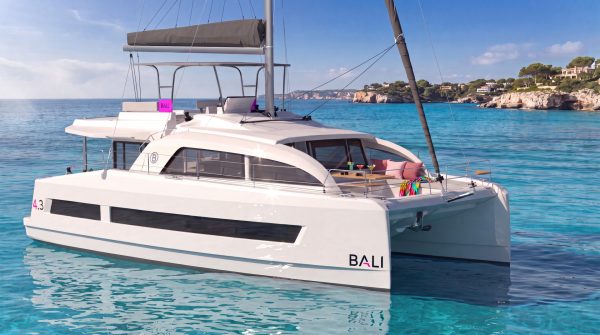
Innovating in the boating world, especially when it comes to layouts, is no easy task. Yet, the Bali 4.3 makes a bold statement. This catamaran redefines spaces and the organization of life aboard a multihull, which has always been the shipyard’s DNA. Here’s a catamaran that’s changing the game.
The Bali 4.3 is a 43-foot cruising catamaran that redefines the standards of its segment in terms of space, autonomy, and comfort. Launched by Catana Group under the Bali Catamarans brand, this model embodies a new generation of multihulls designed to offer a no-compromise cruising experience: record energy autonomy, a generous rooftop, and seamless movement between indoor and outdoor spaces. With its Open Space concept, the Bali 4.3 erases the traditional boundaries between the saloon, cockpit, and aft platform, creating a unique living environment that is both practical and convivial—like an apartment with open terraces facing the sea. A DNA already present since the shipyard’s creation. But here, I think we’ve taken another leap forward—for the better—in cruising.
Key Features
- Cutting-edge design: Dynamic silhouette inspired by the Bali 7.0, with a rigid forward deck (no nets or trampolines) and a BALI® swing door that unifies the saloon and aft cockpit.
- Energy autonomy: 48 V electrical architecture with lithium batteries, solar power production up to 3,000 W, reducing dependence on the generator.
- Loading capacity: Up to 860 L of fresh water and 800 L of fuel, as well as an aft platform capable of accommodating a 3.40 m (250 kg) tender.
- Three-zone rooftop: Helm station, cocktail area, and sunbathing space, all protected by a full bimini.
- Flexible layout: Configurable in 4 cabins (charter) or 3 cabins (owner’s version) thanks to a non-structural transformation kit.
- Optimized sail plan: 122 m² upwind for a weight of 14 tons, offering an excellent weight-to-sail area ratio.
Introducing the Bali 4.3
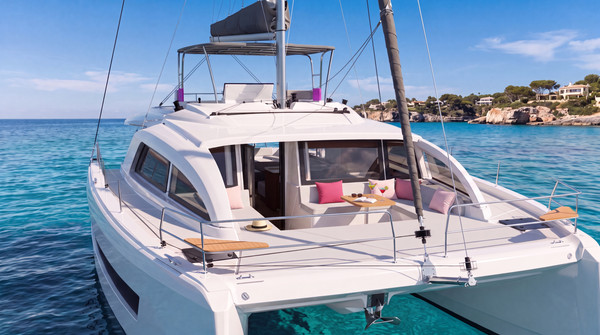
The Bali 4.3 is part of the Catana Group’s strategy to democratize access to high-end cruising catamarans, targeting the 40-45 foot segment, dominated by builders like Lagoon, Leopard, and Fountaine Pajot. Officially launched in September 2026, it is the result of experience accumulated since 2014 with the Bali range, itself born from Olivier Poncin’s (then the group’s director) desire to offer multihulls that are accessible, innovative, and suited to both charter and private ownership.
The naval architecture is designed by Xavier Faÿ, a recurring name at Catana and Bali, known for his high-performance hulls and proven technical solutions. The interior design is the work of Berco Design + Piaton, while the overall concept was led by Aurélien Poncin. The Bali 4.3 adopts the innovations of the brand’s flagship models (Bali 5.2, 5.8, 7.0) and adapts them to a more compact size, without sacrificing comfort or performance.
In terms of construction, the shipyard opted for three-part molds (inner hull halves, nacelle, and hull bottom) made of PVC foam sandwich and polyester resin, with an anti-osmosis gel coat. The deck reinforcements are made of monolithic plywood, and the bulkheads are made of stratified or bonded multi-ply plywood. This approach ensures a robust and durable structure, even if it is not the lightest on the market.
The Bali 4.3 will be mass-produced starting this year. In terms of competition, the Bali 4.3 positions itself against models like the Lagoon 42, the Fountaine Pajot 41 or 44, or the Leopard 42. Its major asset lies in its extreme Open Space concept, with total integration of spaces, and energy autonomy far superior to the segment average.
Interior Layouts
The Bali 4.3 breaks away from the classic segmentation of spaces aboard a catamaran. Here, the distinction between saloon/cockpit/aft platform has disappeared in favor of a single, open volume, where each area communicates with the others in a fluid and natural way.
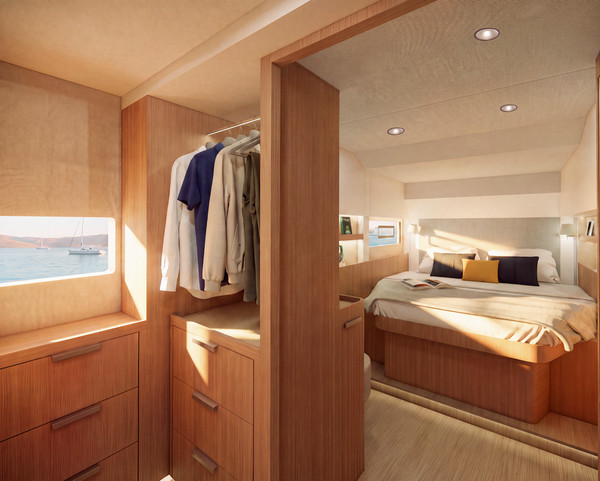
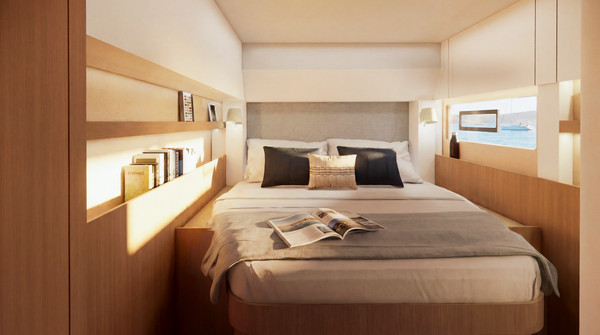
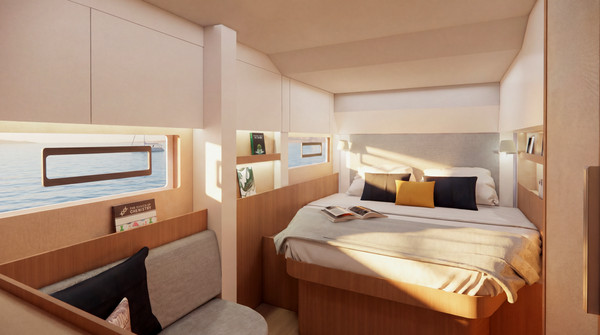
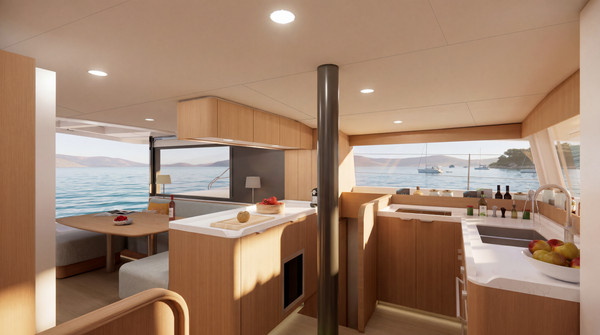
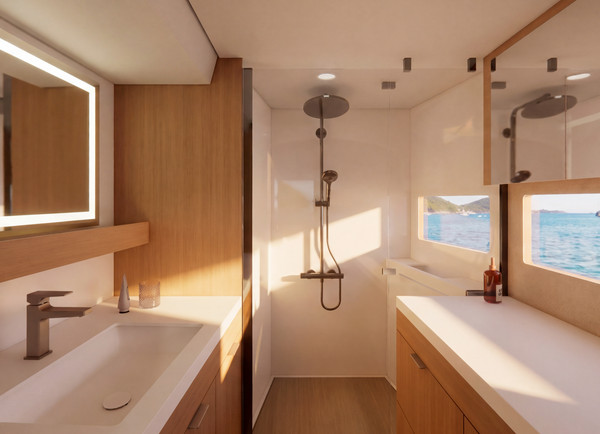
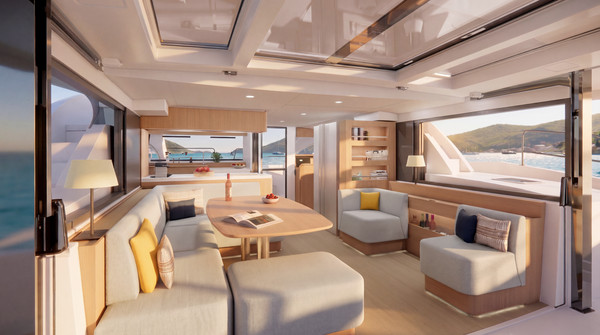
The BALI® swing door is the key element of this revolution. When opened, it creates a flush space between the saloon and the aft cockpit, transforming these two areas into a giant lounge open to the sea. The kitchen, located at the heart of the boat, is central, ergonomic, and open to the saloon. It features generous work surfaces and optimized storage for daily use, even on long cruises. The opening forward panel allows for natural ventilation and easy communication with the forward cockpit.
At the front, the rigid deck replaces the traditional trampolines with a usable forward cockpit, offering additional space for relaxation, swimming, or circulation. This architectural choice also improves protection against spray while sailing.
The owner’s version includes a King Size bed suite (180 cm), a large dressing room, and plenty of storage, while the charter version can accommodate up to 4 double cabins. The storage volumes, inherited from Catana’s long-distance catamaran expertise, allow for provisions and equipment to be carried without cluttering the living spaces.
Sailing Qualities
The Bali 4.3 benefits from the 40 years of expertise of the Catana Group in cruising catamarans. With 122 m² of upwind sail area for a weight of 14 tons, it boasts a particularly favorable weight-to-sail area ratio, giving it good balance, appreciable responsiveness, and a certain ease under sail.
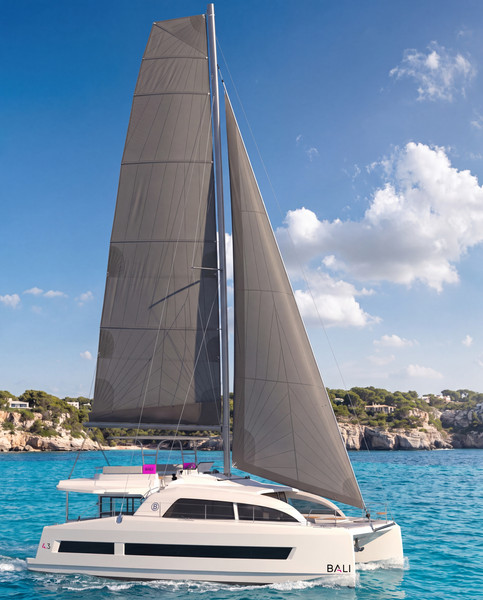
All sheets and halyards are centralized at the helm station, protected by the bimini, which simplifies maneuvers even with a reduced crew. The raised helm station offers excellent visibility over the water, and the controls are grouped within arm’s reach for intuitive navigation.
The rigging, tall and aft, allows for a substantial sail area despite the use of a self-tacking jib. Tests even recommend adding a Code 0 to boost performance in light winds. In terms of appendages, the Bali 4.3 is equipped with fixed keels, a choice that prioritizes robustness, protection of the rudders and propellers, and a good performance/cost compromise.
The tilting aft platform is a major asset: it facilitates the launching and retrieval of the tender, and once open, it creates a fully open space to the sea, ideal for swimming or water activities. Finally, the rooftop, divided into three zones (helm station, cocktail area, sunbathing space), allows for sharing navigation and relaxation moments without inconvenience, with optimal sun protection.
Bali 4.3 Technical Specifications
| Category | Details |
|---|---|
| Shipyard | Bali Catamarans (Catana Group) |
| Naval Architect | Xavier Faÿ |
| Interior Design | Berco Design + Piaton |
| Concept | Aurélien Poncin |
| Overall Length | 13.98 m / 45’10” |
| Hull Length | 13.02 m / 42’8” |
| Waterline Length | 12.09 m / 39’7” |
| Overall Width | 7.42 m / 24’4” |
| Draft | 1.40 m / 4’7” |
| Air Draft | 21.74 m / 71’3” |
| Empty Weight | 14 t / 30,865 lbs |
| Max Load Weight | 19.8 t / 43,652 lbs |
| Upwind Sail Area | 158 m² / 1,700 sq ft (depending on options) |
| Mainsail | 72 m² / 775 sq ft |
| Genoa | 50 m² / 538 sq ft |
| Code 0 | 86 m² / 925 sq ft |
| Engine | 2 x 50 hp to 2 x 59 hp (depending on options) |
| Fuel | Up to 800 L / 212 US gal |
| Fresh Water | Up to 860 L / 228 US gal |
| CE Category | A-12 / B-16 / C-24 / D-30 (certification in progress) |
| Materials | PVC foam sandwich and polyester resin, anti-osmosis gel coat |
| Layouts | 3 or 4 cabins (owner’s or charter version) |
| Energy Autonomy | 48 V Lithium architecture, solar panels up to 3,000 W |
| Aft Platform | Electric, capable of accommodating a 3.40 m / 250 kg tender |
| Rooftop | Three zones (helm station, cocktail area, sunbathing space) |
| BALI® Door | Swing door, unifies saloon and aft cockpit |
Final Thoughts: The Bali 4.3 marks an important step in the evolution of cruising catamarans by reconciling space, autonomy, and ease of use. Its innovative design and revolutionary layouts make it a model particularly suited to owners looking for a boat to live on, as well as to charter investors. Early feedback confirms its potential for long cruises, with comfort and autonomy rarely seen in this segment.