
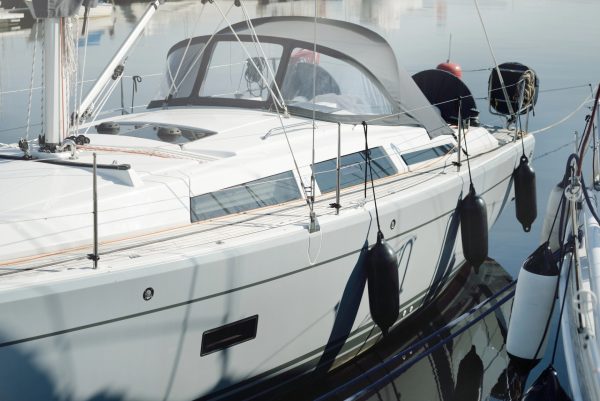
Mooring your boat with complete peace of mind, without worrying about friction or impacts against the dock, another boat, or a pontoon, depends on a thoughtful choice of fenders. This essential equipment plays a very important role in protecting the hull. But what diameter should you choose? How many should you install on each side?
In this guide, we explain how to determine the ideal diameter of your fenders based on the size of your boat, and how many are recommended to install on each side for optimal protection, whether you sail a small sailboat, a cruiser, a motorboat, or a multihull.
This question complements the choice of fender type you will use. On our end, we recommend having both cylindrical fenders and flat fenders, which take up less space, especially on smaller boats.
Key points to remember: the basic rules for choosing correctly
Fenders: what diameter and how many to use according to the size of your boat?
| Criteria | Rule to remember |
|---|---|
| Cylindrical diameter | 2 cm per meter of length for boats up to 8 m; 2.5 cm per meter beyond that. |
| Length | Must cover at least 2/3 of the freeboard (height between the waterline and the deck). |
| Minimum number | 3 fenders per side (6 in total) for boats up to 12 m; 4 per side beyond that. |
| Spacing | 2.5 m between each fender, starting from the beam (widest point). |
| Floating fenders | 1 or 2 additional for docking maneuvers or when mooring alongside another boat. Why not flat ones? |
How to choose the diameter of your fenders?
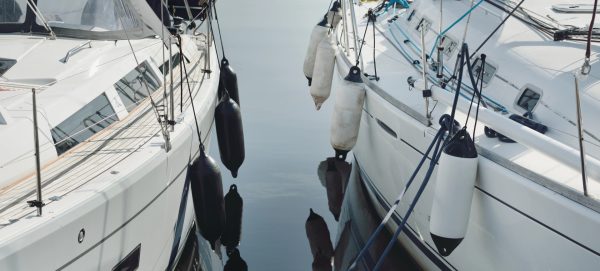
The diameter is the most important criterion for ensuring effective protection.
1. For cylindrical fenders (the most common)
- Boats under 8 meters: 2 cm of diameter per meter of length.
Example: A 6 m boat → 12 cm diameter (6 × 2). - Boats 8 meters and over: 2.5 cm of diameter per meter of length.
Example: A 10 m sailboat → 25 cm diameter (10 × 2.5).
Example: A 12 m boat → 30 cm diameter (12 × 2.5).
Why this difference?
The longer and taller the boat (significant freeboard), the greater its wind resistance and contact surface. Fenders that are too small would not sufficiently cover the friction area, especially in case of tides or waves.
2. For spherical fenders (balls)
- Their diameter should be 1.5 to 2 times that of equivalent cylindrical fenders.
Example: For a 10 m boat (25 cm cylindrical diameter), a spherical fender of 40 to 50 cm will be suitable.
3. Special cases
- High freeboard: If your boat has a very high freeboard (e.g., some sailboats or motorboats), go up one size compared to standard recommendations.
- Very busy ports or exposed areas: Opt for larger fenders for better shock absorption.
How many fenders to install on each side?
The number of fenders depends on the size of the boat and its use.
1. Boats up to 10 meters
- Minimum: 2 fenders per side (4 in total).
- Recommended: 3 fenders per side (6 in total) + 1 or 2 floating fenders (not fixed, for maneuvers).
- Spacing: 2.5 m between each fender, starting from the beam (widest point of the boat).
2. Boats from 10 to 12 meters
- Minimum: 3 fenders per side (6 in total).
- Recommended: 4 fenders per side (8 in total) + 2 floating fenders.
- Spacing: 2 to 2.5 m between each fender.
3. Boats over 12 meters
- Minimum: 4 fenders per side (8 in total).
- Recommended: 4 to 5 fenders per side + 2 or 3 floating fenders (especially for the bow and stern).
- Spacing: 2 m between each fender.
Why floating fenders?
They allow for temporary protection of an uncovered area (e.g., during difficult docking or when mooring alongside a larger boat). A floating fender can also be larger than the others to absorb more significant impacts. These fenders can be flat or spherical.
Where to place your fenders?
- Always start at the beam (widest point), where the boat first rubs against the dock.
- Distribute symmetrically on either side of the beam.
- Protect the bow and stern with an additional fender if necessary (especially for reverse maneuvers or in locks).
Concrete examples based on boat size
Basic rules for choosing fenders
| Boat length | Diameter of cylindrical fenders | Number per side | Recommended floating fenders |
|---|---|---|---|
| 5 m | 10 cm | 2 | 1 |
| 6 m | 12 cm | 2 to 3 | 1 |
| 8 m | 20 cm | 3 | 1 |