

While the boat hook may seem like a very simple tool, on our boats, there are increasingly sophisticated models that can prove very useful in certain situations. Here’s an overview of the different types of boat hooks available.
Essential on board any boat, the boat hook is much more than just a piece of equipment for docking or picking up a mooring buoy: it’s a versatile tool that makes maneuvers easier, ensures safety, and prevents many inconveniences. Knowing how to choose and use a boat hook suited to your needs can make all the difference during mooring, retrieving an object, or performing a delicate maneuver. Above all, your needs will differ depending on whether you regularly pick up a mooring buoy or cat-way in a marina. Today, there are fixed, telescopic, automatic, wooden, or aluminum models. Here’s a guide that outlines the various functions of the boat hook and introduces the main models available on the market to help you make the right choice.
The Boat Hook: A Multifunctional Tool On Board
For newcomers to sailing and boating, a boat hook is a long pole ending in an inward-curving hook. Its uses are multiple:

- Retrieve a rope or an object that has fallen into the water: this is the most common use, especially during mooring or anchoring maneuvers.
- Grab a mooring buoy or anchoring line: it allows you to secure a buoy or ring without dangerously leaning overboard.
- Pass a mooring line to shore or another boat: useful for mooring your boat to a quay or another vessel.
- Push away a boat: helpful to avoid a collision or to move away from a quay.
- Facilitate lock maneuvers: the boat hook is often essential for passing mooring lines around bollards.
- Assist with fishing: some models, equipped with a sharp hook, are used to bring large catches on board during trolling.
In inland navigation, the boat hook is even a mandatory safety equipment, and it is highly recommended at sea.
Why Have One On Board?
- Safety: it prevents you from leaning overboard, thus reducing the risk of falling into the water.
- Precision: it allows you to perform delicate maneuvers, such as grabbing a mooring line or ring, without straining.
- Versatility: some modern models include additional features (buoyancy, telescoping, etc.).
The Different Types of Boat Hooks Available on the Market
Fixed Handle Boat Hook

Features:
- One-piece handle, often made of wood or aluminum.
- Sturdiness and lack of play, which facilitates precise maneuvers.
- More cumbersome, but highly reliable.
Advantages:
- Durability: no risk of jamming or play.
- Precision: ideal for maneuvers requiring strength or precision.
Disadvantages:
- Bulky on board, especially on small boats.
For whom? Boats with sufficient storage space, intensive use.
Telescopic Boat Hook

Features:
- Extensible handle, allowing you to adjust the length as needed.
- Often made of anodized aluminum, lightweight and corrosion-resistant.
- Some models are buoyant, preventing loss in the water.
Advantages:
- Space-saving: easy to store in a locker or under a bench.
- Versatility: adaptable to different situations (mooring, retrieving objects, etc.).
Disadvantages:
- Risk of play or jamming if the mechanism is of poor quality.
For whom? Boaters looking for practicality and reduced bulk.
Retractable Boat Hook

Features:
- Flexible handle that can be coiled for ultra-compact storage.
- Often made of fiberglass or composite materials.
- Some models are disassemblable.
Advantages:
- Very compact: ideal for dinghies or small sailboats.
- Lightweight: easy to handle.
Disadvantages:
- Less sturdy than a fixed or classic telescopic boat hook.
For whom? Owners of small boats or boats where space is limited.
Automatic Boat Hook
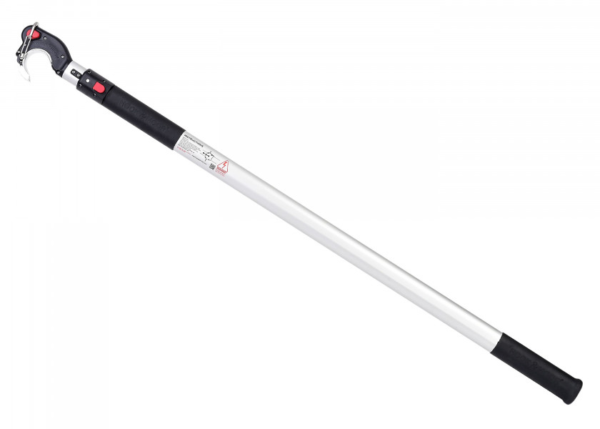
Features:
- Innovative system: the hook opens and closes automatically upon contact with the ring or buoy, thanks to a spring or magnetic mechanism.
- Some models allow you to release the mooring line remotely, without having to lean over.
- Often made of aluminum or stainless steel, with a telescopic handle.
Advantages:
- Ease of use: no need to strain to grab a buoy or ring.
- Increased safety: reduces the risk of falling or sudden movements.
- Speed: ideal for solo mooring maneuvers or in bad weather.
Disadvantages:
- Higher price than classic boat hooks.
- Mechanism to maintain to ensure proper operation.
For whom? Boaters seeking comfort and safety, especially when sailing solo or on medium to large boats.
Wooden or Aluminum Boat Hook?
Wooden Boat Hook
Features:
- Handle made of oak, beech, or mahogany, often varnished to resist moisture.
- Traditional aesthetic, appreciated on classic sailboats.
Advantages:
- Sturdiness and durability if well maintained.
- Aesthetic appeal for wooden boats.
Disadvantages:
- Regular maintenance required (varnish, water protection).
- Heavier than aluminum.
For whom? Lovers of traditional boats or high-end finishes.
Aluminum or Stainless Steel Boat Hook
Features:
- Handle made of anodized aluminum or stainless steel, resistant to corrosion.
- Hook usually made of plastic or stainless steel.
- Models often telescopic or buoyant.
Advantages:
- Resistance to seawater and rust.
- Lightweight and easy to maintain.
Disadvantages:
- Sometimes more expensive than wooden boat hooks.
For whom? Most boaters, for everyday use and without special maintenance.
Multifunctional Boat Hook
Features:
- Some models integrate multiple tips (hook, paddle, etc.).
- Allows you to save space on board by combining several tools into one.
Advantages:
- Space and budget savings.
- Adaptability according to needs.
Disadvantages:
- Less efficient than a dedicated tool for each use.
For whom? Occasional boaters or owners of small boats.
How to Choose the Right Boat Hook?
Here are the criteria to consider:
- Length: between 1.5 m and 3 m depending on the size of the boat and use.
- Material: wood for aesthetics, aluminum or stainless steel for resistance and lightness.
- Type of handle: fixed for sturdiness, telescopic or retractable for space-saving.
- Buoyancy: useful to avoid losing the boat hook in the water.
- Weight: prefer a lightweight model for easy use.
- Budget: from €20 to over €100 depending on materials and options.
In Summary
Comparison of Boat Hook Types
| Type of Boat Hook | Advantages | Disadvantages | Recommended Use |
|---|---|---|---|
| Fixed Handle | Sturdy, precise | Bulky | Spacious boats, intensive use |
| Telescopic | Adjustable, compact | Risk of play | Regular boating |
| Retractable | Ultra-compact, lightweight | Less sturdy | Dinghies, small sailboats |
| Wood | Aesthetic, durable | Maintenance required | Classic sailboats |
| Aluminum/Stainless Steel | Resistant, lightweight, maintenance-free | Sometimes expensive | Everyday use, sea |
| Pulley | Reduced effort, precision | Bulky, heavy | Large boats, anchoring |
| Multifunctional | Versatile, economical | Less efficient | Occasional boaters |
Where to Buy Your Boat Hook?
Major nautical retailers offer a wide selection of boat hooks, both online and in-store. Be sure to check the quality of the hook and the telescopic mechanism if you opt for an extendable model.
In conclusion, the boat hook is an accessory that is as simple as it is essential on board. Your choice depends on your type of navigation, the size of your boat, and your specific needs. Whether you choose a fixed wooden boat hook for its aesthetics, a telescopic aluminum one for its practicality, or a retractable one for its compactness, the important thing is to have one within reach to facilitate your maneuvers and ensure your safety.
And you, which model do you use on board? Have you ever been saved by a boat hook in a tricky situation? Share your experience in the comments!