
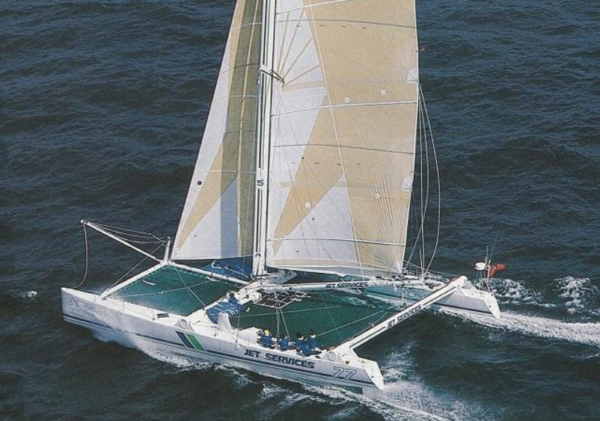
Catamarans have long given way to trimarans in offshore racing. Yet catamarans were once the boats behind many legendary feats. Here’s a look at Jet Services, later renamed Commodore Explorer, a catamaran that became a legend in offshore racing and the Jules Verne Trophy.
Key Points
- First crewed circumnavigation in under 80 days (1993).
- Double North Atlantic record (1988, 1990).
- Major innovations: carbon wing mast, removable beams, ultra-sleek hull.
- Legendary skippers: Serge Madec, Bruno Peyron, Roman Paszke.
- End of career: abandoned in Portugal, now a wreck.
The Commodore Explorer, formerly Jet Services V, is much more than just a race boat: it is a sailing legend, a symbol of innovation and daring. Launched in 1987, this multihull made history in offshore racing with exceptional performances, records, and skippers who are part of racing lore. Designed by architect Gilles Ollier and built by Multiplast shipyard, it evolved over the years, passing into the hands of exceptional sailors like Serge Madec, Bruno Peyron, and Roman Paszke. A look back at the epic journey of a boat that pushed the boundaries of navigation.
Construction: A Technological Revolution

In the late 1980s, the world of offshore racing was buzzing. Roger Caille, CEO of Jet Services, wanted a catamaran capable of dominating the oceans. He entrusted Gilles Ollier with the design of a lightweight, fast, and innovative multihull. The result? A catamaran of 22.85 meters (later extended to 26.30 meters), entirely made of carbon, with a 300 m² mainsail and a 775 m² downwind sail area. Gone was the central nacelle; in its place were removable cylindrical beams and an ultra-sleek hull, inspired by beach catamarans. The Jet Services V was born in June 1987, featuring a carbon wing mast—a first for the time.
This boat was a technological breakthrough: minimalist, ultra-high-performance, and built for speed. From the moment it was launched, it impressed with its maneuverability and robustness, despite weighing just 9.5 tons (later 10.5 tons after modifications). The renowned Multiplast shipyard delivered a machine tailored for competition and records.
A Story of Skippers and Records
Serge Madec (1987-1992): Triumphant Beginnings
Entrusted to Daniel Gilard, then to Serge Madec after the tragic loss of the former, Jet Services V racked up victories: Tour of Europe, Multihull Trophy, Route of Discovery. It broke the North Atlantic crossing record twice (7 days 6 hours in 1988, then 6 days 13 hours in 1990), and set the greatest distance covered in 24 hours (522.7 miles). The catamaran became a benchmark, but the arrival of ORMA boats (limited to 18.28 meters) marked the end of its career under the Jet Services colors.
Bruno Peyron (1993-1998): Around the World and Glory

In 1992, Bruno Peyron purchased the boat and modified it to attempt the Jules Verne Trophy. Renamed Commodore Explorer, it was lengthened, reinforced, and adapted for the great adventure. In 1993, Peyron and his crew achieved the feat: first crewed non-stop circumnavigation in under 80 days (79 days 6 hours 15 minutes), averaging 14.4 knots. The catamaran became an icon, a forerunner of the future The Race. Peyron continued to break records (Transpac, Yokohama-Los Angeles) and made the Commodore Explorer a symbol of maritime audacity.
Roman Paszke (2000-2001): The Polish Legacy
Sold to Polish sailor Roman Paszke, the boat, renamed Warta Polpharma, took part in The Race in 2000. Despite losing its mast during the Route of Discovery, the crew finished 4th in this legendary race. After this adventure, the catamaran was gradually abandoned, ending its days in a field in Portugal, where it slowly deteriorated.
Commodore Explorer Catamaran Technical Specifications
| Feature | Jet Services V (1987) | Commodore Explorer (1993) | Warta Polpharma (2000) |
|---|---|---|---|
| Length | 22.85 m | 26.30 m | 26.30 m |
| Width | 13.60 m | 13.60 m | 13.60 m |
| Weight | 9.5 t | 10.5 t | 10.5 t |
| Mast height | 30.50 m | 32.00 m | 32.00 m |
| Upwind sail area | 290 m² | 300 m² | 207 m² |
| Downwind sail area | 775 m² | 775 m² | 775 m² |
| Draft | 4.00 m | 3.50 m | 3.50 m |
| Materials | Airex/Carbon | Airex/Carbon | Airex/Carbon |
| Architect | Gilles Ollier | Gilles Ollier | Gilles Ollier |
| Shipyard | Multiplast | Multiplast | Multiplast |
| Sails | North | North | North |
| Crew | 4 | 4 | 4 |
Conclusion
The Commodore Explorer remains a monument in offshore racing, much like the IDEC Sport Trimaran, symbolizing an era when anything was possible. Its history, records, and skippers make it an unforgettable boat, continuing to inspire sailing enthusiasts. A legend worth telling, so that new generations of sailors remember these ocean pioneers.