
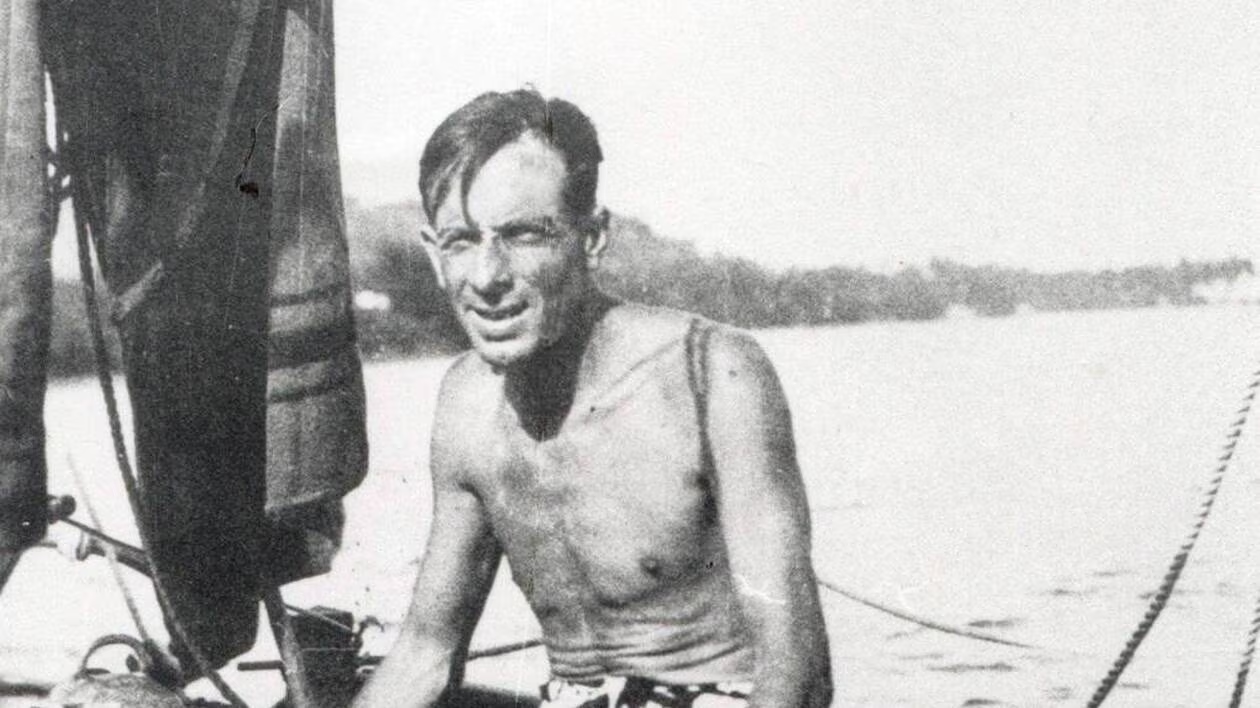
Alain Gerbault is a sailor little known to the general public, and even less so to younger generations. Yet this Frenchman, born in Mayenne, is undoubtedly the one who started it all in offshore sailing. Without him, perhaps Bernard Moitessier wouldn’t have had his long voyage. A look back at a sailor who inspired many generations of aspiring sailors, whether cruising or racing offshore.
In 1923, a 29-year-old Frenchman, a former fighter pilot and tennis champion, left Gibraltar aboard an old 11-meter English cutter. One hundred and one days later, he arrived in New York, exhausted but triumphant. Alain Gerbault has just completed the first solo east-to-west crossing of the Atlantic, a feat that was then unmatched.This Laval native, born in 1893, had no idea yet that he was entering history and that he would become, between Joshua Slocum and Bernard Moitessier, theone of the pillars of French maritime legendHis name remains associated with audacity, freedom, and a certain idea of adventure at sea, where performance vies with the quest for meaning.
An extraordinary destiny

Alain Gerbault was not destined for the sea. Born into a family of industrialists, he grew up between Laval and Dinard, dividing his time between tennis, bridge, and engineering studies. The First World War transformed him: a decorated pilot, he returned with one certainty – he could no longer tolerate a sedentary life. “After experiencing the exhilaration of space in my fighter jet, flying through the clouds, I knew I could never again lead a sedentary life in a city.”he wrote.
In 1921, he bought in England an old racing sailboat, the Firecrest, and ventures into the unknownAfter months of training in the Mediterranean, he left Cannes in the spring of 1923, heading for Gibraltar, then New York. 101 days at sea, alone, non-stop, without GPS, with cotton sails and a compass as my only equipment : his arrival in New York on September 15, 1923, made headlines.
But Gerbault did not stop there. On October 2, 1924, he set off again for a round-the-world voyage, still on the Firecrest. He crossed the Panama Canal, braved the Indian Ocean, rounded the Cape of Good Hope, and returned to Le Havre on July 26, 1929, after five years at sea. He is the first Frenchman to complete a solo circumnavigation of the world by sailboat – an achievement which places him in the lineage of Joshua Slocum, the first solo circumnavigator (1895-1898), and makes him a model for those who will follow, such as Bernard Moitessier.
A bridge between Slocum and Moitessier

Gerbault embodies a major transition in the history of ocean sailing. Slocum, the American, had proven that a solo circumnavigation of the world was possible; Gerbault, the Frenchman, made it a founding act for European sailing.His approach, both technical and poetic, foreshadows that of Moitessier: he seeks not only performance, but a communion with the ocean and the people he encounters. In Polynesia, he immerses himself in the local culture, defends the rights of the islanders, and writes books that blend adventure narrative and humanist advocacy.
Moitessier would later pay homage to Slocum by naming his boat after him. Joshua, but it is Gerbault who paves the way for him. Like him, Moitessier refused honors in order to prioritize freedom and authenticity.Gerbault, for his part, left Europe for good in 1932 aboard a new sailing ship, theAlain Gerbaultwhich he designed himself. He settled in Polynesia, lived among the islanders, and died in 1941 in Timor, carried off by malaria, after spending his last years sailing from lagoon to lagoon.
To remember
- one thousand nine hundred twenty-three : First solo crossing of the Atlantic from east to west (Gibraltar-New York) in 101 days, aboard the Firecrest.
- 1923-1929 : First solo round-the-world voyage for a Frenchman, with stopovers.
- A literary and human legacy : His books (Alone across the Atlantic, The Gospel of the Sun) are classics of maritime literature, where adventure vies with reflection on man’s place in nature.
- A style of navigation Gerbault sails “the old-fashioned way”, with a simple boat, without an engine, and a philosophy close to that of Moitessier: the sea as a school of life, solitude as a choice, encounter as a richness.
Why does Gerbault remain a major figure?
Because he was able to combine sporting achievement with a human and literary dimension. He showed that ocean sailing was not just about records, but also about emotion, respect for the elements and cultures. Between Slocum, the pioneer, and Moitessier, the poet, Gerbault is the link, the one who anchored solo navigation in the French imagination.
Its history reminds us that the sea is not only a field of competition, but also a space of freedom, discovery, and sometimes redemption. Even today, its name resonates as a call to the open sea, an invitation to take the time, to listen to the wind, and to dare to embark on adventure – with humility and passion.