
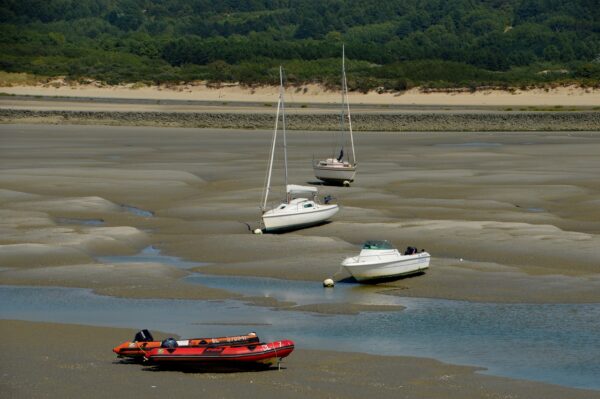
There are two types of dinghies: the centerboard dinghy (DI) and the weighted centerboard dinghy (DL). While both types of sailboats allow access to all bodies of water and can be beached at low tide, each has its own advantages and disadvantages. So how do you choose between a centerboard dinghy and a weighted centerboard dinghy?
Ah, what a pleasure it is to run aground on a white sand beach or simply enjoy a small Breton harbor at low tide. So many memories… I say memories because I can no longer experience these moments. Since I moved to Quimper, my main weekend destination is the Glénan archipelago. But my boat is a keelboat with a 1.90m draft. Local sailors will understand that my anchoring options are limited. With a dinghy, I could go anywhere and, above all, far from others. Yes, sometimes I like to be a bit of a loner…
In the past, I sailed on a weighted centerboard dinghy, a Kelt 7.60. I loved that boat. This weighted centerboard dinghy allowed me to enjoy the Gulf of Morbihan at the time. But it also had its disadvantages. I also sailed on a centerboard dinghy, a friend’s boat, several times. We often debated the merits of the weighted centerboard versus the centerboard dinghy. It must be admitted that the different types of ballast for our sailboats have an impact on our sailing. And even the choice of dinghy can affect our anchorages.
So, I suggest we look again at the weighted centerboard dinghy and the centerboard dinghy. Specifically, their advantages and disadvantages. But I’ll tell you right away: there are no certainties or absolute truths here. I’m just going to give you my opinion. So, I strongly encourage you to contradict me—or not—in the comments.
Introduction to the Weighted Centerboard Dinghy

The weighted centerboard dinghy is a sailboat with movable ballast that dates back many years. You can find Cornu and Herbulot designs, in wood, with weighted centerboards. Philippe Harlé himself proposed many sailboats with a so-called DL version. The Jeanneau shipyard, for example, quickly opted for this solution and has maintained this habit to this day. Edel shipyard sailboats were also all offered in a weighted centerboard version.
The first weighted centerboard dinghies were equipped with a ballast called a “saumon”. From this saumon, a centerboard—or rather, a metal plate serving as a centerboard—extended. Today, weighted centerboard dinghies have evolved quite a bit to offer profiled saumons with fins on the sides. But the centerboard itself has remained a metal plate.

The weighted centerboard dinghy has certain advantages:
- When you run aground, the hull is not in contact with the bottom. So there is less risk of damaging the hull when beaching.
- The saumon allows you to optimize the position of the ballast by placing it lower than the waterline.
- While sailing, if you run aground and lose your centerboard, you can still continue on your way. Tacking might be more difficult, though.
But let’s also acknowledge that the weighted centerboard dinghy has disadvantages:
- To beach upright, the weighted centerboard dinghy must be equipped with legs, unless it can rest on twin rudders or the fins next to the saumon.
- Upwind performance is not as good as on a keelboat or a centerboard dinghy.
- It often happens that the centerboard gets stuck in the saumon. During beaching, mud or sand gets into the saumon and jams the centerboard.
Introduction to the Centerboard Dinghy

Now, let’s talk about the centerboard dinghy. It seems to me that the centerboard dinghy appeared after the weighted centerboard dinghy. I think architects evolved the concept of the movable centerboard. Shipyards like Gib Sea and Kirié, for example, started by offering weighted centerboard dinghies before proposing a whole range of sailboats in the centerboard dinghy version. Philippe Harlé himself switched to the centerboard dinghy after a few years, especially for cruising sailboats.
And it’s true that the centerboard dinghy principle has been adopted by many shipyards specializing in the construction of cruising sailboats.
The main shipyards that offered centerboard dinghies are Kirié, with its Feeling range (except for the Feeling 920 and 720, I think), and the Alubat shipyard with its Ovnis, for example.

For me, the centerboard dinghy has the advantages that are the disadvantages of the weighted centerboard dinghy… Do you follow me?
Advantages of the centerboard dinghy:
- It can beach directly on the beach. Impossible with a weighted centerboard dinghy.
- The centerboard dinghy lies flat.
- Small centerboard dinghies can be more easily transportable.
Disadvantages of the centerboard dinghy:
- The centerboard dinghy will be more tender and will therefore require reducing sail more quickly. But if you know that…
In short, to give you my opinion, very concretely, if I had to buy a small sailboat, whenever possible, I would opt for a centerboard dinghy. This mainly allows it to be transported on a trailer and taken out of the water very easily.
On a larger boat, the choice between the two is more debatable. While the centerboard dinghy has the advantage of lying flat with simplicity, the new weighted centerboard dinghies are quite well designed. I’m thinking in particular of the Sun Odyssey 32i, which, thanks to its two fins and rudders, allows it to lie flat without any constraints while benefiting from additional ballast. But everything is a matter of compromise, as always. And the choice between a keelboat and a dinghy, or even a twin-keel boat or a sailboat with a lifting keel, will be just as much so.
I even wonder if, for my next boat, I could choose between a Sun Odyssey 32i and a Feeling 32?