
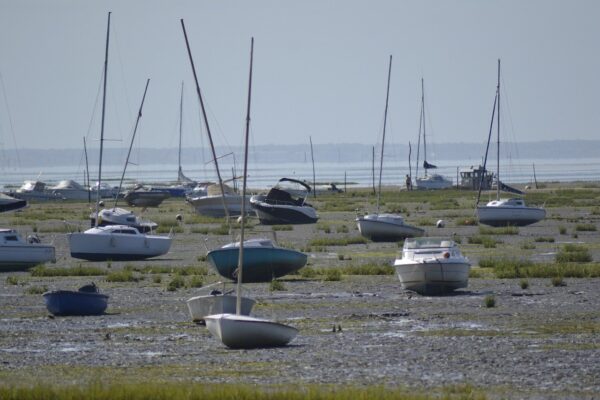
Buying a sailboat means choosing one that matches your sailing program. Whether for coastal cruising or racing, sailboats will not be the same. Among the selection criteria, the type of ballast is crucial. Choosing a keelboat or a dinghy will address several needs related to your type of sailing and mooring. Let’s explore together the different types of dinghies, their advantages, and disadvantages.
What Are the Advantages of a Dinghy?
First, let’s review the benefits of sailing with a dinghy and the drawbacks associated with this type of sailboat.
Easy Grounding, Anywhere and Flat
The main advantage of a dinghy is its ability to run aground. For cruising, this changes everything. You can avoid large marinas and anchor in the back of small coves, as close as possible to beaches and shores. Since a full centerboard dinghy can run aground flat, you can wait out low tide without worry when sleeping aboard.
Easier Maintenance
Finally, another major advantage of a dinghy is its ease of maintenance. First, you can choose a mooring that runs aground at low tide. In this case, the boat is dry half of the year, making the hull less susceptible to fouling. At the same time, you can more easily haul out (while respecting regulations and avoiding pollution) along a quay or slipway. You can access the hull at low tide. This is simpler with a ballasted dinghy, as you will have easier access to the underside of the hull.
Ease of Transport
The advantage of a full centerboard dinghy, especially for a small sailboat, is the ability to be transported easily. Indeed, with the centerboard fully retracted inside the boat, launching and retrieving are simplified to the maximum. You just need to slide the boat on the trailer. Therefore, you do not need a crane.
What Are the Disadvantages of a Dinghy?
While the advantages of a full centerboard dinghy are numerous, there are also a few disadvantages to consider. Two issues come up most often.
- First, a centerboard or lifting keel requires an additional mechanism on the boat. This means the system for lowering and raising the centerboard must be regularly checked. You will find components like the screw, possibly a jack, and the pivot axis of the centerboard.
- Second, beyond the mechanism, it must be acknowledged that the sailing performance of a dinghy is generally lower than that of a keelboat. The dinghy will be less stiff under sail and will not sail as well upwind. This is especially true for full centerboard and ballasted dinghies. It is less the case for sailboats with lifting keels, which we will discuss later.
What Are the Different Types of Dinghies?

There are different types of dinghies and even sailboats with movable ballast. Let’s explore the various solutions offered by shipyards.
Full Centerboard Dinghy
The full centerboard dinghy is the quintessential dinghy. The centerboard, usually ballasted, retracts completely inside the boat. When raised, it is often level with the saloon table. This system has the advantage of allowing the boat to rest flat when grounded. A cast iron plate or similar protects the hull and adds weight to the bottom.
Another advantage of the full centerboard dinghy concerns small sailboats. Indeed, when the sailboat is road-legal, you can more easily slide it on a trailer without needing a crane.
Ballasted Dinghy
The ballasted dinghy is an alternative to the full centerboard dinghy, often found on Jeanneau sailboats in the 1980s. For example, this was the solution chosen for the Fantasia, Tonic 23, and Sun Dream 28. The idea here is to find a compromise between movable ballast and stiffness under sail. To achieve this, the boat is equipped with a keel stub. This stub can be likened to a half keel. The centerboard retracts into this stub.
This solution has the advantage of offering a better-ballasted boat. The disadvantage is that the boat does not remain upright when grounded. In the 2000s, the addition of two rudders corrected this issue. The boat then rests on its stub and the two rudders, allowing it to stay upright at low tide.
Lifting Keel
A sailboat with a lifting keel is not strictly a dinghy. However, the goal is the same: to offer movable ballast for sailing anywhere and to facilitate grounding. Bénéteau is the shipyard that has most used this system. From the early 1980s, it offered the First range with a lifting keel option. It must be acknowledged that the First 25 and First 22 were more performant in the lifting keel version than in the keelboat version. This is quite logical. The lifting keel version allowed for a lower ballast, thus lowering the center of gravity. The boat sailed better upwind, among other things.
Today, only the First range is still equipped with a lifting keel. The Océanis range is offered in a ballasted dinghy version.
Breton shipyards Structure and its Pogo range, as well as Marée Haute and its Django sailboats, also offer this option.
There are two types of lifting keels:
- Pivoting lifting keels.
- Daggerboard keels, which retract vertically.
The Best New Dinghies
Today, several shipyards offer sailboats with movable ballast. We can distinguish three types of sailboats with different programs.
Cruising Dinghies
Among the most well-known shipyards offering their sailboats in a dinghy version by default, we immediately think of the Ovni range from Alubat. But it is not the only one. The shipyard Allures Yachting with the Allures 45.9, and Boreal also offer their sailboats in a dinghy version. Aluminum sailboats are often offered in a dinghy version.
Besides series production, the vast majority of cruising sailboats were offered in a dinghy version. This is the case for Trismus, the Cordova 40, and others.
Large Series Sailboats Available as Dinghies
More mainstream shipyards also offer their sailboats in full centerboard or ballasted dinghy versions. For example, I think of the Océanis and Sun Odyssey ranges.
Additionally, more specialized shipyards, such as Marée-Haute with its Djangos, or IDB Marine with its Mojitos, offer their sailboats with lifting keels. The goal is to maintain good sailing performance.
Small Transportable Dinghies
Finally, it is among small transportable sailboats that the dinghy offers the most advantages. And the manufacturers of small sailboats have understood this well. The Poles, in particular, offer all their boats in a full centerboard version: Maxus, for example, with the Maxus 24, Navikom, and TES, with the TES 246. The French company B2marine also offers its Blue Djinn and Djinn 7 in a full centerboard version.
The Best Used Dinghies
As we saw earlier, dinghies have been around for a long time. Many used dinghies are available on the market. Among these sailboats, some have become references in their category.
The Feeling Range from Kirié Shipyard
If one shipyard has built its reputation on dinghies, it is Kirié. From the 1980s to the 2000s, Feelings were all references in this field. From the Feeling 920 to the Feeling 32, including the Feeling 306, the range became a benchmark.
Small Full Centerboard Gib Sea Dinghies
Gib Sea shipyard long offered small sailboats under 8 meters in a dinghy version. The best known are the Gib Sea 242 and 262, all available in a full centerboard version.
Jeanneau’s Ballasted Dinghies
As we saw earlier, Jeanneau shipyard offered many sailboats in a ballasted dinghy version. The most famous are: the Tonic 23, the Fantasia, the Sun Dream 28, and more recently the Sun Odyssey range.
Kelt shipyard also offered its sailboats in a ballasted dinghy version. One of the best models is the Kelt 7.60.
Bénéteau’s Lifting Keels
Finally, Bénéteau shipyard opted for lifting keels. The First range benefited from this for many years: First 25, First 260, First 27.7,…
Finally, I could also mention the BJet, Jouët sailboats, Edel sailboats,… and I’m sure I’m forgetting some.