
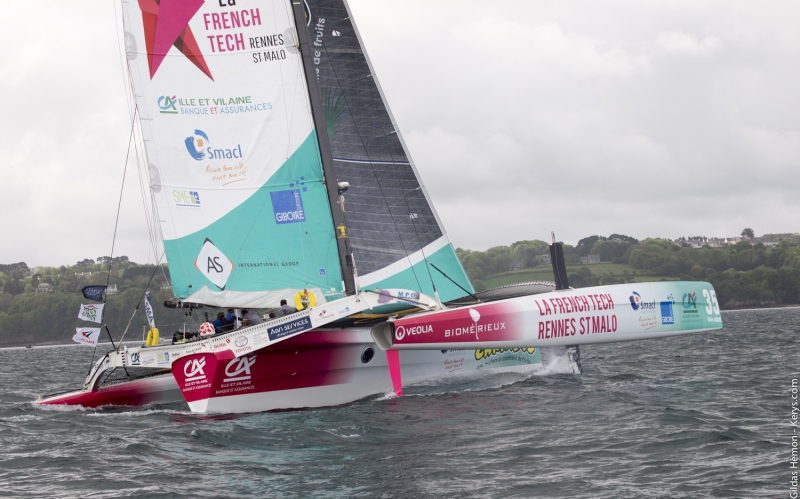
The OceanFifty class was born in 2021. It succeeded the Multi50 class and brings together 15-meter catamarans and trimarans in the main offshore races.
Multihulls in the OceanFifty class are attracting growing interest from offshore racing skippers and sponsors. The class was established in 2021, following the Multi50 class, which itself was created in 2015. While the Orma class struggled to survive, the desire to organize a structure around fast but budget-friendly multihulls was emerging. It is clear that the bet was a winning one. Ocean Fifty boats are becoming increasingly numerous, with next-generation trimarans soon to be launched, such as Ciela Village and Solidaires en Peloton, which will be equipped with foils.
The championship is also seeing renewed interest from both professionals and the public. The appeal of the Ocean Fifty class lies in its ability to offer major offshore races that are very popular, such as the Transat Jacques Vabre, the Route du Rhum, and the Transat Quebec Saint Malo, as well as coastal raid races like the Grand Prix Guyader. These coastal spectacles are important for the popularity of these trimarans with the general public.
What is an Ocean Fifty multihull?
The Ocean Fifty class consists of multihulls that must comply with certain rules. The Multi50s are 50-foot-long (15.24m) trimarans and up to 50 feet wide, but less well-known is that the class also includes catamarans of the same dimensions.
The maximum air draft must be 23.77m and the water draft 3.50m. The number of appendages (rudders and daggerboards) is limited to 4. Materials are also regulated, and construction must comply with current rules and/or measurement standards. The main materials allowed are fiberglass, carbon fiber, wood, aluminum, epoxy resin, Airex foam, etc.
To prevent budget overruns, certain technologies are prohibited, such as tilting masts, hydraulics, and honeycomb materials. While some multihulls are high-tech boats, there are also older units in the fleet.
Introduction to the Ocean Fifty Class

The Ocean Fifty class brings together skippers with diverse ambitions, both professionals and amateurs. Some aim for podiums in major ocean races, while others simply seek the joy of sailing on three hulls. The conviviality that characterizes the Multi50 class often makes it the most represented class of large boats in the spring regattas. This strict measurement rule allows for the creation of multihulls with strong potential and does not prohibit architectural developments, while ensuring controlled investment levels, resale value of the boats, and the safety of sailors.
The Ocean Fifty class is indeed a laboratory for innovation in sailing. The boats in this class are considered prototypes, meaning they serve as platforms for architects and boat builders to test new ideas and concepts while adhering to the Class Rules established each year. These rules are designed to strike a balance between the cost of building and equipping the boats and their sporting and technological performance.
The main objective of the Ocean Fifty Class Rules is to find the best compromise between these two aspects. This means that designers must seek innovative solutions while remaining aware of the costs associated with building and equipping the boats. It is a delicate balance to achieve, but it is what makes this class of sailboats so exciting and technologically stimulating.
It is important to note that in the Ocean Fifty class, the number of multihulls allowed is now limited to 10 units. This may be due to cost control, competition management, or other considerations. This limitation also helps maintain a high level of competition while encouraging innovation in boat design.
Main Races of the OceanFifty Circuit
- Prosailing Tour
- Route du Rhum
- Transat Jacques Vabre
- Trophée des Multicoques