
Mers&Bateaux offers you a dictionary of sailing and boats, in the form of a lexicon of maritime words and expressions. Discover all the nautical vocabulary, concepts, and terms related to boating.
Knowing nautical vocabulary is essential. More than just maritime culture, the words and expressions used in boating allow you to make yourself understood on board a boat. Nautical vocabulary is a guarantee of safety.
The Lexicon of Nautical Vocabulary
A
- to back: to place a sail or the tiller in the opposite direction of the normal course.
- broach: when the boat suddenly turns broadside to the wind.
- to bear away: to turn the boat away from the wind. The opposite of luffing.
- Collision: intentional or unintentional collision between two boats.
- Fittings: deck equipment used for handling the boat.
- to veer: when the wind shifts aft, becoming more favorable relative to the boat’s course. The opposite is to head up.
- AIS: Anti-collision system that identifies ships and provides their position, heading, and speed.
- to luff up: spontaneous movement of a boat that luffs.
- to lower: to bring down a sail.
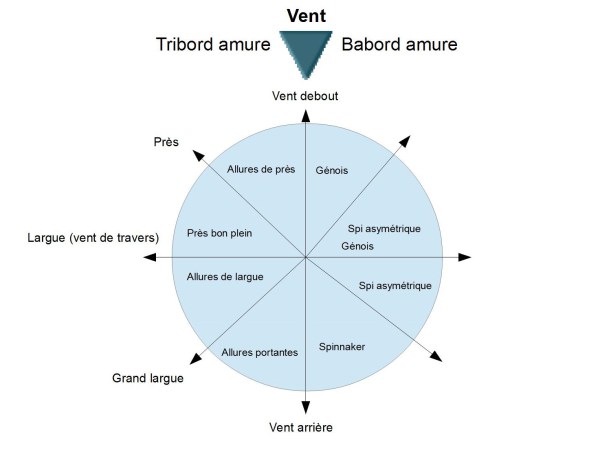
- point of sail: the boat’s course angle relative to the wind.
- mooring lines: ropes used to moor a boat to a dock or buoy.
- to lower: to bring down a sail or flag.
- landmark: a notable point on the coast used to calculate position.
- tack: the side of the boat from which the wind is coming. “Port tack” when the wind comes from port; “starboard tack” when the wind comes from starboard.
- anchor: equipment used to immobilize a boat by dropping it to the seabed.
- weather helm: describes a boat that tends to turn into the wind, either naturally or not.
- to reef: to take in one or more reefs in a sail to reduce its area.
- mizzen: the mizzen is the smallest and rearmost mast on a ketch, a two-masted boat. The sail hoisted on it bears the same name.
- windward: the side of the boat facing the wind.
B
- port: the left side of the boat when looking forward. Port is the opposite of starboard.
- port tack: when the wind comes from the port side of the boat.
- topping lift: a rope running from the top of the mast to hold the boom at its end.
- barber hauler: a system with a pulley used to move a control line away from the boat’s centerline, often a sheet or spinnaker guy.
- tiller/helm: handle or wheel connected to the rudder, allowing the skipper to steer the boat.
- to steer: to drive or direct the boat.
- mainsheet track: a rail located in the cockpit or on the roof, along which the mainsheet block travels.
- spreader: a fitting on the mast that spreads the shrouds.
- backstay: part of the standing rigging. There are two, and they hold the mast from the rear. The windward backstay is tensioned, while the leeward one is slack.
- lifeline: protection along the deck.
- beam: the widest part of the boat.
- boom: a horizontal spar attached to the mast, used to rig the mainsail.
- to sheet in: to pull on a sheet or halyard.
- foot: the lower edge of a sail.
- gasket: a small rope used to furl a sail. Furling line, reefing line.
- line: the term used for ropes on a boat.
C
- chainplate: a fitting that holds the shrouds, which support the mast. It is attached to the deck or hull.
- heave-to: a technique to limit the effects of heavy weather. It is a waiting position that allows the boat to drift. Useful for resting the crew or recovering a man overboard.
- mainsheet traveler: a carriage that slides along the mainsheet track and to which the mainsheet block is attached.
- fairlead: a deck fitting at the bow through which mooring lines are passed.
- to ease: to release or loosen a sheet or halyard.
- stanchions: vertical rigid posts used to run lifelines along the boat.
- leech: the aft edge of a sail.
- cockpit: the area at the stern or center of the sailboat where the helm and main controls are located.
- mooring block: a block to which a buoy is attached via a chain, used to moor a boat.
- cunningham: an adjustment located at the tack of the sail, used to control the draft.
D
- hawsepipe: a deck fitting at the bow through which the anchor chain passes.
- delamination: separation of the layers and materials in composite structures, often due to water infiltration. Makes the structure flexible.
- centerboard: part of the hull that acts as an anti-drift system. Unlike a keel, the centerboard is not ballasted and can be raised.
- to capsize: when a boat turns over.
- crown: the point where the shank and flukes of an anchor cross.
- forestay: part of the standing rigging that reinforces the mast. The cable runs from mid-height down to the bow. A staysail can sometimes be set on it.
- halyard: part of the running rigging used to hoist or lower a sail.
E
- sheet: a line used to adjust a sail.
- to jibe: to change tack when sailing downwind.
- to plunge: to push the bow and fore deck underwater.
- forestay: part of the standing rigging that supports the mast from the front.
- to tension: to pull a line tight.
- bow: the front end of the boat.
F
- to luff: a sail luffs when it flutters in the wind without being sheeted in.
- running off: a downwind course used in bad weather for safety.
- jib: a sail located forward of the mast.
- to furl: to roll up a sail.
G
- shroud: a lateral stay taken to the masthead.
- genoa: a large headsail that overlaps the mainsail significantly. The genoa can be on a furler.
- gennaker: an intermediate headsail between a genoa and an asymmetrical spinnaker.
- heel: the inclination of a sailboat due to the wind. It can also occur if the sailboat is poorly balanced due to the effects on board.
- sculling oar: an oar used from the stern of the boat in a figure-eight motion, allowing a single crew member to propel the boat.
- squall: a strong, short-lived wind accompanied by rain or hail.
- mainsail: the main sail of the ship, hoisted at the rear of the main mast and on the boom.
- running rigging: the movable part of the rigging used to hoist and adjust the sails.
- standing rigging: the fixed part of the rigging that holds the mast in place.
- windlass: a winch used to raise an anchor and the mooring line. It can be manual or electric.
- rudder: a movable device used to steer the boat.

H
- downhaul: running rigging used to hold the boom or spinnaker pole down. For the boom, it can consist of a tackle.
- shroud: a cable that is part of the standing rigging of a sailboat. It supports the mast laterally.
- to haul: to pull on a line.
- to hoist: to raise a sail or load.
I
J
- fluke: the crossbar of an anchor that allows it to hook.
- rating: a set of rules specifying the technical framework that a racing sailboat must comply with to fit a class.
K
- ketch: a two-masted sailboat with a main mast forward and a smaller mizzen mast aft.
L
- ballast: weight located at the bottom to counterbalance the heel of the sailboat.
- waterline: the line that marks the limit of the hull’s immersion. It separates the underwater part from the above-water part.
- wind direction: the direction from which the wind is coming.
- to luff up: a sudden turn into the wind.
- to luff: to bring the boat’s axis closer to the wind direction. The opposite is to bear away.
- length overall (LOA): the maximum length of the boat, including parts outside the hull.
- to tack: to change tack successively when close-hauled to sail upwind.
M
- nautical mile: a unit of maritime distance equal to approximately 1852 meters.
- tender: a sailboat is tender when it tends to bear away.
- to anchor: to drop the anchor.
- whiskers: lines used to hold the bowsprit laterally.
N
- knot: the unit of speed used in navigation. One knot corresponds to one nautical mile per hour, or 1.852 kilometers per hour.
O
- eyelet: a small eye-shaped hole in a sail, used to pass a gasket or sheet.
- trip line: a line attached to the crown of an anchor to make it easier to release.
P
- fender: buoys used to protect the hull.
- backstay: a cable in the standing rigging that supports the mast from the rear.
- hull fitting: a tube passing through the hull, used to position navigation instrument sensors, seawater intakes, and waste water outlets.
- clutch bank: a set of cleats, usually located in the cockpit or on the roof.
- tack: the lower forward point of a sail.
- head: the upper point of a sail, used to hoist it.
- clew: the lower aft point of a sail, used to sheet it in.
- deck: the platform that protects the interior of a boat and allows movement on board.
- stern: the rear part of a boat.
- bow: the front part of a boat.
- close-hauled: a point of sail that allows sailing upwind.
- close reach: the closest point of sail to the wind.
- centerboard trunk: a housing in the hull that allows the centerboard to slide vertically.
- tackle: a system of ropes and pulleys used to multiply force.
Q
- keel: the ballasted part under the sailboat that acts as a counterweight. It also serves as an anti-drift plane. The keel can be fixed, retractable, or pivoting.
- rake: an angle less than 90° formed by the mast and the waterline.
R
- hiking out: the action of the crew moving to the windward side to keep the boat at a reasonable heel.
- sheave: the movable part of a pulley around which the line runs.
- to head up: the opposite of veering. When the wind shifts forward.
- turnbuckle: a tool used to tension and adjust the standing rigging.
- reef: a system for reducing sail area.
- roll: the transverse movement of the boat.
S
- rudder: the rudder is the submerged and pivoting part of the steering system used to direct the boat.
- wake: the trail left by a boat on the water as it moves forward.
- solent: a small jib.
- spinnaker: a large, hollow headsail without a luff, used on downwind points of sail.
- spi: short for “spinnaker”.
- bobstay: a line that holds the bowsprit horizontally and in line with the boat.
- leeward: the side of the boat opposite to the wind direction.
T
- to touch bottom: to hit the seabed with the keel.
- pitch: the longitudinal movement of a boat.
- spinnaker pole: a spar used to hold a sail (jib, staysail, spinnaker) away from the boat.
- storm jib: a very small jib used in bad weather.
- drogue: lines trailing in the water to reduce the boat’s speed when running off.
- starboard: the right side of the boat when looking forward.
- starboard tack: a sailboat on starboard tack receives the wind from the right side.
U
- U flag: a flag in the international code. It represents the letter U and indicates the presence of danger.
V
- apparent wind: relative wind, resulting from the boat’s speed and the true wind.
- head to wind: when the wind comes directly from the bow.
- true wind: the actual wind direction.
- reef cringle: pulleys through which reefing lines pass to reef the sail.
- to tack: to change course and the side from which the wind is coming, by passing through the wind.
- gooseneck: a metal fitting that attaches the boom to the mast.
- VMG: a reference used to optimize between a sailboat’s speed relative to the wind direction and the distance to be covered.
W
- winch: a drum used to sheet in or tension halyards.
X
Y

What is the purpose of nautical language and vocabulary?
For a boater, mastering the lexicon and specific terms of boating is of crucial importance. One could even say that mastering this nautical vocabulary allows you to sail in clear waters.
First, sailing requires a precise understanding of safety instructions; regardless of the sailboat, from dayboats to offshore sailboats. By mastering nautical terms, you can communicate effectively, thus reducing the risk of avoidable accidents. Whether it’s navigation lights, buoys, or right-of-way rules, each word has a vital meaning, safeguarding the lives of sailors and their precious crew.
The appropriate use of nautical vocabulary allows for the transmission of precise and concise information, facilitating delicate maneuvers and enhancing the efficiency of the crew.
Finally, and this is always useful, knowing nautical vocabulary promotes social integration within the large family of boaters. Like a secret dialect shared among initiates, this specific language creates strong bonds between sailors. By mastering this vocabulary, the boater becomes a respected member of this brotherhood, able to share stories, tips, and experiences with other sea lovers. It is a key that opens the doors to a community where lasting friendships and unforgettable memories are forged.
Why is nautical vocabulary important?
Nautical vocabulary is important when sailing on a boat for several reasons:
-
Safety: Nautical vocabulary is used to communicate important information about navigation, weather, sea conditions, obstacles, lights, and navigation signals. If you don’t understand these terms, you risk not understanding important instructions and making dangerous decisions that could endanger your boat and crew.
-
Communication: By knowing nautical vocabulary, you can communicate effectively with other sailors and port authorities. This allows you to easily integrate into the sailing community and obtain important information about navigation conditions and ports of call.
-
Precision: Nautical terms are often very precise and specific, and their use allows for clear and concise communication. This is particularly important in emergency situations where it is essential that messages are understood quickly and without ambiguity.
-
Tradition: Nautical vocabulary is an integral part of maritime tradition. By knowing and using these terms, you connect with a rich maritime history and culture that dates back centuries.
In short, knowledge of nautical vocabulary is crucial for ensuring safety, communication, and precision during navigation, while preserving maritime tradition.
To go further:
- The different types of boat rigging
- Describing a boat’s rigging
- Describing a sail
- Describing a boat’s deck
- Describing a boat’s hull
How to rent a catamaran in Corsica?
Thanks to this article, you now know all the vocabulary related to sailing and boats. Whether you are a passionate enthusiast or a simple amateur, the sea, the open ocean, and maritime excursions fascinate many people. For your summer holidays, you may aspire to live an exceptional experience at sea. Some places are more suitable than others to enjoy these moments, such as the Mediterranean Sea and the Isle of Beauty. If you wish to rent a catamaran with a skipper in Corsica, let us advise you on the criteria to analyze before making your choice.
Indeed, while this project may make you dream, it remains expensive. The advantage of a catamaran generally lies in its large size. It can therefore accommodate several people, allowing you to share the rental costs and enjoy this moment with a group of friends, family, or loved ones. You should therefore analyze the rental price in relation to the number of people that can be accommodated. The second advantage of this type of outing is that you will enjoy an exceptional boat, allowing you to benefit from a memorable excursion. Firstly, it is stable and therefore suitable for all types of people, whether they suffer from seasickness or not. It is also spacious and very fast. Finally, this outing involves an experienced skipper accompanying you to steer the catamaran and to act as a guide, showing you inaccessible spots for non-connoisseurs.