
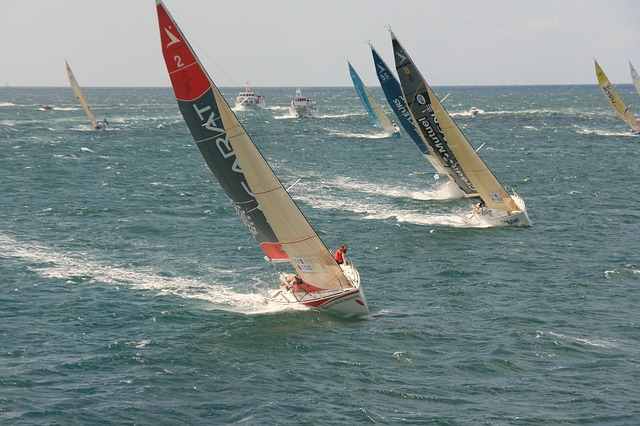
Offshore racing has greatly contributed to the popularity of competitive sailing and the democratization of sailing practice. Major transatlantic races and around-the-world races have inspired many sea lovers and adventure seekers. Today, the world of sailboat racing has become structured, and different **racing sailboats** are organized into classes or ratings. So, what are the different types of offshore racing sailboats?
The early days of sailboat racing, often organized by our English friends, like the OSTAR or the Golden Globe Challenge, were events that attracted more adventurers than professional athletes. Today, things have changed. Races like the Route du Rhum or the Vendée Globe feature numerous racing sailboats organized into classes and ratings. Let’s explore these different classes and ratings participating in the greatest sailing races.
IMOCA Class Sailboats

IMOCA class sailboats are undoubtedly the most well-known offshore racing sailboats to the general public. And for good reason: they are the boats used by skippers in the Vendée Globe, among other races. The **International Monohull Open Class Association** (**IMOCA**) was established in 1991.
These 18-meter sailboats, commonly referred to as 60-foot IMOCA, have become increasingly technical and high-performing over the years. The latest IMOCA boats, equipped with foils, offer absolute discomfort for their skippers.
The leading names in this class are design firms such as **Finot-Conq, FARR Yacht Design, VPLP/Verdier**, and the architect **Marc Lombard**. These designers have revolutionized the world of sailing with their technological advancements.
Notable skippers in the IMOCA class include Titouan Lamazou, who won the first Vendée Globe, Alain Gautier, Catherine Chabaud, Isabelle Autissier, Michel Desjoyeaux (three-time winner), Ellen MacArthur, Jean Le Cam, Roland Jourdain, Jean-Pierre Dick, Yann Eliès, Armel Le Cléac’h, Jérémie Beyou, Samantha Davies, and Clarisse Crémer.
Main Races in the IMOCA Circuit:
- Vendée Globe
- Defi Azimut
- Route du Rhum
- Transat Jacques Vabre
- The Ocean Race
- Rolex Fastnet
Class40 Sailboats

The Class40 is often seen as the little sister of the IMOCA class. I have never liked this comparison. While the sailboats in this class may resemble smaller IMOCAs, the similarities end there. The circuit is much more open and dynamic. The number of races is significant, and the types of courses are very varied. Races like the Normandy Channel Race, for example, are highly technical and bring together the best skippers.
Today, the leading names in this class are the same architects found in the IMOCA class. Skippers who have made their mark in the Class40 include Maxime Sorel, Ian Lipinski, Miranda Merron, Phil Sharp, and Louis Duc.
Main Races in the Class40 Circuit:
- Route du Rhum
- Transat Jacques Vabre
- Normandy Channel Race
- Drheam Cup
- Corsica Med
Racing Multihulls: Ultim and Ocean Fifty

Racing multihulls are boats that have inspired many sailors. These often legendary sailboats are true racing machines. The first racing multihulls appeared in the 1970s with Eric Tabarly’s Pen Duick. These multihulls are inseparable from major transatlantic races like the Route du Rhum or the Transat Jacques Vabre.
The most famous multihulls include:
- Acapella is a series of five trimarans built between 1978 and 1982. The most famous is Olympus Photo, which won the first Route du Rhum in 1978 with Mike Birch.
- Jet Service, a catamaran built in 1987. This Gilles Ollier design was skippered by Serge Madec and then Bruno Peyron. It was the first giant of the seas and the first boat to win the Jules Verne Trophy in 1993 with Bruno Peyron.
- Geronimo, a 21-meter trimaran built in 2001. It won the Jules Verne Trophy in 2004 with Olivier de Kersauson and later broke the solo sailing around the world record in 2016 before winning the Transat Jacques Vabre in 2017.
- IDEC Sport. This boat, built in 2006, was first named Groupama and skippered by Franck Cammas. It was later renamed Banque Populaire and skippered by Armel Le Cléac’h before being purchased by Francis Joyon in 2015. Its record is impressive: 2 Jules Verne Trophies, 3 Route du Rhum victories, and numerous records.
Today, there are three main classes of multihulls. The Ultims, these immense 23 to 32-meter trimarans, have their own class created in 2015, with skippers like François Gabart, Sébastien Josse, Thomas Coville, Armel Le Cléac’h, and Francis Joyon.
The Ocean Fifty class, formerly Multi50, includes several 15-meter trimarans. The best-known skippers in this class are Armel Tripon, Erwan Leroux, Gilles Lamiré, and Lalou Roucayrol.
Figaro Bénéteau One-Design Sailboats

Figaro Bénéteau sailboats are less known to the public but are inseparable from the world of sailing, especially in France. These sailboats have their own offshore racing and regatta circuit.
The history of this sailboat is closely linked to the Half Tonners. In the 1990s, the idea of creating a one-design to replace the **Half Tonners** materialized with the Finot group and then Jean Berret, who designed a sailboat built by the Bénéteau shipyard. In 1991, the Bénéteau Figaro became the one-design for the Solitaire du Figaro.
In 2003, **Marc Lombard** designed the second version. In 2017, the one-design was redesigned by the Van Peteghem Lauriot-Prévost architecture firm and equipped with foils.
Skippers who have marked the history of this one-design include Guy Cornou, Eugène Riguidel, Gilles Gahinet, Philippe Poupon, Jean Le Cam, Michel Desjoyeaux, Yann Eliès, Yoann Richomme, and Nicolas Lunven.
Main Races in the Figaro Circuit:
- Solitaire du Figaro
- Solo Maître Coq
- Solo Guy Cotten
- Transat en Double
- Tour de Bretagne
- Sardinha Cup
Mini 6.50 Class

The **Mini-Transat** is a transatlantic race that has inspired many sailors, young and old. This race is synonymous with low budgets, camaraderie, adventure, and technical innovation. These small 6.50-meter sailboats have brought a breath of fresh air and simplicity to offshore racing.
The history of these small sailboats began in 1977. A race, starting from the United Kingdom, brought together about twenty 6.50-meter sailboats for a solo transatlantic race. The first sailboats were Muscadets and Serpentaires. Among the skippers at the start were big names like **Halvard Mabire**, **Bruno Peyron**, and **Jean-Luc Van Den Heede**. The smallest offshore racing sailboats were born, along with their favorite race: the **Mini-Transat**.
Today, the Mini-Transat has become a French classic and is part of offshore racing history. Certain sailboats and architects have marked this race, such as Bernard Veys’ Serpentaire, Philippe Harlé’s Muscadet and Coco, Pierre Rolland’s Pogo, and David Raison’s Maxi 6.50.
Skippers who have marked the history of the 6.50 class include Daniel Gilard, the first winner of the Mini Transat, Yves Parlier, Yvan Bourgnon, Sébastien Magnen, Ian Lipinski, and many others.
Main Races in the Mini 6.50 Class:
- Mini Transat
- Mini Golfe
- Mini Fastnet
- Mini en Mai
IRC Production Sailboats

But it’s not just the major sailboat classes that can race across the oceans. Several races are open to production sailboats. These sailboats, often designed for offshore racing, are highly sought after by amateurs to participate in races like the Transquadra or the CeltikCup. These sailboats must meet certain standards and rules, particularly being registered under the IRC rating.
The production sailboats that have most marked the history of competitive sailing include boats like the Romanée, Half Tonners, Contessa 32, Dufour 34, Pogos, and more recently the Sun Fast 3200 and the JPK range. Find the regatta calendar here.
Main Races in IRC:
- Transquadra
- Duo Max
- Celtikup
- Transat Cap
- Yacht Cup
- Armen Race